TEST_DE_CHEM_4.4_Electrochemistry

Last updated over 2 years ago
15 questions
1
In electrochemical cells, __________.
1

What do the half-reactions in an electrochemical cell represent?

1

Given the following equation describing a voltaic cell, describe the path of electron flow in the cell. Mg + Zn2+ -> Mg2+ + Zn (Eo=+1.61V)

1

The following equation shows the net reaction taking place in a voltaic cell. Identify the substance that is oxidized and the substance that is reduced.
Zn + Br2 -> Zn2+ + 2Br- (Eo = +1.85V)

1

Which of the following equations represents the decomposition of a chemical compound via an electrolytic reaction?

1

An anion is a negative ion, as it contains more electrons than protons.

1
Cell _______ is a measure of the amount of electricity that a chemical battery or cell can produce (measured in voltage)
1
In an electrolytic cell, electric energy is used to cause a __________ chemical reaction. In a voltaic cell, a __________ chemical reaction is used to convert chemical energy into electrical energy.
1
_______ is the process of using electricity to cause a chemical reaction that would not occur spontaneously
1
An ion is a charged atom or group of atoms formed by the addition or removal of one or more electrons. For example, when a sodium atom donates an electron, its net charge becomes __________, and it forms a sodium ion. Similarly, when a chlorine atom gains an electron, its net charge becomes __________, and it forms chloride ion.
1
Two half-cells connected using a salt bridge make a voltaic cell. Oxidation takes place in one half-cell and reduction in the other. This oxidation-reduction reaction triggers the flow of _______ and generates an electric current.
1
A _______ reaction is one that involves the transfer of one or more electrons from one species to another.
1
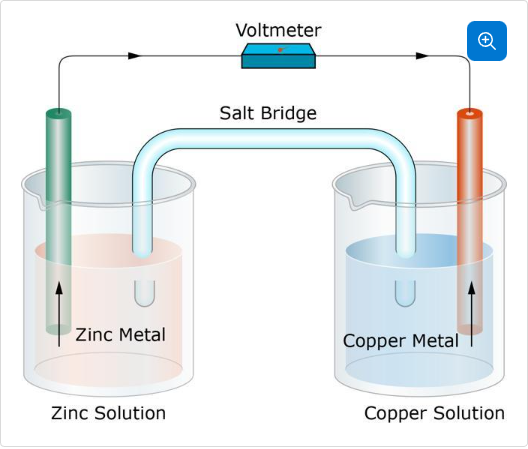
This is an example of a(n) __________ cell.
1

In your lab, you didn't use a salt bridge with metallic salt solutions. What did you use?

1
In your lab, the electrons were flowing from the __________.