DE_CH_5.1_TheCompositionAndBehaviorOfTheAtmosphere

Last updated over 2 years ago
37 questions
Pre-Assessment/Background Knowledge
Required
4

What do I already know about the composition and behavior of the atmosphere?

Engage
Required
1

What percent of Venus's atmosphere is carbon dioxide?

Required
1

Would the atmosphere of Venus support human life? Why or why not?

Required
4
The atmosphere at Venus’s surface is approximately _______ times denser than Earth’s surface. This is equivalent to traveling to a depth of _______ kilometer below the surface of the ocean, which is about _______ times deeper than what is considered safe for scuba divers. Surface temperatures on Venus are over _______C°, which is higher than the temperature for baking bread in an oven.
Required
1

Explain how a heater warms the air in a room, including the words density, volume, and temperature in your explanation.

Required
10

Drag the descriptions of the layers of the atmosphere to the layers that they go with, recognizing that a layer may have more than one description.

  • auroras occur here
  • clouds and weather are found here
  • contains the ozone layer
  • highest layer of the atmosphere; air molecules go into space
  • lowest atmospheric layer
  • meteors burn up in this layer
  • satellites are generally placed in this layer
  • second layer from Earth
  • temperature decreases with height and can be -90C°
  • temperature increases greatly as you travel higher
  • Exosphere
  • Thermosphere
  • Mesosphere
  • Stratosphere
  • Troposphere
Required
5

Match the gas that composes our atmosphere with the correct percentage.

Draggable itemCorresponding Item
trace gases
0.09%
oxygen
0.03%
nitrogen
21%
argon
78%
carbon dioxide
0.07%
Required
4

Select the factors that contribute to the formation of wind.

Required
1

What is the formula for Density?

Required
1

Earth's atmosphere too, can exhibit different densities. For example, a high pressure system can cause the air temperature to increase (get warmer). In this example, is the air more or less dense?

Required
1

What do you think these special cameras are showing?

Required
1

What is causing the light to bend?

Required
1

The force applied over an area is called what?

Required
1

What is a common device used to measure pressure (especially when measuring air pressure/atmospheric pressure?

Required
1

At the beginning of the video, what formula did they give for pressure?

Required
1

At the beginning of the video, what 'unit(s)' did they say pressure was measured in?

Explore 1
1

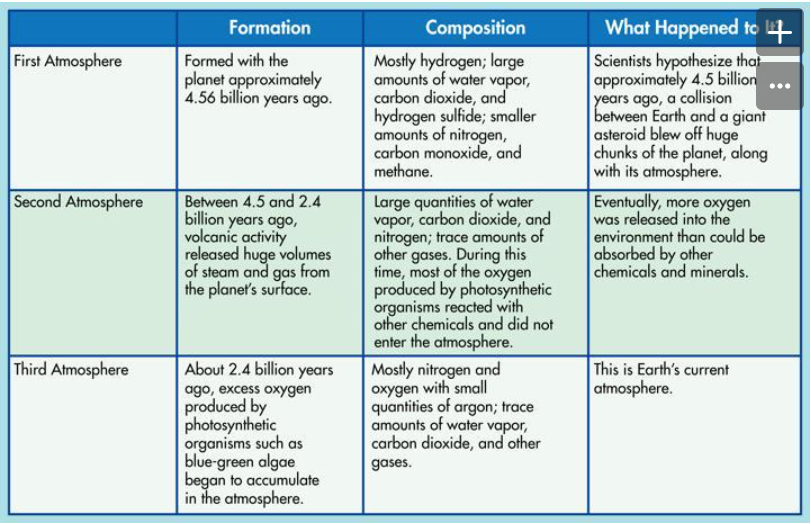
According to the text, Earth's final atmosphere (the one we are familiar with) developed over three distinct stages (or 'atmospheres'). Which one contributed free oxygen to the atmosphere.

4

Do you think planet Earth could experience a significant shift in atmosphere again that could be catastrophic? Please EXPLAIN.
1

What is the composition of Earth's Atmosphere?

Draggable itemCorresponding Item
other gases
.02%
Argon
0.95%
Nitrogen
21%
carbon dioxide
78%
Oxygen
.03%
1

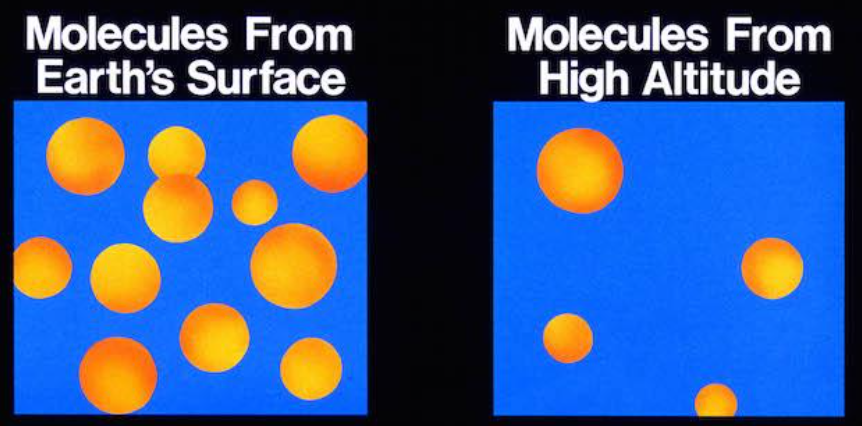
Why do we have difficulty breathing at high altitudes?

Explore 3: What effect does the sun have on Earth's Atmosphere?
1

Thermal energy is transferred through the atmosphere in three ways. What are they?

3
Draggable itemCorresponding Item
conduction
the transfer of thermal energy by collisions between particles of matter
radiation
the transfer of energy by electromagnetic waves
convection
the transfer of thermal energy by a flowing substance
2
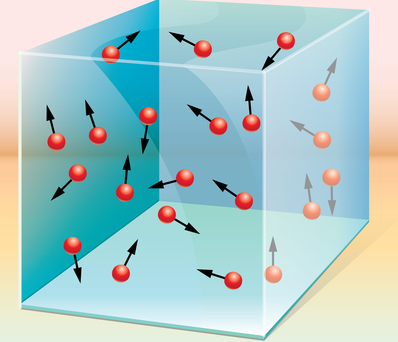
If the container were to get smaller, the density of the particles inside the container would __________ and if the container were to get bigger, the density of the particles inside the container would __________.
4
__________ air is denser than __________air. As a result, the force of gravity causes __________air to sink towards Earth's surface forcing the __________air to rise.
4

Which of the following reasons explain why Earth's surface heats unevenly?

1
Because Earth's surface is curved, some of Earth's surface gets concentrated light while others get their light more spread out. This is because the angle that the sun appears on the horizon (the incoming light) can be low or high. This angle of incoming solar radiation is also known as _______ .
1

Land absorbs and releases thermal energy faster than water does.

1

Cloud layer does not affect the amount of solar radiation the Earth receives.

4

Sort the events in order for how wind is produced.

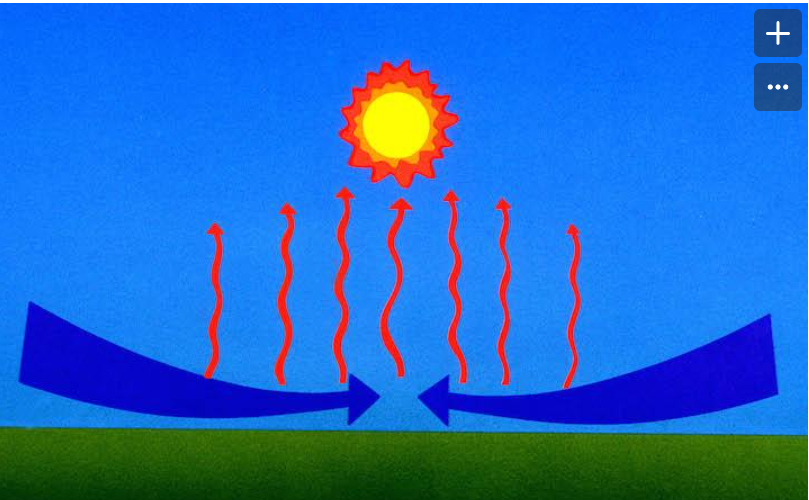
  1. land heats up faster than water, causing the air above it to warm up and rise
  2. warm air rises
  3. cold air which is an area of high pressure sinks and displaces the warm, less dense air
  4. solar radiation from the sun heats up earth's surface
1
Winds are commonly named for the direction _______ which they blow.
1

The apparent effect of a rotating body that influences the motion of any object or fluid moving over it. In the Northern Hemisphere on Earth, air and other objects (airplanes, missiles) move toward the right. In the Southern hemisphere, air and other objects move toward the left. What does this describe (vocabulary word)?

1

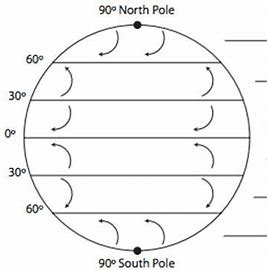
Which region demonstrates the westerlies?

1

Which region describes the Northeast trade winds

1

Which region exemplifies the southeast trade winds?

1
The four major jet streams are referred to as _______ winds because they circumnavigate the globe.
1
Local winds tend to blow over small areas. They include __________breezes which blow from the wind and __________breezes which blow from the land.
Explore 4: How are human activities altering the atmosphere?
1
Some chemicals produced by humans destroy _______, and the best known of these are the chlrofluorocarbons used in refrigerators and air conditioners in years prior to the 1990's. Ozone protects earth from the worst of the sun's _______ rays.