Period 6, Day 2: "Separate But Equal" in the Jim Crow South

Last updated over 1 year ago
13 questions
Note from the author:
Content Objective: I will be able to evaluate the legal claims that support and refute the Supreme Court’s ruling in Plessy v. Ferguson.

Standard Objective: I will be able to identify claims and counterclaims explicitly stated in text or determine implicit claims and counterclaims from text.

Absent? Just want to review the slides? Click here.
Content Objective: I will be able to evaluate the legal claims that support and refute the Supreme Court’s ruling in Plessy v. Ferguson.

Standard Objective: I will be able to identify claims and counterclaims explicitly stated in text or determine implicit claims and counterclaims from text.

Absent? Just want to review the slides? Click here.
0

Warm Up: Please rate how well you understood last night's pre-work on a scale from 1 to 4. If you have any questions, drop them in the "Show Your Work" area.

Required
0

Warm Up: Do you feel like people are separated by race in the United States (i.e. segregation)? Explain.

0

Warm Up: One interesting historical fact I learned from the pre-work is…

Building Knowledge Together: Please follow along as we take notes as a class.

Required
1
Although the Declaration of Independence affirmed that “all men are created equal,” and had inalienable rights including liberty, African Americans were _______ denied their liberty with the institution of slavery. Even after the Civil War and the passage of the Thirteenth, Fourteenth, and Fifteenth Amendments, _______ was a fact of life in the United States. Throughout the country, the races remained separated by both custom and law.

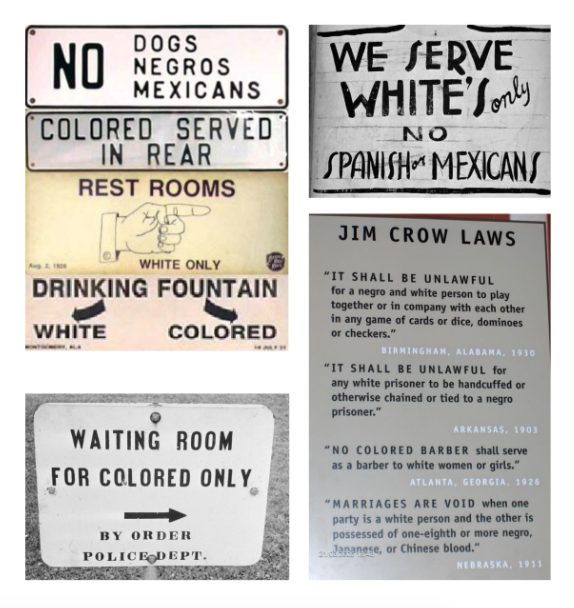
With the end of Reconstruction, every southern state, as well as some northern ones, passed what came to be termed _______ laws. These policies required segregation in public places. African Americans were denied equal _______ to public facilities like transportation, education, and the voting booth. In 1878, the Supreme Court held that states could not require integration on interstate common carriers. In 1890, the Court held that Mississippi could require segregation on modes of interstate transportation.
📷
Required
1
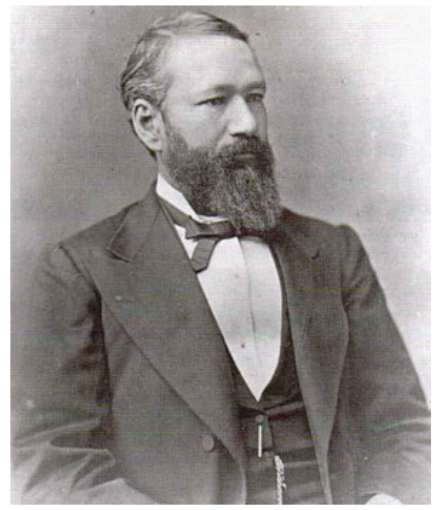
Five years later, Homer _______ , a resident of Louisiana, decided to challenge a Louisiana law requiring segregation on railcars by purchasing a train ticket and sitting in a “whites only” car. Because Plessy was an “octoroon” (1/8th Black), he was subject to the _______ of Louisiana. When he was questioned as to his status, he admitted to being an octoroon, and was arrested when he refused to leave the car. He appealed his case to the Supreme Court of Louisiana and eventually the United States Supreme Court, claiming that the Louisiana law violated the _______ Amendment.

Applying Knowledge: Well done! Let’s now apply the new knowledge and vocabulary that we just learned to today’s topic.

Required
1

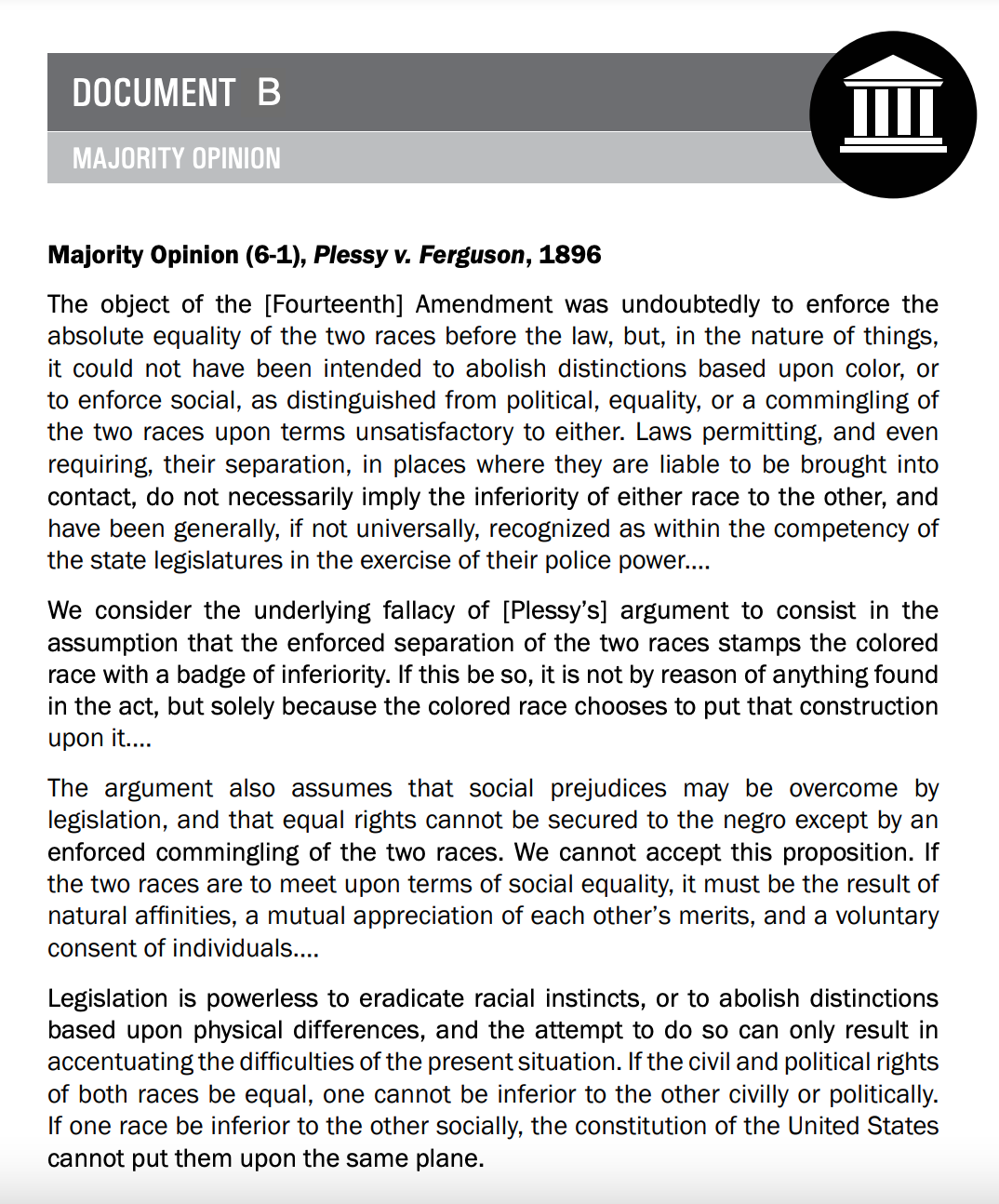
What kinds of laws does the Court say that state legislatures have the rightful power to pass?

Required
1

What reasoning does the Supreme Court give in support of the “separate but equal” doctrine [legal theory]?

Under "Show Your Work," please cite a specific phrase that helped you arrive at this conclusion.

Required
1

What does the Court argue about laws that try to abolish racial prejudices?

Under "Show Your Work," please cite a specific phrase that helped you arrive at this conclusion.

Required
1

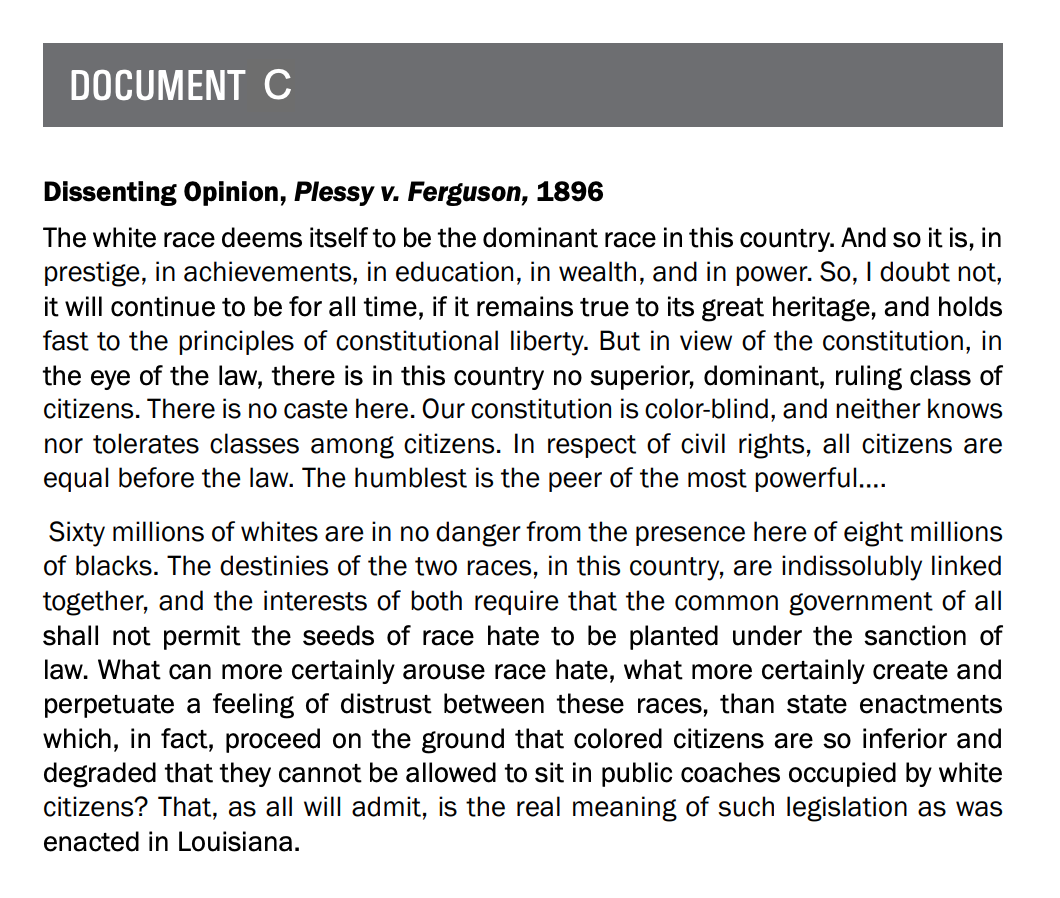
What does the Dissenting [Disagreeing] Opinion mean by “Our constitution is color-blind”?

Under "Show Your Work," please cite a specific phrase that helped you arrive at this conclusion.

Required
1

In terms of the “real meaning” of the Louisiana segregation law, the Dissenting Opinion claims that it

Required
1

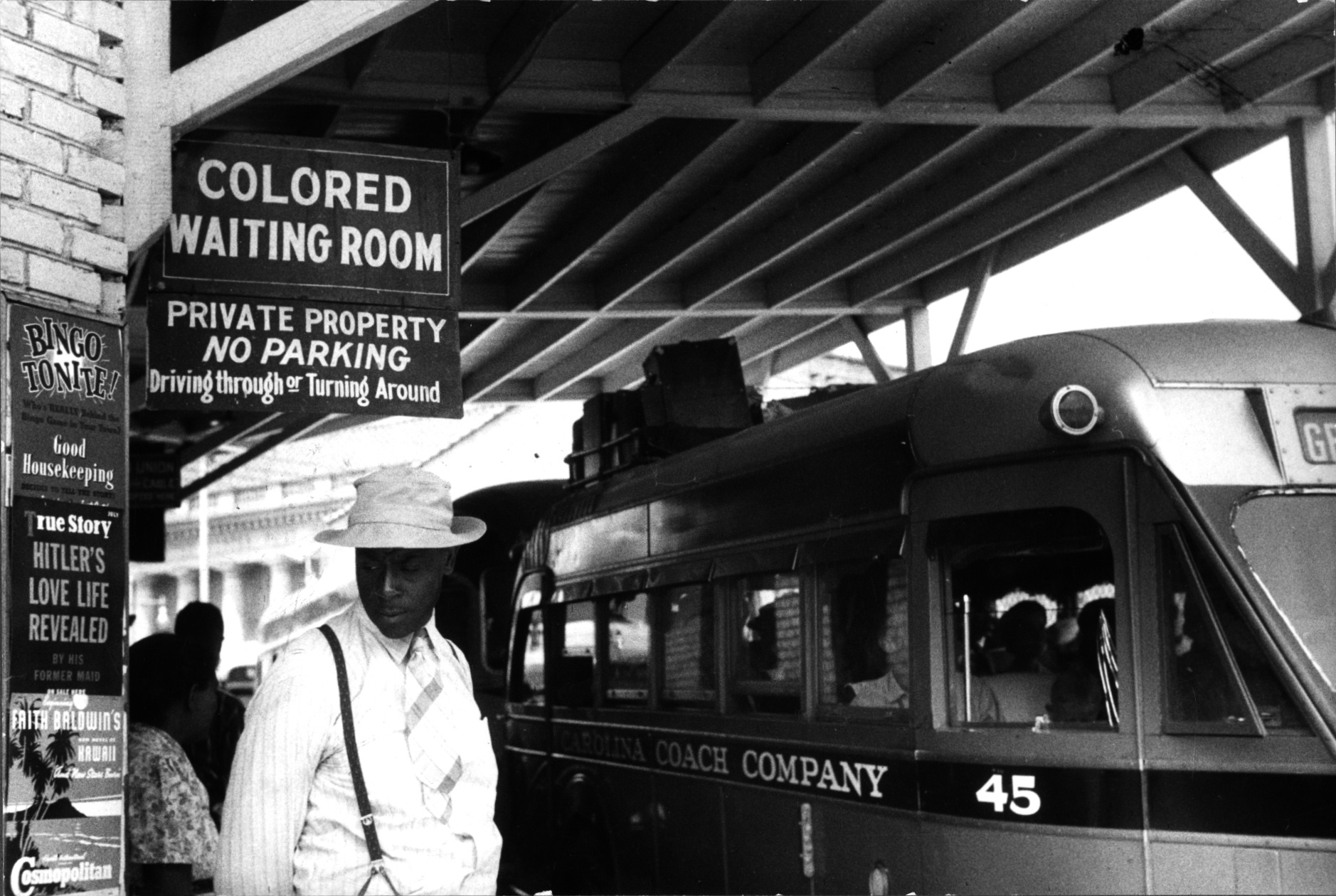
How does this photograph from 1940 reveal the legacy of the Plessy decision?

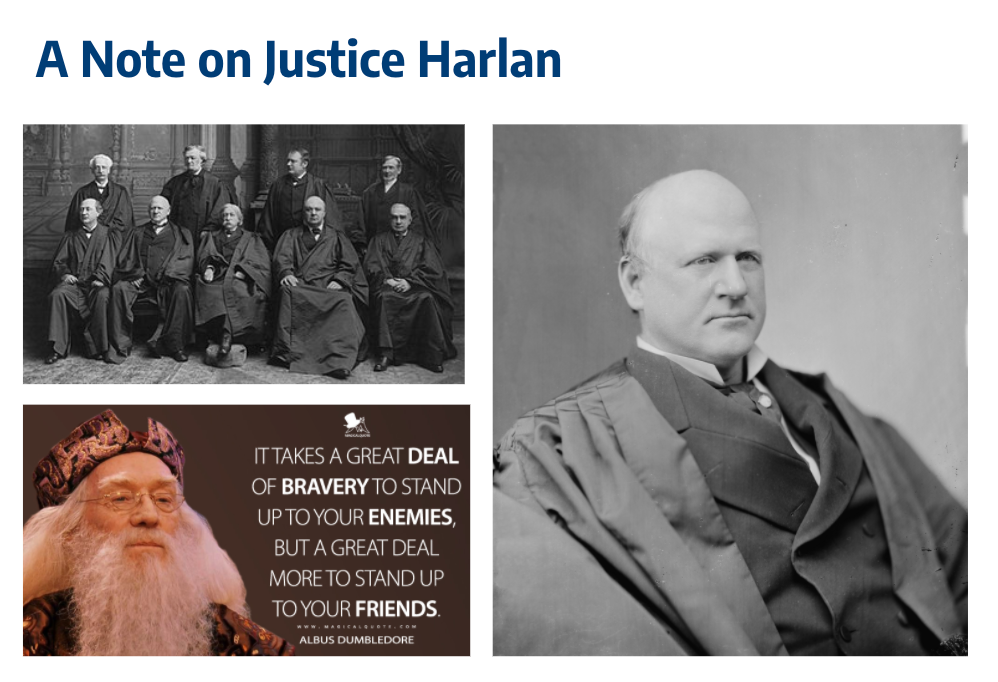
  • Justice Harlan was the sole voice who disagreed with the majority of his colleagues in the 6-1 Plessy v. Ferguson ruling.
  • While some Supreme Court cases are decided unanimously, other times the justices do not agree with the majority decision. These justices often write dissenting opinions that express how and why they disagree with the majority decision. In his dissent, Justice Harlan argues that segregation violated the 14th Amendment because it used the law to sanction inequality among races.
  • Though dissents do not become law as majority opinions do, they are important because they document the struggle between different interpretations of the law. Sometimes the dissent in one case becomes the prevailing viewpoint in a future case that overturns an earlier decision.
2

Exit Ticket: Do you agree with the Majority Opinion [Document B] or the Dissenting Opinion [Document C] of Plessy v. Ferguson (1896)? Explain why.

0

Exit Ticket: Please evaluate how well you understood today’s lesson on a scale from 1 to 4: