Corn is one of the most important crops grown in the United States. Corn, which is mostly starch, is used as a food source for humans and other animals.
Humans first developed corn as a food crop over 8000 years ago. These early farmers produced corn by selectively breeding a wild grass called teosinte. The kernels of teosinte have a hard coating that makes them difficult for humans to eat. A key step in developing corn as a food crop was selecting individual plants that produced kernels without this coating so that they could more easily be used as a food source. The illustrations show the kernels on an ear of corn and the kernels on an ear of teosinte.
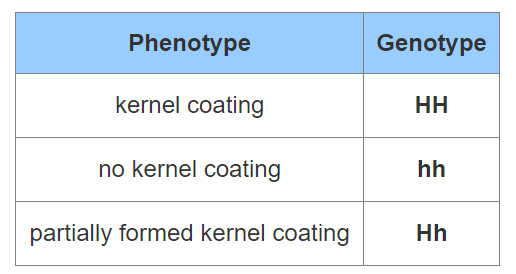
Corn and teosinte share the scientific name Zea mays. A single gene with two alleles codes for kernel coating (H) or no kernel coating (h) in Zea mays. To determine the inheritance pattern of this gene, scientists crossed teosinte that is true-breeding (homozygous) for kernel coating and domestic corn that is true-breeding for no kernel coating to produce offspring with partially formed kernel coatings. The three phenotypes and their genotypes are shown in the table.
A student claims that the inheritance pattern for kernel coating is not complete Mendelian dominance. Which of the following pieces of evidence best supports the student’s claim?
Corn is one of the most important crops grown in the United States. Corn, which is mostly starch, is used as a food source for humans and other animals.
Humans first developed corn as a food crop over 8000 years ago. These early farmers produced corn by selectively breeding a wild grass called teosinte. The kernels of teosinte have a hard coating that makes them difficult for humans to eat. A key step in developing corn as a food crop was selecting individual plants that produced kernels without this coating so that they could more easily be used as a food source. The illustrations show the kernels on an ear of corn and the kernels on an ear of teosinte.
Corn and teosinte share the scientific name Zea mays. A single gene with two alleles codes for kernel coating (H) or no kernel coating (h) in Zea mays. To determine the inheritance pattern of this gene, scientists crossed teosinte that is true-breeding (homozygous) for kernel coating and domestic corn that is true-breeding for no kernel coating to produce offspring with partially formed kernel coatings. The three phenotypes and their genotypes are shown in the table.
A student claims that the inheritance pattern for kernel coating is not complete Mendelian dominance. Which of the following pieces of evidence best supports the student’s claim?