In superheroes, flying is the dominant trait, not flying is recessive. Flying is the...
Question 2
2.
In superheroes, flying is the dominant trait, not flying is recessive. If a hero can fly, what are their possible genotypes?
Question 3
3.
In superheroes, flying is the dominant trait, not flying is recessive. If a hero can fly and is heterozygous, what is their possible genotypes?
Question 4
4.
In superheroes, flying is the dominant trait, not flying is recessive. If a homozygous dominant hero is crossed with a heterozygous hero, what are the genotypes of those two parents?
Question 5
5.
In superheroes, flying is the dominant trait, not flying is recessive. If a homozygous dominant hero is crossed with a heterozygous hero, what are the genotypes of the offspring? Show your Punnett Square!
Question 6
6.
In lizards, two toes on the back feet is a recessive trait, three toes is dominant. If a homozygous dominant lizard is crossed with a homozygous recessive lizard, what are the phenotypes of the offspring?
Question 7
7.
In order to produce a non-flying hero...
Question 8
8.
What is a trait?
Question 9
9.
What is Heredity?
Question 10
10.
What is a gene?
Question 11
11.
What is an Allele?
Question 12
12.
TRUE OR FALSE: You get one allele for a trait from you mom, and one from you dad.
Question 13
13.
TRUE OR FALSE: Recessive alleles will only express a trait when there are NO dominant alleles.
Question 14
14.
Fill in the blank: _________________ Alleles - An allele that covers another allele.
Question 15
15.
Fill in the blank: ______________________ Alleles - An allele that is covered, or hidden by another allele.
Question 16
16.
Which TWO of the following are correct?
Question 17
17.
Which of the following is the correct defintion of Genotype?
Question 18
18.
Which of the following is the correct defintion of Phenotype?
Question 19
19.
Select ALL the following that are examples of a Genotype.
Question 20
20.
Select ALL the following that are examples of a Phenotype.
Question 21
21.
Select ALL the following staments that are true.
Question 22
22.
What is a punnett square?
Question 23
23.
Complete the following Punnett square below.
Question 24
24.
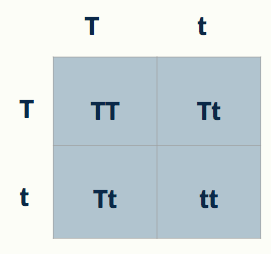
A heterozygous tall (Tt) pea plant with a heterozygous tall (Tt) pea plant were crossed. Note: tt indicates a short plant. The punnet square is below. What are the correct ratios and percentages of the offspring's genotypes?
Question 25
25.
A heterozygous tall (Tt) pea plant with a heterozygous tall (Tt) pea plant were crossed. Note: tt indicates a short plant. The punnet square is below. What are the correct ratios and percentages of the offspring's phenotypes?