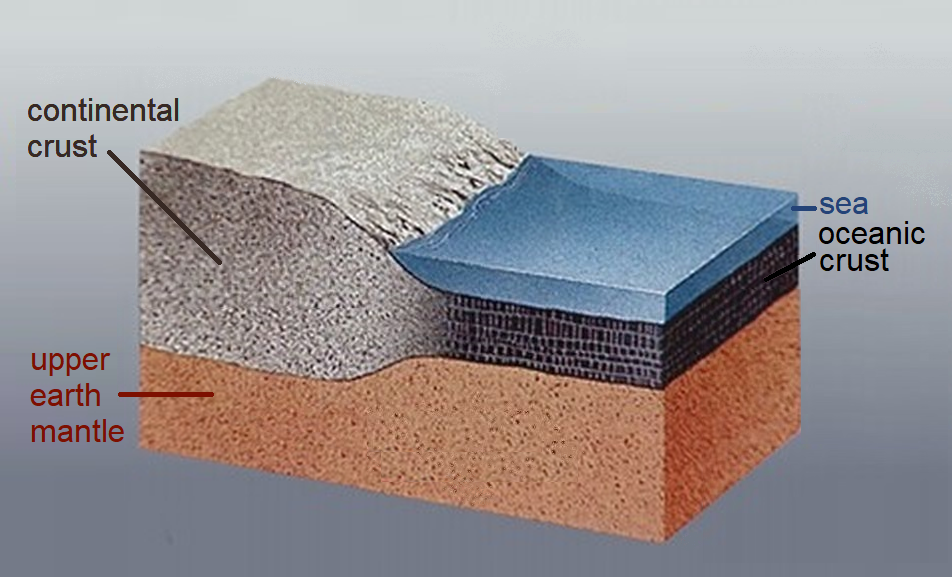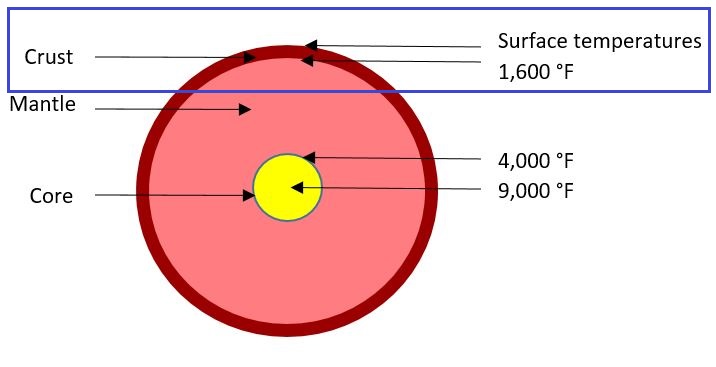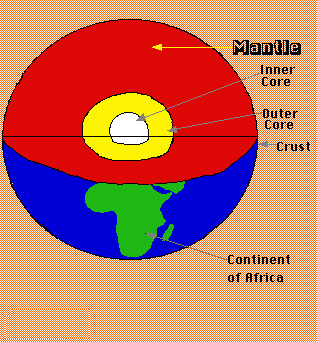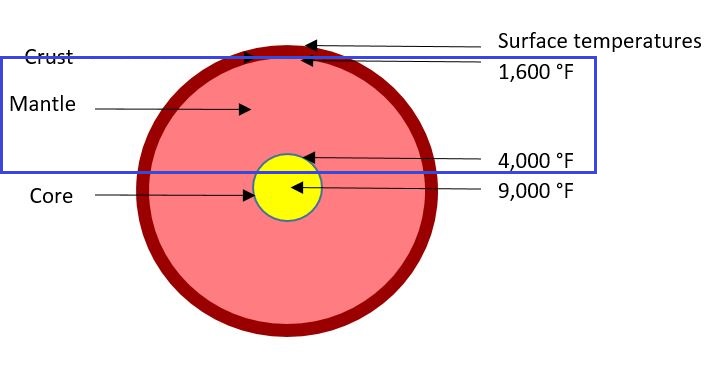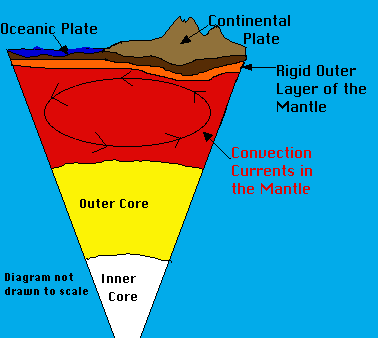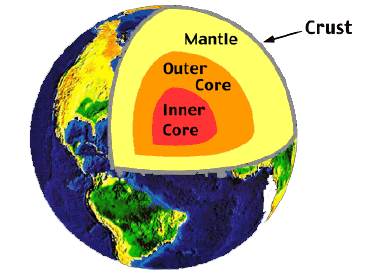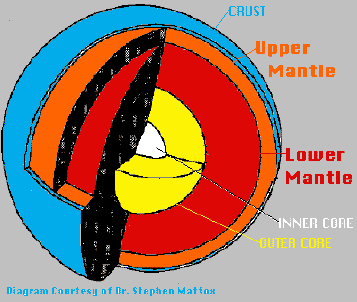
The Earth is composed of three different layers... The Crust - upper part of the Earth, the Mantle -middle layer of the Earth and the Core - the inner layer of the Earth
Many geologists believe that as the Earth cooled the heavier, denser materials sank to the center and the lighter materials rose to the top. Because of this, the crust is made of the lightest materials (rock- basalts and granites) and the core consists of heavy metals (nickel and iron).
The crust is the layer that you live on, and it is the most widely studied and understood. The mantle is much hotter and has the ability to flow. The core is hotter still with pressures so great that you would be squeezed into a ball smaller than a marble if you were able to go to the center of the Earth!!!!!!
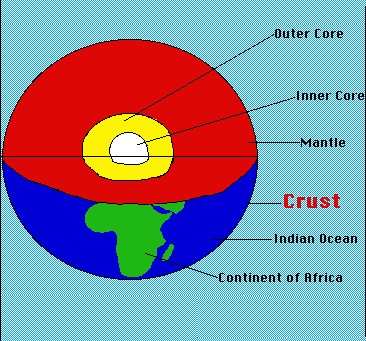
1 point
1
Question 1
1.
Where are the three layers of the Earth found?
Draggable item
arrow_right_alt
Corresponding Item
Core
arrow_right_alt
outer layer
Crust
arrow_right_alt
middle layer
Mantle
arrow_right_alt
inner layer
1 point
1
Question 2
2.
The heavier material stayed on the surface of the Earth while the lighter material sank to the center of the Earth.
1 point
1
Question 3
3.
Basalt
Nickel
Granite
Iron
Heavier rock
Lighter rock
The Crust
The Earth's Crust is like the skin of an apple. It is very thin in comparison to the other three layers.
The crust that makes up the continents is up to 25 miles thick and made up of granite rock which is very thick but light. Hint: Continenetal granite (like granite counter tops) on top, thick - think mountains and light/not as dense - above the water.
The crust under the oceans is called oceanic crust which is made of basalt lava rock that is very thin but dense.; it is only 3-5 miles thick. Hint: Oceanic basalt rock (ba salt - salt found in oceans ) and dense- sinks under the water and thin being squished under the weight of the water
The temperatures of the crust vary from air temperature on top to about 1,600 degrees Fahrenheit in the deepest parts of the crust (that's hot enough for rocks begin to melt).
1 point
1
Question 4
4.
Match the characteristics of the oceanic and continental crusts
Basalt lava rock
Granite rock
very thin (3-5 miles thick)
very dense
very thick (up to 25 miles thick)
very light/not dense
under the oceans
the land and mountains
Oceanic crust
Continental crust
1 point
1
Question 5
5.
Chose the statements that is true about the crust. You may chose more than one.
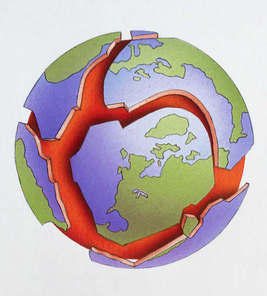
The crust of the Earth is broken into many pieces called plates. The plates "float" on the soft, movable mantle which is located below the crust. These plates usually move along smoothly but sometimes they stick and build up pressure. The pressure builds and the rock bends until it snaps. When this occurs an Earthquake is the result!
1 point
1
Question 6
6.
These plates that make up the Earth's crust are movable and float on the middle layer - the mantle
The Mantle
The mantle is the layer located directly under the crust. It is the largest layer of the Earth, 1800 miles thick. The mantle is composed of very hot, dense rock. This layer of rock even flows like wet concrete under a heavy weight. This flow is due to great temperature differences from the bottom to the top of the mantle. The movement of the mantle is the reason that the plates of the Earth move!
The temperature of the mantle varies from 1600 degrees Fahrenheit at the top to about 4000 degrees Fahrenheit near the bottom!
1 point
1
Question 7
7.
What is true about the mantle? You may chose more than one.
1 point
1
Question 8
8.
Watch the video.
Describe how convection currents in the Mantle work. Start with what is happening at the bottom of the mantle.
the heated rock, being so far away form the heated Earth's core, begins to cool down
the heated rock hits the crust and spreads sideways both directions
the cool rock begins to sink back down, only to be reheated and the whole thing repeats itself
hot rock rises after being heated by the even hotter Earth's core
Convection Currents
The mantle is made of much denser, thicker material, because of this the plates "float" on it like oil floats on water.
Many geologists believe that the mantle "flows" because of convection currents. Convection currents are caused by the very hot material at the deepest part of the mantle rising, then cooling, sinking again and then heating, rising and repeating the cycle over and over. When the convection currents flow in the mantle they also move the crust. The crust gets a free ride with these currents.
1 point
1
Question 9
9.
What is the name of the process where magma in the Earth's mantle rises and cools only to sinks and then is reheated to rise again?
The core can be divided into two parts with very different characteristics: the outer core and the inner core
Outer Core
The core of the Earth is like a ball of very hot metals. (4000 degrees F. to 9000 degrees F.) The outer core is so hot that the metals in it are all in the liquid state. The outer core is located about 1800 miles beneath the crust and is about 1400 miles thick. The outer core is composed of the melted metals nickel and iron.
Inner Core
The inner core of the Earth has temperatures and pressures so great that the metals (nickel and iron) are squeezed together and are not able to move about like a liquid, but are forced to vibrate in place as a solid. The inner core begins about 4000 miles beneath the crust and is about 800 miles thick. The temperatures may reach 9000 degrees F. and the pressures are 45,000,000 pounds per square inch. This is 3,000,000 times the air pressure on you at sea level!!!