Relationships Within Ecosystems NOTES
star
star
star
star
star
Last updated almost 2 years ago
37 Nsɛmmisa
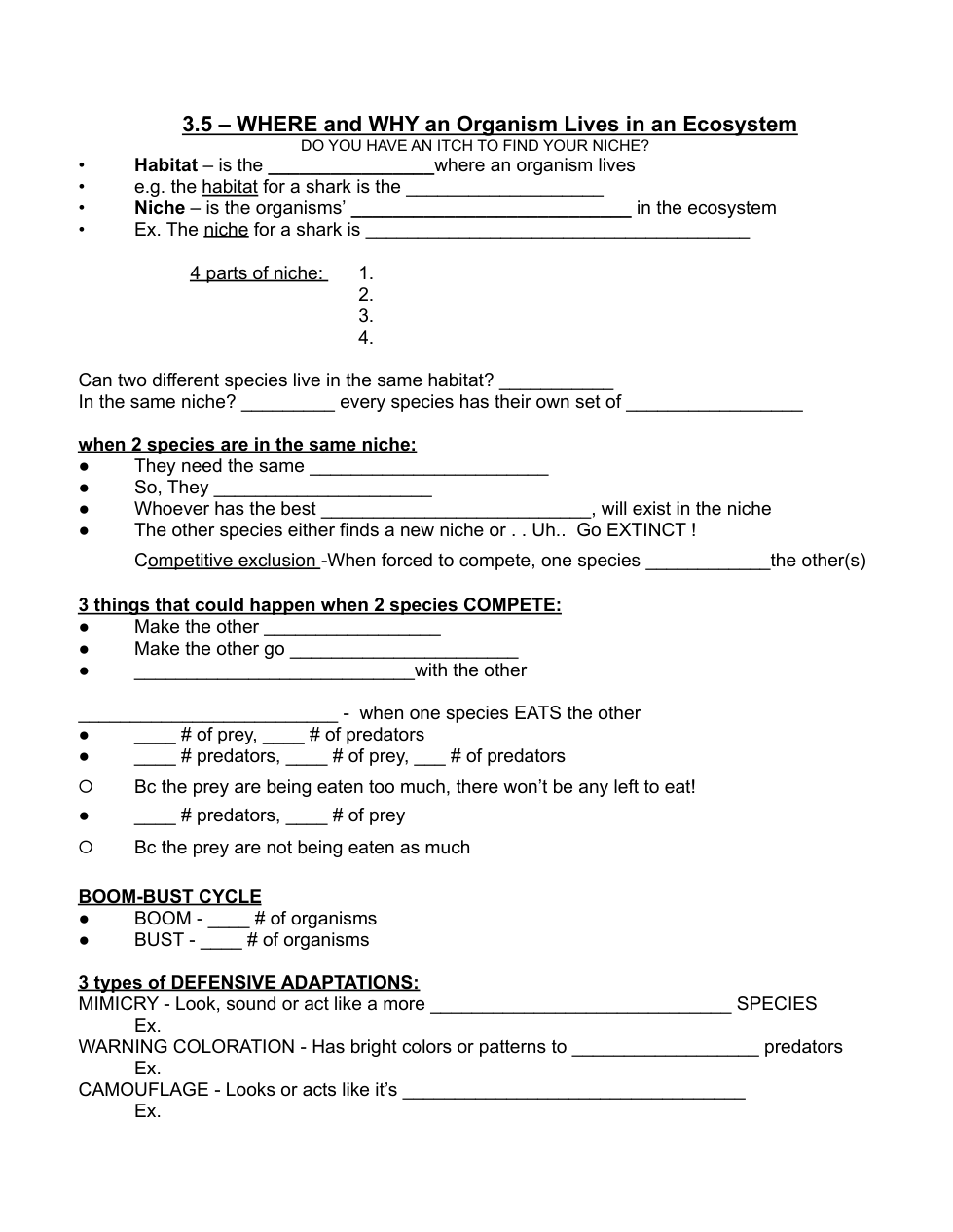
Habitat - is the _____ where an organism lives
A shark's habitat:
Niche -
Niche for a shark:
Niche:
1.
2.
3.
4.
Can 2 different species live in the same habitat? (like birds in a tree)
But can 2 different species DO the same thing? (like birds eat the same worm)
This is because every species has their own set of ____________ in a niche.
When 2 species are in the same niche, they need the same _______.
So they _______ (fight) with each other.
Whoever has the best ___________, will exist in that niche.
The other species either finds a new niche or .. uh.. goes extinct.
Competitive exclusion - when forced to compete, one species _______ the other(s)
_______ species invades and competitively excludes native species
What is an example of an invasive species?
Which grassy reed is native to our Meadowlands?
When species compete, they can:
Make the other ________ away
Make the other go _______
or _____ with the other
Ex - bats and dragonflies both eat mosquitoes in their same niche, but:
(select 2)
PREDATION - when predator eats/hunts the ________
If the # of prey (zebras) goes up, the # of predators (lions) goes ____
If the # of predators (lions) goes up, the # of prey (zebra) goes ____
If the # of prey (zebra) goes down, the # of predators (lions) goes ____
If the # of predators (lions) goes down, the # of prey (zebra) goes back ____
BOOM-BUST CYCLE:
| Draggable item | arrow_right_alt | Corresponding Item |
|---|---|---|
bust | arrow_right_alt | when population increases |
boom | arrow_right_alt | when population decreases |
What do you call a species that can REALLY affect the boom-bust cycle in its ecosystem?
a ______ species - a KEY organism that makes an ecosystem work,
ex. - beaver, prairie dogs, wolves
MIMICRY - Look, sound or act like a more _______ SPECIES
example of mimicry:
WARNING COLORATION - Has bright colors or patterns to ______ predators
example of WARNING COLORATION:
CAMOUFLAGE - looks or acts like its _________
example of CAMOUFLAGE:
REVIEW: Which is NOT part of an organism's niche?
REVIEW: A snake eating a mouse and a frog eating a fly are examples of:
REVIEW: A caterpillar disguised as a bird poop on the ground is an example of which defensive adaptation?
REVIEW: What is the whole point of a boom-bust cycle in an ecosystem?
REVIEW: If the # of predators decrease, why do the # of prey increase?