Twa kɔ nsɛm atitiriw so
Log in
Sign up for FREE
arrow_back
Laabri

Partner Test Ch. 5

star
star
star
star
star
Last updated about 2 years ago
25 Nsɛmmisa
Ɛhia
2
Ɛhia
2
Ɛhia
2
Ɛhia
2
Ɛhia
2
Ɛhia
3
Ɛhia
2
Ɛhia
2
Ɛhia
2
Ɛhia
2
Ɛhia
2
Ɛhia
2
Ɛhia
4
Ɛhia
2
Ɛhia
2
Ɛhia
2
Ɛhia
2
Ɛhia
2
Ɛhia
2
Ɛhia
2
Ɛhia
4
Ɛhia
3
Ɛhia
3
Ɛhia
3
Ɛhia
0
Asemmisa {{asɛmmisaAhyɛnsode}}
1.

Which of the following are discrete random variables?

Asemmisa {{asɛmmisaAhyɛnsode}}
2.

The probability distribution below is for the random variable X = the number of questions correct on a randomly chosen 3 question quiz.

Is X a discrete or a continuous random variable? Explain.

Asemmisa {{asɛmmisaAhyɛnsode}}
3.

The probability distribution below is for the random variable X = the number of questions correct on a randomly chosen 3 question quiz.

Show that the probability distribution of X is valid.

Asemmisa {{asɛmmisaAhyɛnsode}}
4.

The probability distribution below is for the random variable X = the number of correct questions on a randomly chosen three question quiz.

Compute the expected value of X. Show work on the recording document.

What does this mean? (Interpret the expected value)

Asemmisa {{asɛmmisaAhyɛnsode}}
5.

Asemmisa {{asɛmmisaAhyɛnsode}}
6.

Which of the following are conditions for the binomial setting?

Asemmisa {{asɛmmisaAhyɛnsode}}
7.

Binomial Probability:

It is known that 15% of the seniors in a large high school enter military service upon graduation.

If a group of 20 seniors are randomly selected, what is the probability of observing eighteen who will be entering military service?

Which is the correct set up?

Asemmisa {{asɛmmisaAhyɛnsode}}
8.
Asemmisa {{asɛmmisaAhyɛnsode}}
9.

In a certain large lake 40% of the fish are thrown back because they are too small. Consider catching 20 fish from the lake. Assume that the fish you caught can be considered a random sample from the very large number of fish in the lake.

Let Y = the number of fish that you throw back because they are too small.

Find the probability that exactly 5 fish are thrown back.

Show your work on your half sheet.

Round to three places.

Asemmisa {{asɛmmisaAhyɛnsode}}
10.

In a certain large lake 40% of the fish are thrown back because they are too small. Consider catching 20 fish from the lake. Assume that the fish you caught can be considered a random sample from the very large number of fish in the lake.

Let Y = the number of fish that you throw back because they are too small.

Calculate (5.4) and interpret the mean of Y.

Asemmisa {{asɛmmisaAhyɛnsode}}
11.

In a certain large lake 40% of the fish are thrown back because they are too small. Consider catching 20 fish from the lake. Assume that the fish you caught can be considered a random sample from the very large number of fish in the lake.

Let Y = the number of fish that you throw back because they are too small.

Calculate (5.4) and interpret the standard deviation of Y. Round to three places past the decimal.

Asemmisa {{asɛmmisaAhyɛnsode}}
12.

Thirty percent of all trucks undergoing a certain inspection will fail the inspection. Assume that 40 trucks are independently undergoing this inspection, one at a time.

The expected number of trucks who fail the inspection is:

Hint: expected value = mean

Asemmisa {{asɛmmisaAhyɛnsode}}
13.
Asemmisa {{asɛmmisaAhyɛnsode}}
14.
Asemmisa {{asɛmmisaAhyɛnsode}}
15.

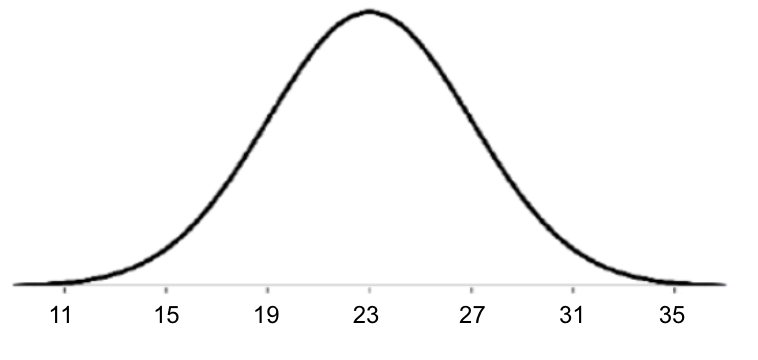
If the foot length of women follows a normal distribution with a mean of 23 cm, and 95% have a foot length between 15 cm and 31 cm, what is your estimate of the standard deviation of the foot lengths in this population?

Asemmisa {{asɛmmisaAhyɛnsode}}
16.

Use the 68-95-99.7 Rule:

A normal distribution has a mean of 0.40 and standard deviation of 0.028. What percentage of observations will lie between 0.344 and 0.456?

Asemmisa {{asɛmmisaAhyɛnsode}}
17.

The heights of a population of women follow a normal distribution, and the middle 95% have heights between 58 inches and 70 inches.

What is your estimate of the mean height in this population?

Hint: sketch a normal curve or look at your flipbook.

Asemmisa {{asɛmmisaAhyɛnsode}}
18.

Which of the following is the closest z-score to the 9th percentile of the standard normal distribution?

Asemmisa {{asɛmmisaAhyɛnsode}}
19.

Which of the following is the closest percentile to a z-score of 1.02 in the standard normal distribution?

Asemmisa {{asɛmmisaAhyɛnsode}}
20.

The proportion of pepperoni pizza orders on a randomly selected day at a local pizza shop is approximately normal with mean 0.26 and standard deviation 0.03.

Let X = the proportion of pepperoni pizza orders on a randomly selected day.

Give the notation for the normal model:

Asemmisa {{asɛmmisaAhyɛnsode}}
21.
Asemmisa {{asɛmmisaAhyɛnsode}}
22.

Professional tennis player Novak Djokovic hits the ball extremely hard. His first-serve speeds follow a normal distribution with mean 112 miles per hour (mph) and standard deviation 6 mph. If you randomly choose one of Djokovic’s first serves at random, let X = its speed, measured in miles per hour.

A first serve with a speed less than 99 miles per hour is considered “slow.”

What percent of Djokovic’s first serves are slow?

Enter your answer as a decimal rounded to three places.

Asemmisa {{asɛmmisaAhyɛnsode}}
23.

Professional tennis player Novak Djokovic hits the ball extremely hard. His first-serve speeds follow a normal distribution with mean 112 miles per hour (mph) and standard deviation 6 mph. If you randomly choose one of Djokovic’s first serves at random, let X = its speed, measured in miles per hour.

A first serve with a speed more than 115.5 miles per hour is considered “fast.”

Round the z score to two places.

What percent of Djokovic’s first serves are fast?

Enter your answer as a decimal rounded to three places.

Asemmisa {{asɛmmisaAhyɛnsode}}
24.

Professional tennis player Novak Djokovic hits the ball extremely hard. His first-serve speeds follow a normal distribution with mean 112 miles per hour (mph) and standard deviation 6 mph.

Find the speed for the slowest 10.5% of Novak Djokovic’s first-serve speeds.

Keep all decimal places.

Asemmisa {{asɛmmisaAhyɛnsode}}
25.

BONUS:

Professional tennis player Novak Djokovic hits the ball extremely hard. His first-serve speeds follow a normal distribution with mean 112 miles per hour (mph) and standard deviation 6 mph. Choose one of Djokovic’s first serves at random.

Let X = its speed, measured in miles per hour.

Find the speed for the fastest 4% of Novak Djokovic’s first-serve speeds.

Keep all decimal places.

The probability distribution below is for the random variable X = the number of correct questions on a randomly chosen three question quiz.

Give the notation for “ the probability of getting at least 2 questions correct" in terms of X and find its probability.