You will work on this individually for the first 10 minutes, then with your partner. With 10 minutes left in the class period you will receive feedback on the correctness of your answers.
Collaborate with your partner, take notes on important things you need to remember for during the test tomorrow.
Use this activity as a way to check and deepen your understanding.
Get out both packets: 5.1-5.4 AND 5.5-5.7 as well as the class activity 5.6.
You will work on this individually for the first 10 minutes, then with your partner. With 10 minutes left in the class period you will receive feedback on the correctness of your answers.
Collaborate with your partner, take notes on important things you need to remember for during the test tomorrow.
Use this activity as a way to check and deepen your understanding.
Get out both packets: 5.1-5.4 AND 5.5-5.7 as well as the class activity 5.6.
Required
1 point
1
Question 1
1.
An ecologist studying starfish populations records values for each of the following variables from randomly selected plots on a rocky coastline.
Read over the following variables:
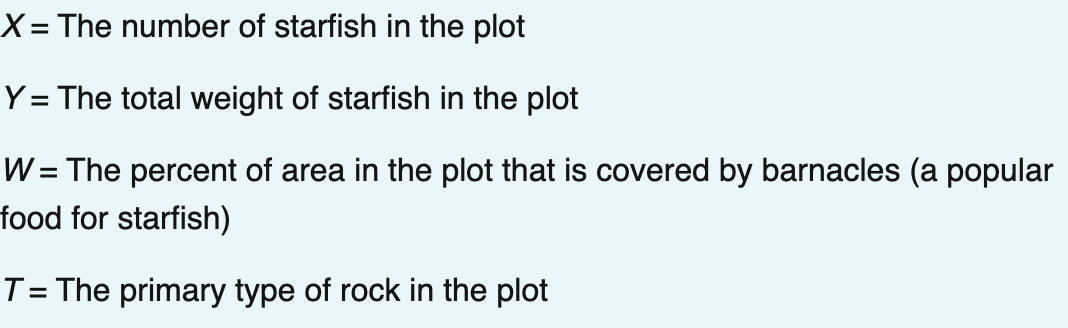
How many of these are continuous random variables and how many are discrete?
Required
1 point
1
Question 2
2.
Which of the following is closest to the 28th percentile in the standard normal distribution?
Required
1 point
1
Question 3
3.
A hat holds a large number of slips of paper, each with a single digit from 0 to 4 on it. Which one of the following is a possible probability distribution for X = the number on a randomly selected slip of paper?
Check 5.1 for the properties of a valid probability model.
Required
1 point
1
Question 4
4.
A private school has 25 students in each of grades 1 through 12. The principal randomly selects 1 student from each grade and records whether or not the student is over 5 feet tall. Let X = the number of students in the sample who are over 5 feet tall.
Which of the following requirements for a binomial setting is violated in this case?
Hint: check the meanings of B I N S.
Required
1 point
1
Question 5
5.
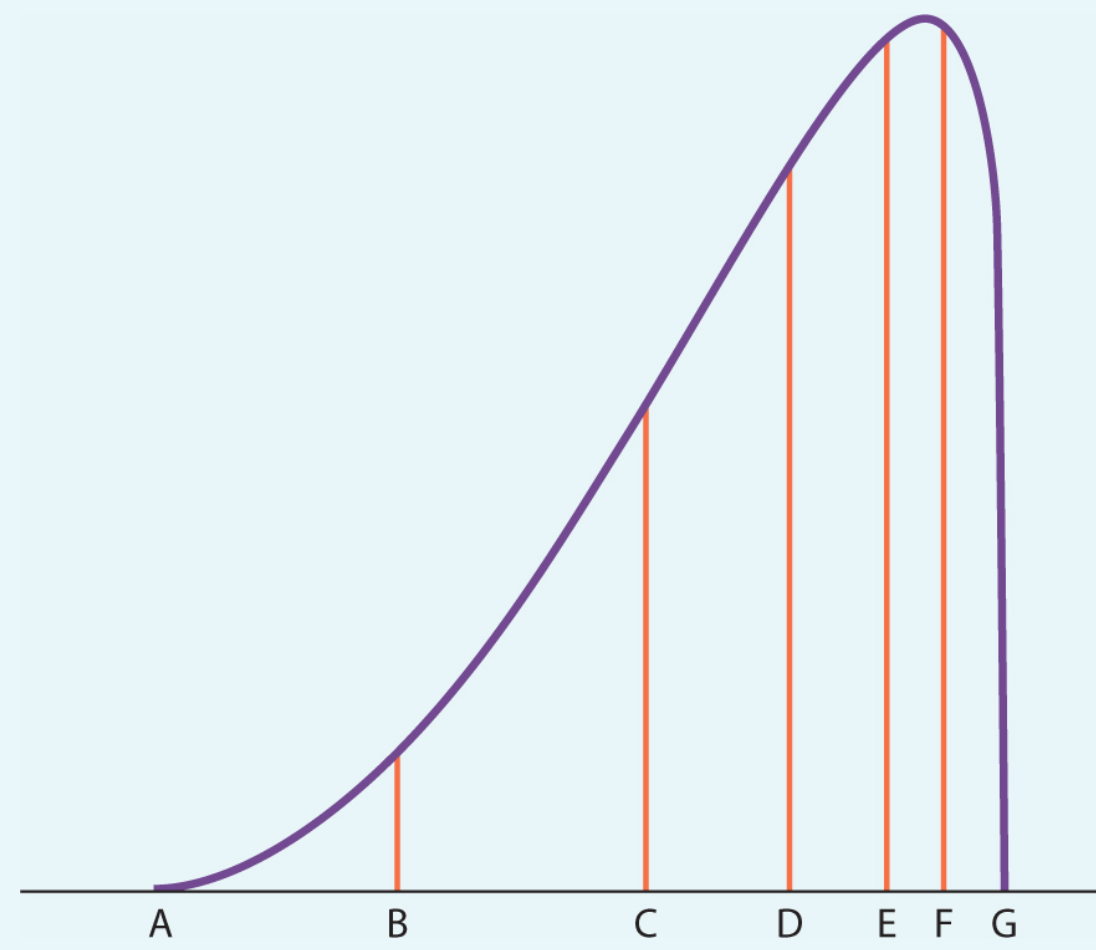
The figure shows the density curve that is the probability distribution of a continuous random variable. Seven values are marked on the density curve.
Which two of the following statements are true?
Required
1 point
1
Question 6
6.
Questions 6 and 7 refer to the following setting.
A psychologist studied the number of puzzles that subjects were able to solve in a 5-minute period while listening to soothing music. Let X be the number of puzzles completed successfully by a randomly chosen subject.
The psychologist found that X had the following probability distribution:
What is the expected number of puzzles a subject could solve in the 5-minute period while listening to soothing music?
Check Lesson 5.2 for an example.
Required
1 point
1
Question 7
7.
Questions 6 and 7 refer to the following setting.
A psychologist studied the number of puzzles that subjects were able to solve in a 5-minute period while listening to soothing music. Let X be the number of puzzles completed successfully by a randomly chosen subject.
The psychologist found that X had the following probability distribution:
What is the probability that a randomly chosen subject completes more than the expected number of puzzles in the 5-minute period while listening to soothing music?
Remember to use your answer to the previous question.
Required
1 point
1
Question 8
8.
The standard deviation of X is 0.9. Which of the following is the best interpretation of this value?
Required
1 point
1
Question 9
9.
Lesson 5.5 part 1
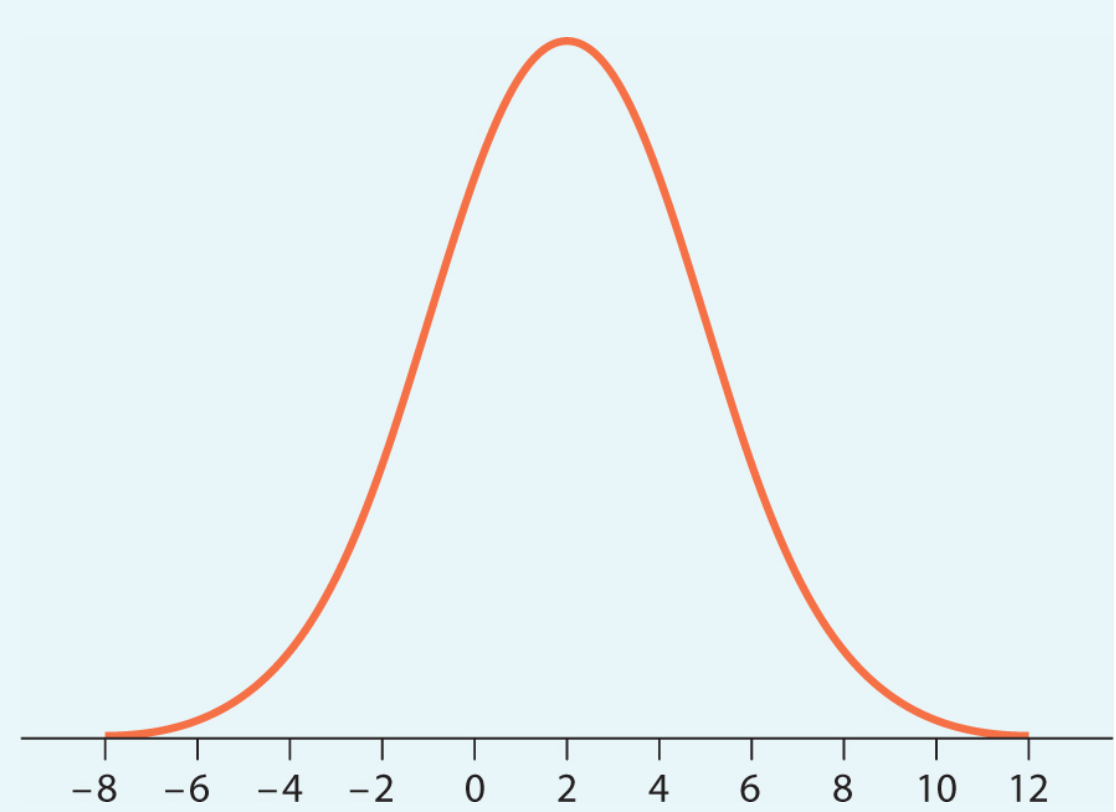
For the normal distribution shown:
The standard deviation is closest to which of the values below.
Hint: refer to your half sheet for help.
Required
1 point
1
Question 10
10.
In the game Pass the Pigs, a small plastic pig is rolled, and its orientation when it comes to a stop determines the number of points a player scores. Approximately 9% of rolls produce a “trotter”—that is, the pig lands right side up, standing on its four feet.
Suppose you roll a pig 10 times.
Which of the following expressions represents the probability that you roll exactly 2 trotters?
Required
1 point
1
Question 11
11.
If the heights of a population of men follow a normal distribution, and 99.7% have heights between 5 feet 0 inches and 7 feet 0 inches, what is your estimate of the standard deviation of the heights in this population?
Hint: remember there are 12 inches in one foot
Check your half sheet for the visual for the 68-95-99.7 Rule
Required
1 point
1
Question 12
12.
Let Y denote the number of broken eggs in a randomly selected carton of one dozen “store brand” eggs at a local supermarket. Suppose that the probability distribution of Y is as follows.
What is the probability that at least 2 eggs in a randomly selected carton are broken?
Required
1 point
1
Question 13
13.
Let Y denote the number of broken eggs in a randomly selected carton of one dozen “store brand” eggs at a local supermarket. Suppose that the probability distribution of Y is as follows.
Calculate and interpret the mean of Y.
Lesson 5.1 & 5.2, remember mean is the same thing as Expected Value.
Required
1 point
1
Question 14
14.
Let Y denote the number of broken eggs in a randomly selected carton of one dozen “store brand” eggs at a local supermarket. Suppose that the probability distribution of Y is as follows.
I used statsmedic to find the standard deviation, it is 0.837. Interpret the standard deviation of Y using context.
Required
1 point
1
Question 15
15.
An airline claims that its 7:00 A.M. New York to Los Angeles flight has an 85% chance of arriving on time on a randomly selected day. Assume for now that this claim is true. Suppose we take a random sample of 20 of these flights. Let X = the number of flights that arrive on time.
Explain why X is a binomial random variable using B I N S.
Required
1 point
1
Question 16
16.
An airline claims that its 7:00 A.M. New York to Los Angeles flight has an 85% chance of arriving on time on a randomly selected day. Assume for now that this claim is true. Suppose we take a random sample of 20 of these flights. Let X = the number of flights that arrive on time.
Use the binomial probability formula to find P(X = 19).
Round to three placees.
Required
1 point
1
Question 17
17.
Use your answer from above when you found P(X=19). Interpret this value in context, what does it mean?
Required
1 point
1
Question 18
18.
An airline claims that its 7:00 A.M. New York to Los Angeles flight has an 85% chance of arriving on time on a randomly selected day. Assume for now that this claim is true. Suppose we take a random sample of 20 of these flights. Let X = the number of flights that arrive on time.
Calculate the mean of X.
Required
1 point
1
Question 19
19.
An airline claims that its 7:00 A.M. New York to Los Angeles flight has an 85% chance of arriving on time on a randomly selected day. Assume for now that this claim is true. Suppose we take a random sample of 20 of these flights. Let X = the number of flights that arrive on time.
Calculate the standard deviation of X. Round to three places past the decimal.
Required
1 point
1
Question 20
20.
An airline claims that its 7:00 A.M. New York to Los Angeles flight has an 85% chance of arriving on time on a randomly selected day. Assume for now that this claim is true. Suppose we take a random sample of 20 of these flights. Let X = the number of flights that arrive on time.
What is the probability that only 14 of the 20 flights arrive on time? Calculate P(X = 14)
Round your answer to three places past the decimal.
Required
1 point
1
Question 21
21.
An airline claims that its 7:00 A.M. New York to Los Angeles flight has an 85% chance of arriving on time on a randomly selected day. Assume for now that this claim is true. Suppose we take a random sample of 20 of these flights. Let X = the number of flights that arrive on time.
What is the probability that all of the 20 flights arrive on time? Calculate P(X = 20)
Required
1 point
1
Question 22
22.
An airline claims that its 7:00 A.M. New York to Los Angeles flight has an 85% chance of arriving on time on a randomly selected day. Assume for now that this claim is true. Suppose we take a random sample of 20 of these flights. Let X = the number of flights that arrive on time.
What is the probability that at least one of the 20 flights arrives late?
Remember back to Chapter 4, what do we do if we want 'at least one'.
Required
1 point
1
Question 23
23.
The Virginia Cooperative Extension reports that the mean weight of yearling Angus steers is 1152 pounds. Suppose the standard deviation is 84 pounds and a Normal Model is useful for making predictions. Using N(1152, 84) what percent of the steers weigh less than 1250 pounds?
Required
1 point
1
Question 24
24.
The Virginia Cooperative Extension reports that the mean weight of yearling Angus steers is 1152 pounds. Suppose the standard deviation is 84 pounds and a Normal Model is useful for making predictions. Using N(1152, 84) what percent of the steers weigh less than 1062 pounds?
a. What is the z-score? _______ Round to 2 places past the decimal.
b. What is the percent of steers that weigh less than 1062? _______
Required
1 point
1
Question 25
25.
The Virginia Cooperative Extension reports that the mean weight of yearling Angus steers is 1152 pounds. Suppose the standard deviation is 84 pounds and a Normal Model is useful for making predictions. Using N(1152, 84) what percent of the steers weigh more than 1325 pounds?
a. What is the z-score? _______ Round to 2 places past the decimal.
b. What is the percent of steers that weigh MORE than 1325? _______
Required
1 point
1
Question 26
26.
The Virginia Cooperative Extension reports that the mean weight of yearling Angus steers is 1152 pounds. Suppose the standard deviation is 84 pounds and a Normal Model is useful for making predictions.
What percent of the steers weigh between 1062 and 1349 pounds?
Hint: Use your answer from #24 above for the percent less than 1062 pounds, then you only need to do calculations for 1349 pounds.
Required
1 point
1
Question 27
27.
The Virginia Cooperative Extension reports that the mean weight of yearling Angus steers is 1152 pounds. Suppose the standard deviation is 84 pounds and a Normal Model is useful for making predictions. Using N(1152, 84) what is the steer weight for the lowest 21.5% of weights?
a. What is 21.5% as a decimal? _______
b. What is the z score from the blue chart? _______
c. Set up the z formula. What is the weight of the steer for the lowest 21.5%? _______