Lesson 5.1-5.4 Quiz Review Probability Models due 2/6

Last updated over 1 year ago
30 questions
Required
8

Use the probability model to find the expected value of the random variable.
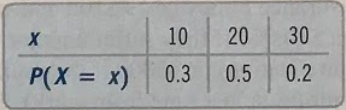
Use the method you learned in class to calculate the expected value. (expected value is the mean or average)

The expected value is the sum of each of the possible values multiplied by its probability of occurring. Calculate by hand using the example in 5.1 to set it up.
Enter your answer as a number.
Required
8
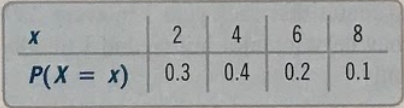
Use the probability model to find the given probabilities.


a. P(X > 6) = _______

b. P(X < 6) = _______

c. P(X < 6) = _______
Required
4

An electronics retailer is developing a model for insurance policies on new cell phone purchases. It estimates that 60% of customers never make a claim (cost=$0), 25% of customers require a small repair costing an average of $50, and 15% of customers request a full refund costing $200.
What is the long term average cost the retailer should expect to pay to its customers per claim?
First:
Define the random variable, what does 'X= ' represent?

Required
10

An electronics retailer is developing a model for insurance policies on new cell phone purchases. It estimates that 60% of customers never make a claim (cost=$0), 25% of customers require a small repair costing an average of $50, and 15% of customers request a full refund costing $200.
What is the long term average cost the retailer should expect to pay to its customers per claim?
Remember: X=expected cost of the repair ($)
Second:
Use the 'show your work' area to create the probability model.
I will grade this question.

Required
10

An electronics retailer is developing a model for insurance policies on new cell phone purchases. It estimates that 60% of customers never make a claim (cost=$0), 25% of customers require a small repair costing an average of $50, and 15% of customers request a full refund costing $200.

Now that you've created the probability model in #4, you are ready to answer:

" What is the long term average cost the retailer should expect to pay to its customers per claim? "
Remember, the average cost is the Expected Value or E(X), also known as mean.
Your answer should include two places past the decimal.
Your answer should also include units (hint, this is money).

Required
1

What is the interpretation of your answer from #5?
What does it mean? Give context...
Ex. 'If many many insurance claims are filed...'

I will grade this question.

Required
1

Using the probability distribution from #4 & 5 and your result from statsmedic.com/applets, discrete random variable, what is the standard deviation?
This is money so use $ and only two places past the decimal.

Required
1

Interpret your answer from number 7.
What does the standard deviation mean in this situation?
Remember to use context:
'If many many insurance claims are filed...'
I will grade this question.

Required
1

Use the information from the probability model you created in #4:
If P(X)=0.40, what is the most likely question?

Required
2

The following are examples of random variables:
I. N = students in each class at DHS
II. C = amount of colleges that seniors at DHS applied to this year
III. T = the 50m dash time of DHS athletes

Which 2 are discrete random variables?

Required
2

The following are examples of random variables:
I. N = the number of puppies in a litter
II. C = the cost for car repairs at Universal Toyota
III. H = the height of basketball players on the DHS varsity basketball team

Which 2 are continuous random variables?

Required
3

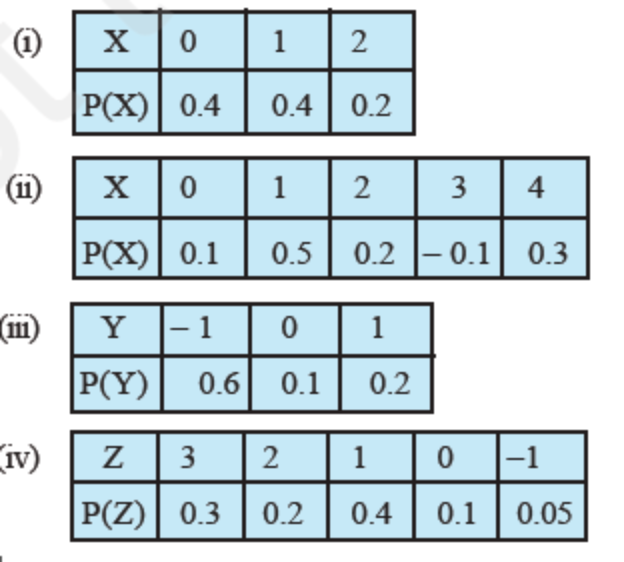
Use the following probability distribution:
Is the distribution a valid probability model?
How do you know?
Select all 3 answers.

Required
3

Use the following probability distribution:
Which of the following are NOT valid probability distributions?
Then select the reasons why not.
You will have three answers.

Required
4

About 8% of males are colorblind. A researcher has a list of 12 men who have volunteered to be tested.

Select the four answers that explain why this is a binomial distribution.

Required
1

About 8% of males are colorblind. A researcher has a list of 12 men who have volunteered to be tested.

Identify the binomial probability model.
Use the format below for the binomial model:

Binom(n, p)

Keep your percent as a decimal, replace the n and p with the correct information.

Required
1

About 8% of males are colorblind. A researcher has a list of 12 men who have volunteered to be tested.
Find the probability that exactly none of the 12 men is colorblind.
Use the binomial formula from Lesson 5.3 to calculate the probability.

Keep your answer as a decimal, rounded to three places past the decimal point.

Required
1

About 8% of males are colorblind. A researcher has a list of 12 men who have volunteered to be tested.
Find the probability that exactly one of the 12 men is colorblind.
Use the binomial formula from Lesson 5.3 to calculate the probability.

Keep your answer as a decimal, rounded to three places past the decimal point.

Required
1

About 8% of males are colorblind. A researcher has a list of 12 men who have volunteered to be tested.
Find the probability that exactly two of the 12 men are colorblind.
Use the binomial formula from lesson 5.3 to calculate the probability.

Keep your answer as a decimal, rounded to three places past the decimal point.

Required
1

About 8% of males are colorblind. A researcher has a list of 12 men who have volunteered to be tested.
Find the probability that exactly three of the 12 men is colorblind.
Use the binomial formula from lesson 5.3 to calculate the probability.

Keep your answer as a decimal, rounded to three places past the decimal point.

Required
1

About 8% of males are colorblind. A researcher has a list of 12 men who have volunteered to be tested.
Find the probability that at most three of the 12 men is colorblind.

What is the notation that shows 'at most three of the 12 men is colorblind.'?

Required
1

About 8% of males are colorblind. A researcher has a list of 12 men who have volunteered to be tested.
Find the probability that at most three of the 12 men is colorblind.
Hint:
P(x=0 or 1 or 2 or 3) =
Use the previous three answers.
Keep your answer as a decimal, rounded to three places past the decimal point.

Required
1

Hoping to find many men who are colorblind for her study, the researcher in the above scenario tests 450 men for her study. Keep in mind that about 8% of men are colorblind.
What is the expected value for the number of men she can expect to be colorblind?

Remember:
Check lesson 5.4 for the formula.
Enter your answer as a number, no units.

Required
1

Hoping to find many men who are colorblind for her study, the researcher in the above scenario tests 450 men for her study.
What is the standard deviation for the number of men she can expect to be colorblind?

Check lesson 5.4 for the formula.​
Enter your answer as a decimal rounded to three places past the decimal point.
Do not include units.

Required
1

If the probability that a light bulb is defective is 0.1,
what is the binomial probability model for the situation involving 7 light bulbs?
Use the format:
Binom(n, p)

Required
1

If the probability that a light bulb is defective is 0.1, what is the probability that 4 out of 7 bulbs are defective?

Use the binomial formula to calculate the probability.

Keep your answer as a decimal, rounded to four places past the decimal point.

Required
1

If the probability that a light bulb is defective is 0.1, what is the probability that 3 out of 7 bulbs are defective?

Use the binomial formula & the TI-Nspire to find the probability.

Keep your answer as a decimal, rounded to three places past the decimal point.

Required
1

Use the answers from #26 & 27:
If the probability that a light bulb is defective is 0.1, what is the probability that 3 or 4 out of 7 bulbs are defective?
Hint: what does 'or' indicate you should do in probability calculations?

Keep your answer as a decimal, rounded to four places past the decimal point.

Required
1

Use the information from above:
If the probability that a light bulb is defective is 0.1, what is the probability that less than 2 out of 7 bulbs are defective?
Hint: what does 'or' indicate you should do in probability calculations?
You will need to do 2 probability calculations first before finding your answer.

Keep your answer as a decimal, rounded to four places past the decimal point.

Required
1

The probability that a light bulb is defective is 0.1and 254 light bulbs will be evaluated.
What is the expected value for the number of defective light bulbs?

Hint: what is another word for 'expected value'?
Check 5.4 for the formula.
Enter your answer, keep all decimal places.

Required
1

The probability that a light bulb is defective is 0.1and 254 light bulbs will be evaluated.
How much will the the number of defective light bulbs typically vary?
Hint: check 5.4 for the formula.
Enter your answer as a decimal, round to three places past the decimal.