The model shows a mutation to a partial sequence of bases in a gene. Which type of mutation does the model represent?

The model shows a mutation to a partial sequence of bases in a gene. Which type of mutation does the model represent?
What is a tumor?
People who have leukemia, a cancer that affects white blood cells, are often given Cytarabine. This drug inhibits the synthesis of DNA. Which phase of the cell cycle is most affected by Cytarabine?
Which statement describes what would most likely happen if p53 mutated and could not perform its task?
As cell division increases the rate of mutation
The base pair C pairs with during DNA replication.
The base pair T pairs with during DNA replication.
DNA replication results in two DNA molecules
When does DNA replication occur?
The model shows a mutation to a partial sequence of bases in a gene. Which type of mutation does the model represent?
A gene on chromosome 17 codes for the p53 protein.
Select from the drop-down menus to correctly complete the sentence.
After the gene is into mRNA the mRNA is to produce the p53 protein.
A student created a model of a DNA sequence and its mRNA transcript, as shown.
DNA 3'- AGC CGT ATC - 5'
RNA 5'- TCG GCA TAG- 3'
Another student found a mistake in the model
Select from the drop-down menus to complete the sentence describing the correction that should be made to the model.
The nucleotides in the mRNA transcript should be replaced with nucleotides
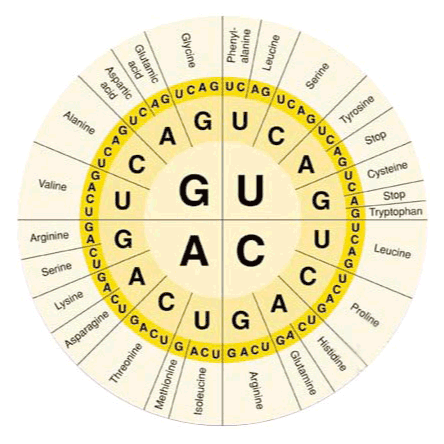
Transcribe the normal DNA sequence:
Translate the mRNA sequence you found in #12.
Which amino acid chain would be built from the RNA segment
In cancer cells, mutations in the DNA cause the cells to reproduce uncontrollably, forming a tumor. Cancer directly affects which cellular process?
Which of the following is a primary reason for cancer cells developing in an organism?
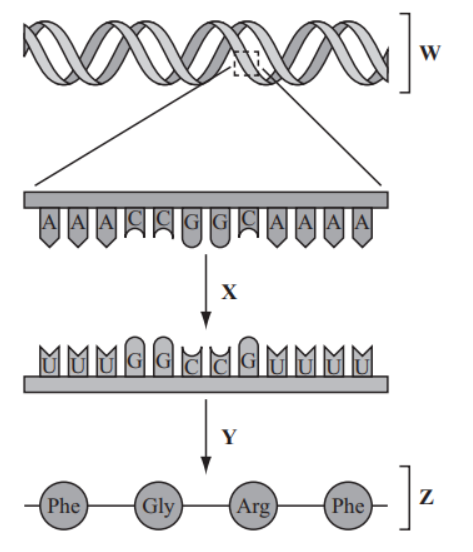
Image W is a molecule that is a double helix. Image W is
Which of the following is the correct sequence of events in the creation of a protein?
A DNA sequence is shown below. What is produced when the sequence is transcribed TAGGAGCAT
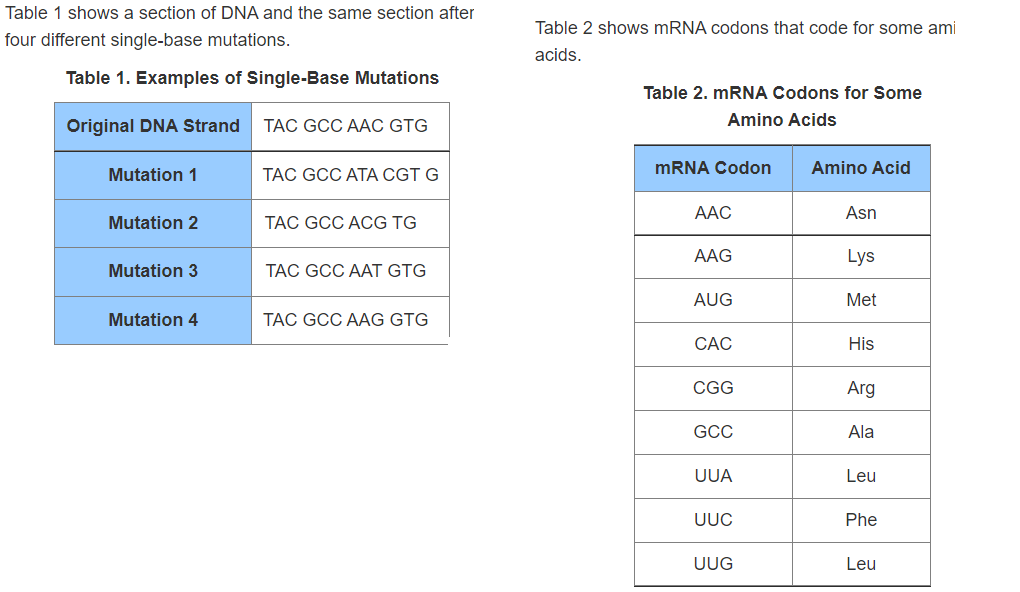
Which mutation would leave the phenotype (appearance) of the organism unchanged?
All six codons listed below code for the same amino acid during protein synthesis. CGU, CGC, CGA, CGG, AGA, AGG Which of the following statements describes an advantage of having multiple codons for the same amino acid?
Methylation is a process that can add methyl (CH3) groups to DNA. A gene containing methylated nucleotides often cannot be transcribed. As a result, proteins will not be produced. Which of the following cellular processes is most directly affected by DNA methylation?
All corn plants contain the ZmLA1 gene. Some corn plants contain a certain mutation in the ZmLA1 gene. The graph below shows the amount of ZmLA1 RNA produced in plants with the normal gene and in plants with the mutated gene.
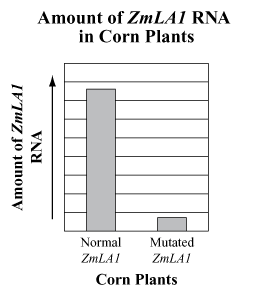
Based on the graph, what most likely happens in corn plant cells as a direct result of the mutated gene?
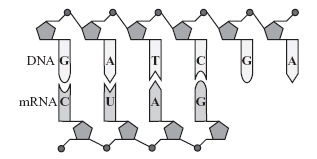
The diagram below shows a strand of DNA matched to a strand of messenger (mRNA). What process does this diagram represent?
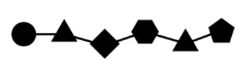
The diagram represents a chain of amino acids. The different shapes represent different amino acids.
A scientist wants to produce a single strand of DNA that codes for this amino acid chain. How many nucleotides will be in the DNA that the scientist produces?
Which diagram shows how RNA is read to produce an amino acid chain?
In a sample of double stranded DNA, 20% of the nitrogenous bases are adenine (A). What percentage of the nitrogenous bases in the sample are cytosine (C)?
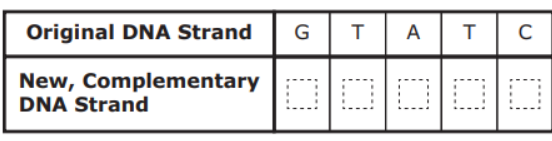
The diagram shows a small part of an original DNA strand and an incomplete DNA strand. Which of the following show the complementary bases for the new strand?
The stage of the cell cycle where the cell membranes form to divide a cell into two cells
The stage of the cell cycle where the cell grows in size, replicates DNA, and develops.
The stage of the cell cycle where the chromosomes of the cell separate and two identical cells are made.
The arrow labeled X represents a process where DNA is read, copied, and made into a single strand of mRNA. This process called
The arrow labeled Y represents the step in the process when mRNA is made into a protein chain. This process is called