Log in
Sign up for FREE
arrow_back
Library

CFU for 6.LS2.7 Animal Communication

star
star
star
star
star
Last updated over 2 years ago
10 questions
1
1
1
1
1
1
1
1
1
1
Question 1
1.

Question 2
2.

Question 3
3.

Question 4
4.

Question 5
5.

Question 6
6.

Question 7
7.

Question 8
8.

Question 9
9.

Question 10
10.

If a bird wanted to warn its flock of a possible threat, which type of communication would be most effective?
visual communication
auditory communication
tactile communication
chemical communication
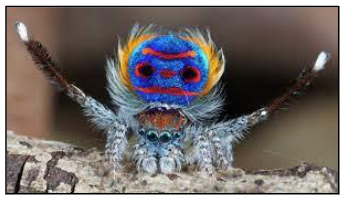
The image shows a male peacock spider lifting two of its legs and its colorful tail flap up in the air.

Why does a male peacock spider display this kind of behavior?
to attract suitable mates
to hook and catch its prey easily
to warn other spiders about predators
to get rid of excess body heat
Male American alligators are known to produce a combination of sounds by roaring and slapping their heads against water. What is one purpose of making such large displays of their presence?
to show strength in their territories
to show that they are hungry
to adapt to weather changes
to find smaller fish to eat
A vervet monkey sees a snake. He then makes a chittering sound to the other members of his troop. The other members respond by looking at the ground. Which type of communication is the vervet monkey using to his troop?
tactile
visual
chemical
auditory
Sage grouses come together in groups called leks, where females watch the group dance in order to choose the most fit male. How is the sage grouse dance an example of a species visually communicating as a species' survival strategy?
Sick, weak, or injured birds are less likely to be chosen keeping the population strong and healthy.
Dancing is not a survival strategy of visual communication.
It scares away predators and keeps the lek safe.
It attracts insects that the birds eat to survive.
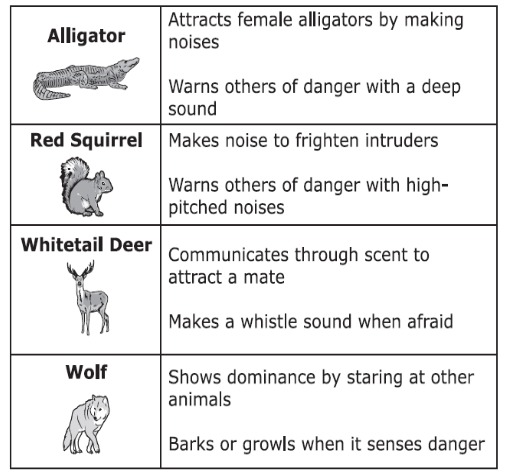
Animals have different methods of communication with members of their own species and other types of animals.

Which animal uses visual communication as a survival strategy?
alligator
red squirrel
white tail deer
wolf
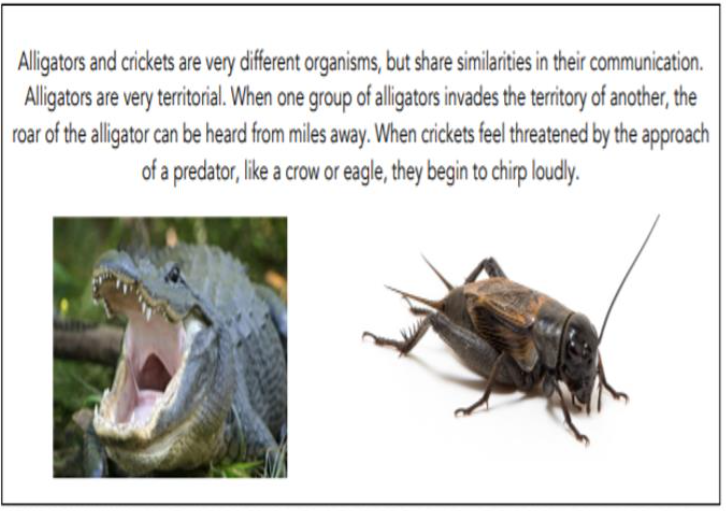
Use the scenario to answer the following question.


How are the survival functions of the alligator and cricket different?
The alligator is using auditory communication, while the cricket is using visual communication.
Although they are both using auditory communication, the alligator is using roaring to scare off competitors, while the cricket is chirping to warn other crickets that a predator is near.
Although they are both using auditory communication, the alligator is using roaring to warn others of predators, while the cricket is chirping to scare off competitors.
The alligator and cricket are both using color to defend their territory from competitors.
Study the scenarios below. Choose THREE of the scenarios that demonstrate examples of visual communication.
Scenario A: Young chimpanzees express the "fear grin" to show submission to the dominant male chimpanzee in the troop.

Scenario B: Rattlesnakes will rattle their tails to warn their predators that attacking the snake will come with a poisonous bite.

Scenario C: Wolf packs hunt in groups to enhance their ability to survive by using complex movements to surround their prey.

Scenario D: Pheromones are secreted from special glands that allow for communication among organisms. Some examples of pheromones are urine, sweat, and even feces. Dogs use pheromones and other auditory communication to warn other animals to stay away.

Scenario E: A puffer fish gulps large amounts of water to make itself blow up large and round in the hopes of evading predators. The spines on a puffer fish are also toxic if ingested.
Scenario A
Scenario B
Scenario C
Scenario D
Scenario E
You are hiking in the woods documenting the different species you encounter with your
camera. As you are hiking, you notice a herd of whitetail deer grazing in a nearby opening. You are able to take a picture of the herd, but want a closer picture. You quietly move closer to the herd when suddenly, a doe (female deer) raises her tail and stomps her back feet as pictured. You see the white under her brown tail. Why is the doe raising her tail?
As a survival instinct to let other deer know there is possible danger in the area.
To attract a mate.
To show off her two-toned colors.
As a signal to the rest of the herd where there is food.
The male peacock has an ornamental tail full of blue and green “eye spots” called the ocellus.
The peacock will fan out his tail or train to communicate with other organisms. Select how the peacock will use his tail to communicate.
Auditory communication; prey nearby
Visual communication; to attract a mate
Pheromone communication; to show dominance
Tactile communication; to warn of danger nearby