Log in
Sign up for FREE
arrow_back
Library

SS Unit Test

star
star
star
star
star
Last updated about 3 years ago
14 questions
5
CCR.R.2
5
CCR.R.1
CCR.R.2
5
CCR.R.1
5
CCR.R.4
3
5
CCR.R.4
3
CCR.R.1
CCR.R.3
3
CCR.R.1
CCR.R.3
3
CCR.R.1
CCR.R.3
3
CCR.R.5
5
CCR.R.1
CCR.R.2
5
CCR.R.1
CCR.R.2
1
CCR.R.3
5
CCR.R.1
CCR.R.4
Question 1
1.

Which of the following best represents the theme of the passage?

Question 2
2.

What quote from the text best supports your answer to the previous question?

Question 3
3.

Select two sentences that belong in an accurate summary of the passage.

Question 4
4.

Read the following sentence from the passage:

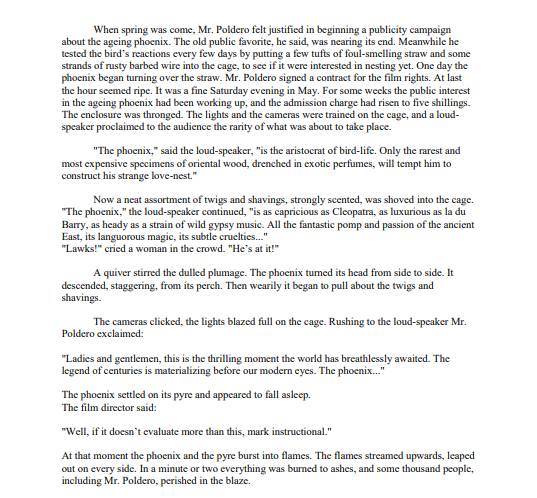
A quiver stirred the dull plumage. The phoenix turned its head from side to side. It descended, staggering, from its perch. then wearily it began to pull about the twigs and shavings.

How does the author's word choice contribute to the meaning of the passage?

Question 5
5.

Identify the main character of the story.

Question 6
6.

Question 7
7.

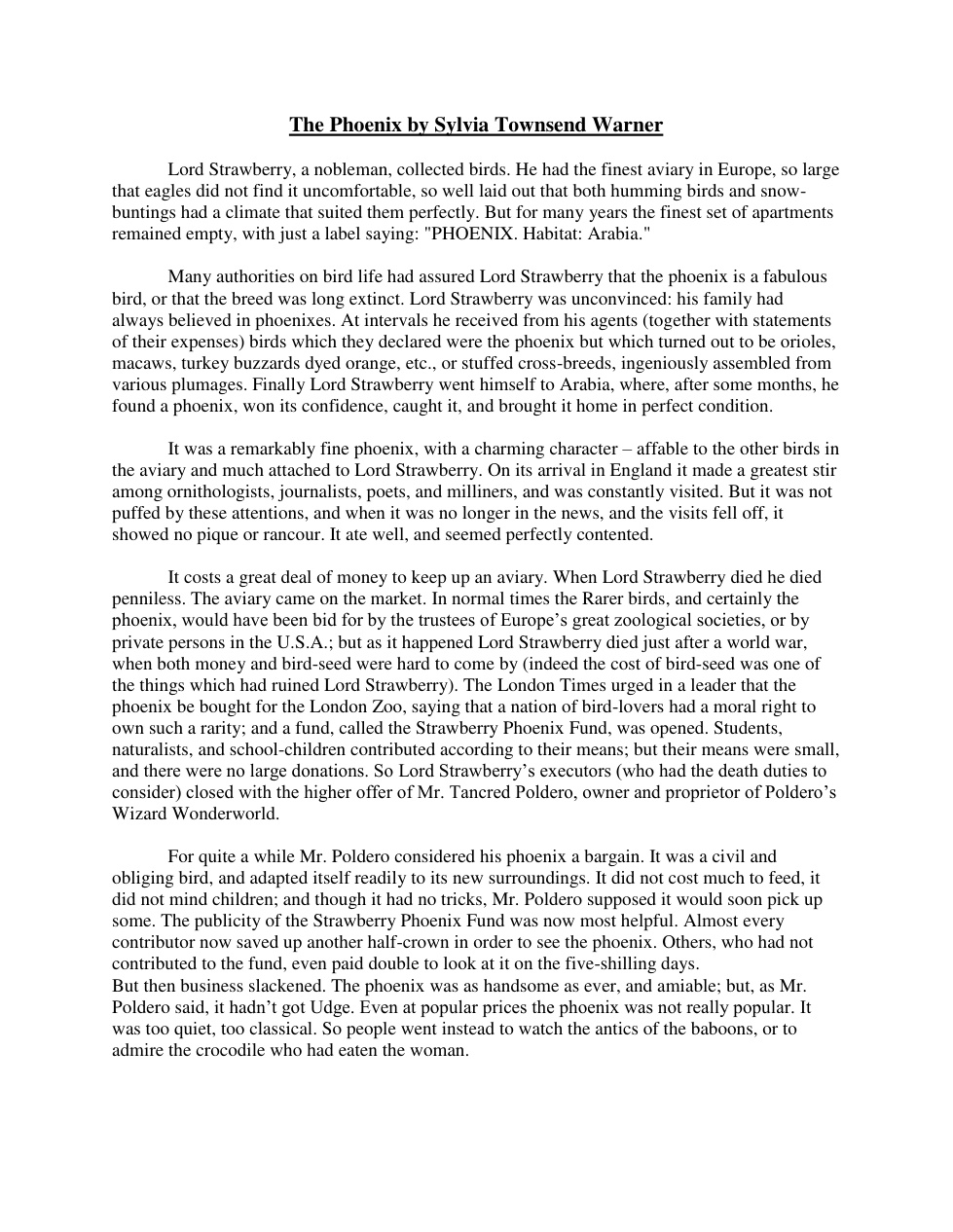
Identify which of the paragraphs from the passage best displays the following aspect of setting: landscape/architecture.
Question 8
8.

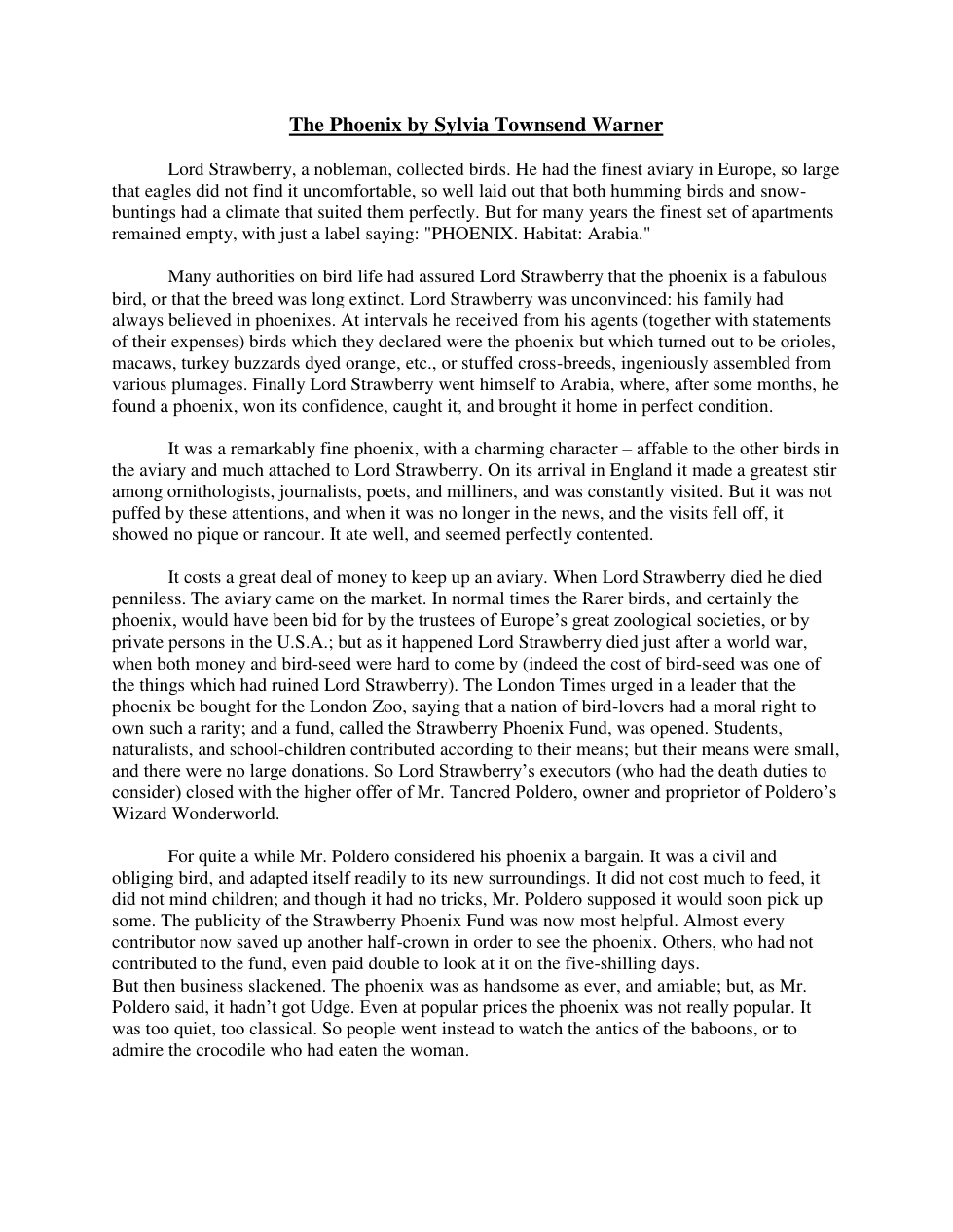
Identify which part of the passage best displays the following aspect of setting: social context.
Question 9
9.

Identify a quote which effectively characterizes the main character.
Question 10
10.

Identify the climax of the story.

Question 11
11.

Which of the following is the best theme for the passage?

Question 12
12.

Choose two quotes from the passage that support your answer to the previous question.
Question 13
13.

What is the mood of the passage?

Question 14
14.

Select 5 examples of diction that build the mood of the passage.

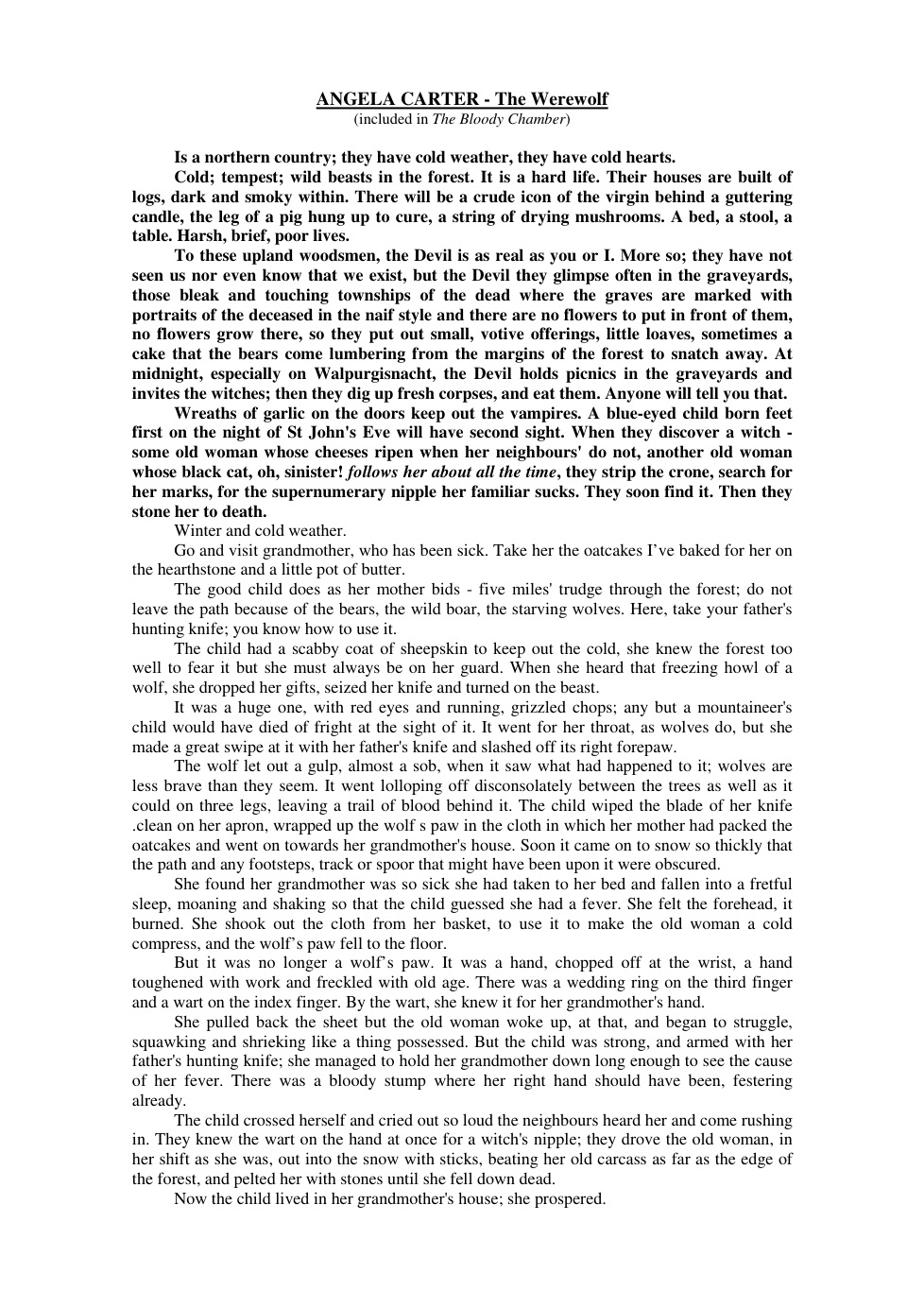
Is a northern country; they have cold weather, they have cold hearts.
Cold; tempest; wild beasts in the forest. It is a hard life. Their houses are built of logs, dark and smoky within. There will be a crude icon of the virgin behind a guttering candle, the leg of a pig hung up to cure, a string of drying mushrooms. A bed, a stool, a table. Harsh, brief, poor lives. To these upland woodsmen, the Devil is as real as you or I. More so; they have not seen us nor even know that we exist, but the Devil they glimpse often in the graveyards, those bleak and touching townships of the dead where the graves are marked with portraits of the deceased in the naif style and there are no flowers to put in front of them, no flowers grow there, so they put out small, votive offerings, little loaves, sometimes a cake that the bears come lumbering from the margins of the forest to snatch away. At midnight, especially on Walpurgisnacht, the Devil holds picnics in the graveyards and invites the witches; then they dig up fresh corpses, and eat them. Anyone will tell you that.
Wreaths of garlic on the doors keep out the vampires. A blue-eyed child born feet first on the night of St John's Eve will have second sight. When they discover a witch - some old woman whose cheeses ripen when her neighbors' do not, another old woman whose black cat, oh, sinister! follows her about all the time, they strip the crone, search for her marks, for the supernumerary nipple her familiar sucks. They soon find it. Then they stone her to death.

Winter and cold weather.
Go and visit grandmother, who has been sick. Take her the oatcakes I’ve baked for her on the hearthstone and a little pot of butter.
The good child does as her mother bids - five miles' trudge through the forest; do not leave the path because of the bears, the wild boar, the starving wolves. Here, take your father's hunting knife; you know how to use it.
The child had a scabby coat of sheepskin to keep out the cold, she knew the forest too well to fear it but she must always be on her guard. When she heard that freezing howl of a wolf, she dropped her gifts, seized her knife, and turned on the beast.
It was a huge one, with red eyes and running, grizzled chops; any but a mountaineer's child would have died of fright at the sight of it. It went for her throat, as wolves do, but she made a great swipe at it with her father's knife and slashed off its right forepaw.
The wolf let out a gulp, almost a sob when it saw what had happened to it; wolves are less brave than they seem. It went lolloping off disconsolately between the trees as well as it could on three legs, leaving a trail of blood behind it. The child wiped the blade of her knife clean on her apron, wrapped up the wolf s paw in the cloth in which her mother had packed the oatcakes, and went on towards her grandmother's house. Soon it came on to snow so thickly that the path and any footsteps, track, or spoor that might have been upon it were obscured.
She found her grandmother was so sick she had taken to her bed and fallen into a fretful sleep, moaning and shaking so that the child guessed she had a fever. She felt the forehead, it burned. She shook out the cloth from her basket, to use it to make the old woman a cold compress, and the wolf’s paw fell to the floor.
But it was no longer a wolf’s paw. It was a hand, chopped off at the wrist, a hand toughened with work and freckled with old age. There was a wedding ring on the third finger and a wart on the index finger. By the wart, she knew it for her grandmother's hand.
She pulled back the sheet but the old woman woke up, at that, and began to struggle, squawking and shrieking like a thing possessed. But the child was strong, and armed with her father's hunting knife; she managed to hold her grandmother down long enough to see the cause of her fever. There was a bloody stump where her right hand should have been, festering already.
The child crossed herself and cried out so loud the neighbors heard her and come rushing in. They knew the wart on the hand at once for a witch's nipple; they drove the old woman, in her shift as she was, out into the snow with sticks, beating her old carcass as far as the edge of the forest, and pelted her with stones until she fell down dead.

Now the child lived in her grandmother's house; she prospered.
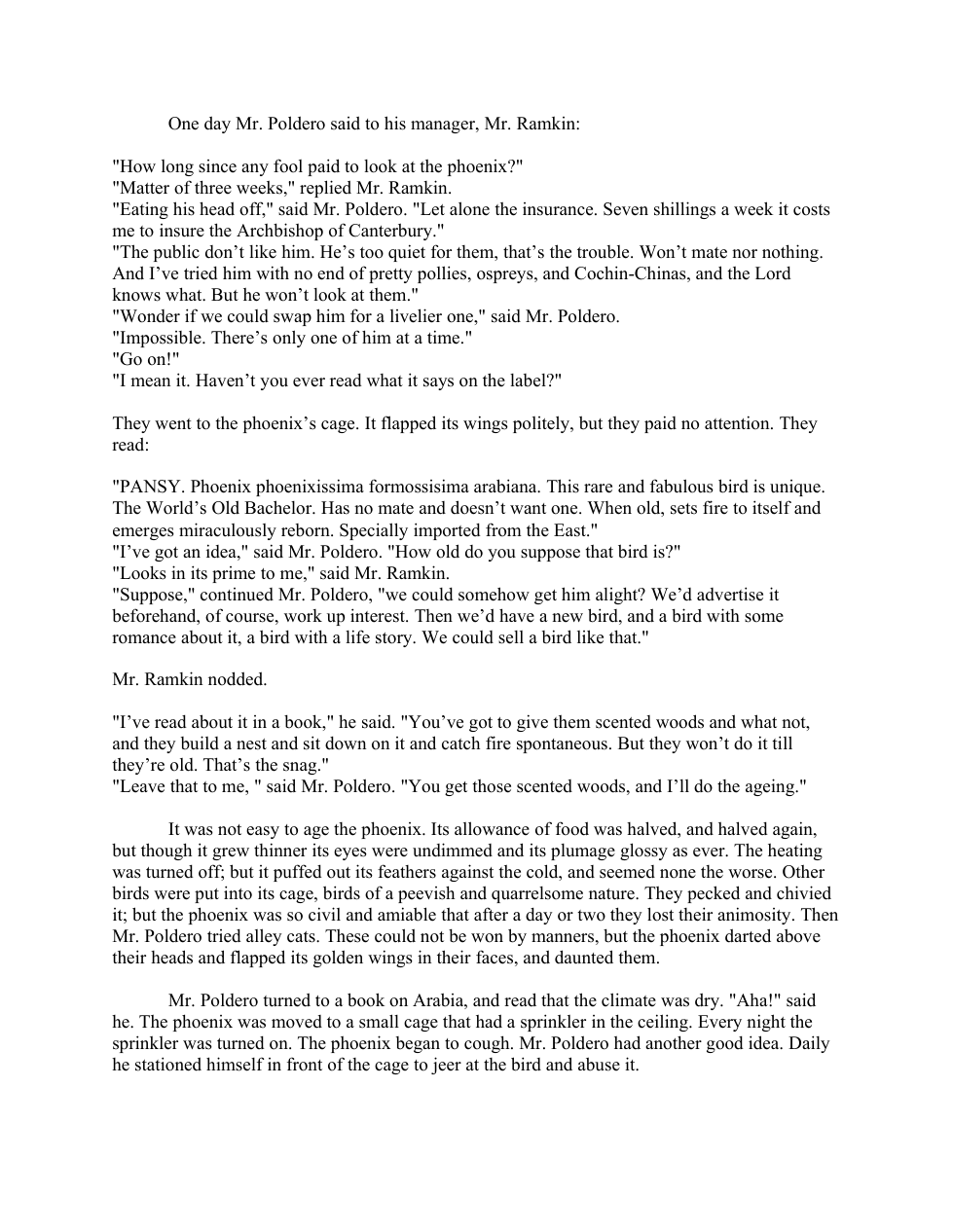
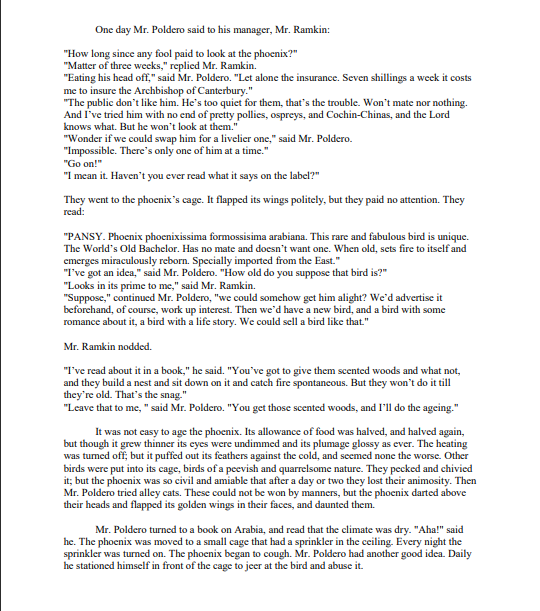
"Suppose," continued Mr. Ploldero, "we could somehow get him alight? We'd advertise it beforehand, of course, work up interest. Then we'd have a new bird, and a bird with some romance about it, a bird with a life story. We could sell a bird like that."
It was not easy to age the phoenix. Its allowance of food was halved, and halved again, but though it grew thinner its eyes were undimmed and its plumage glossy as ever. The heating was turned off; but it puffed out its feathers against the cold, and seemed none the worse.
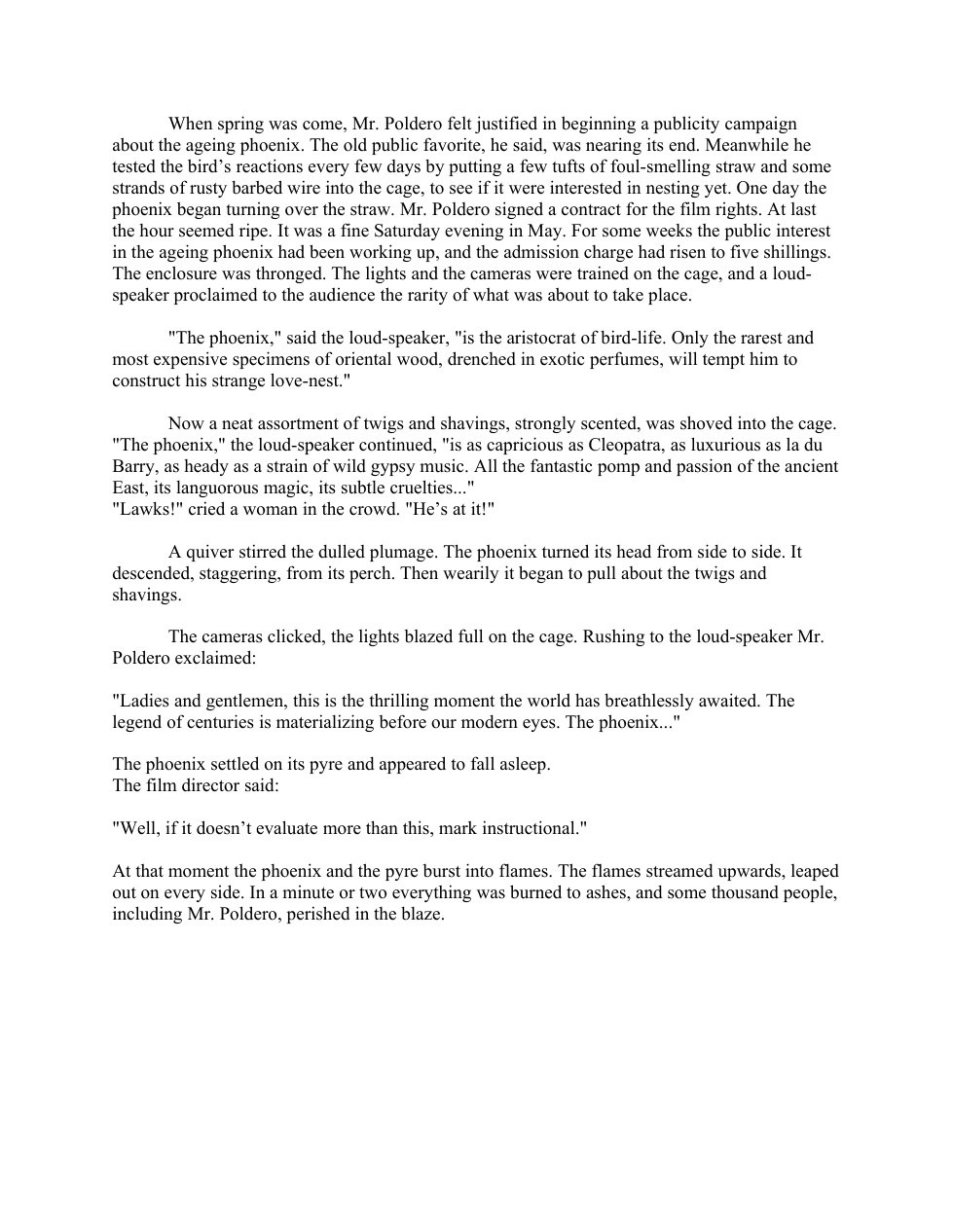
At that moment the phoenix and the pyre burst into flames. The flames streamed upwards, leaped out on every side. In a minute or two everything was burned to ashes, and some thousand people, including Mr. Poldero, perished in the blaze.
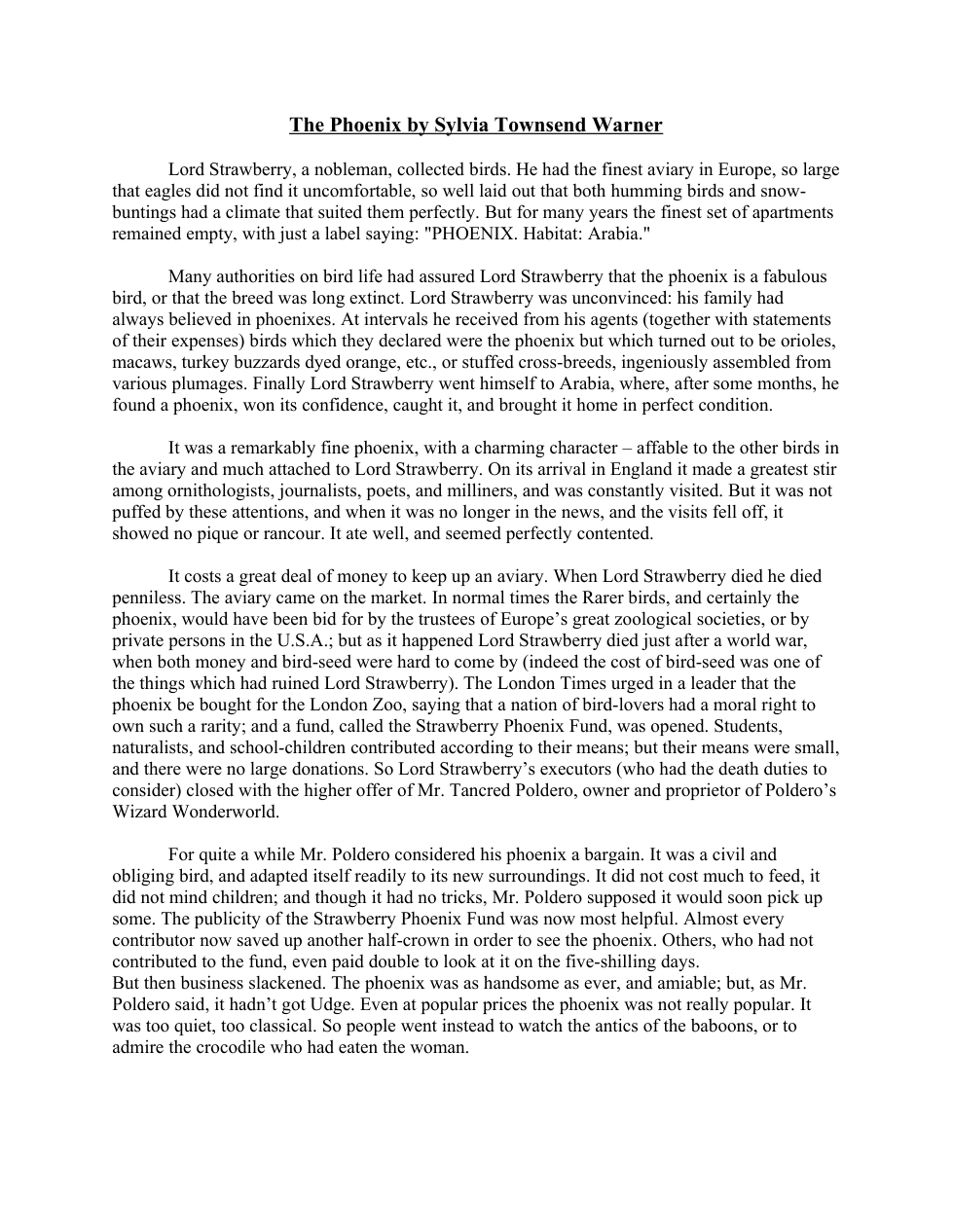
It costs a great deal of money to keep up an aviary, so Mr. Strawberry died penniless.
Mr. Poldero outbids the Strawberry Phoenix Fund and brings the Phoenix to Poldero's Wizard Wonderworld.
Mr. Poldero and his manager decide to age the phoenix so that it will die and be born again as a new, more interesting, bird.
Mr. Poldero puts the phoenix into a smaller cage with a sprinkler in the ceiling which is turned on each night.
Words like stirred, descended, and perch emphasize the compelling and powerful nature of the phoenix despite its abuse.
Words like dull, twigs, and shavings emphasize the detail put into the phoenix's nest.
Correctly sort the options below into the correct mood and the diction words that build the mood. There will only be one mood of the story. NOT ALL OPTIONS WILL BE USED!
"abuse"
"spring"
"ashes"
"Saturday"
corrupt
"Poldero"
"advertise"
"friendly"
neat
"manners"
"fire"
cheerful
moody
"bird"
Mood of the story.
Diction that builds the mood.
Survival, if not peace, is maintained through mutual preying and destruction of outsiders.
Courage is not the absence of fear, but rather the judgement that something else is more important than fear.
It is better to light a candle than to curse the darkness.
desolate
dreamy