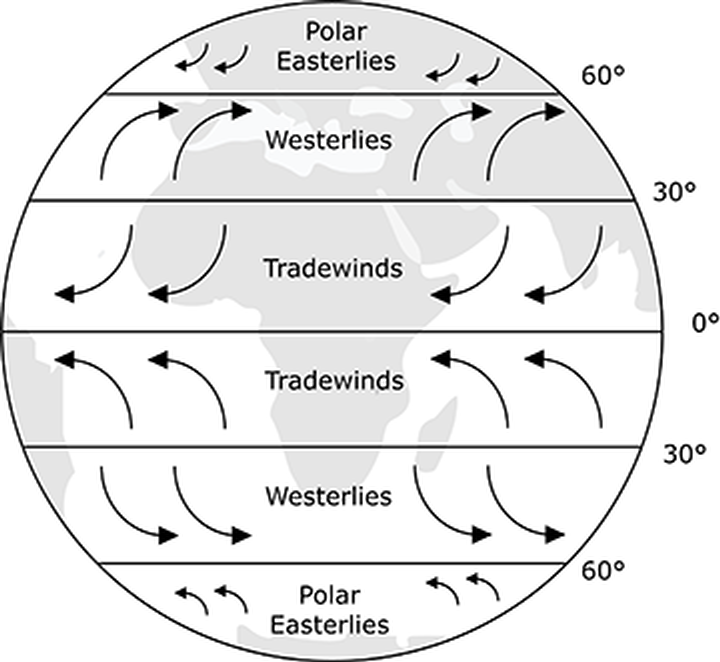
The Coriolis Effect can explain the pathways of global wind systems, such as the polar easterlies, westerlies, and tradewinds. Indicate whether each statement about the Coriolis Effect is true or false.
Ɛhia
1
Ɛhia
1
Ɛhia
1
Ɛhia
1
How would humans most likely function in an atmosphere that was 19% oxygen?
Earth's current atmosphere is approximately
Air circulates as a result of uneven distribution of heat in the atmosphere. Heat can be transferred by conduction, convection, or radiation.
Match each description of the energy transfer with its type.
| Draggable item | arrow_right_alt | Corresponding Item |
|---|---|---|
Convection | arrow_right_alt | The temperature of the air directly above the warm sand increases. |
Radiation | arrow_right_alt | Air higher in the atmosphere sinks and pushes the warmer air upward. |
Conduction | arrow_right_alt | Sand on the beach gets warm on a hot, sunny day. |
Over which area would a high pressure system most likely develop during the day?
Match the following characteristics with the correct atmosphere(s).
First Atmosphere | Second Atmosphere | Third Atmosphere | |
|---|---|---|---|
This atmosphere was on Earth approximately 5.4 to 2.6 billion years ago. | |||
This atmosphere contained mostly hydrogen and large amounts of water vapor, carbon dioxide, and hydrogen sulfide. | |||
This atmosphere was around the same time that the oceans were formed. | |||
This atmosphere had free oxygen (O2 gas) in the atmosphere. |
During the time of Earth’s second atmosphere, many types of blue-green bacteria called
Why is it more difficult to breath at higher altitudes?
There are many reasons for Earth's surface heating unevenly. One reason is the curvature of Earth, which affects the angle of incoming solar radiation, called
Earth’s surface is about percent land and percent water. Land absorbs and releases thermal energy much rapidly than water does, as water absorbs heat more slowly and holds on to it .
Wind is caused by differences in air pressure. Atmospheric circulation is driven mostly by solar radiation, and winds and convection currents in the atmosphere are the result of distribution of thermal energy in the atmosphere. Winds are commonly named for the direction from which they blow. For example, westerlies blow the west.
Match human activity w/ consequence to atmosphere
| Draggable item | arrow_right_alt | Corresponding Item |
|---|---|---|
chlorofluorocarbons from airconditioners and refrigerators | arrow_right_alt | less transpiration, reduced humidity, cloud formation and rainfall |
Sulfur and Nitrogen Oxides formed during combustion | arrow_right_alt | destruction of ozone layer which protects us from UV rays |
carbon dioxide and methane gases produced from combustion and natural gas formation | arrow_right_alt | acid rain |
removal and reduction of plants i.e. deforestation | arrow_right_alt | greenhoue gases |
Heating a fluid, like air, causes its density to . In the air, volumes of dense fluid are pulled strongly by gravity than are equal volumes of less dense air. In Earth’s atmosphere, dense air is pulled toward Earth’s surface with more force than is less dense air, while the lower-density air is forced upward. air rises because it is forced upward by the surrounding , dense air.
Without the Coriolis Effect, air currents would move from the dense, high-pressure air of the poles to the warm, low-pressure air at the equator with no overall deflection
The Coriolis Effect occurs because land heats and cools faster than water.
Without the Coriolis Effect, air would move in a straight line from the dense, high-pressure air in the West to the warm, low-pressure air in the East.
The Coriolis Effect results from the rotation of the Earth.