1
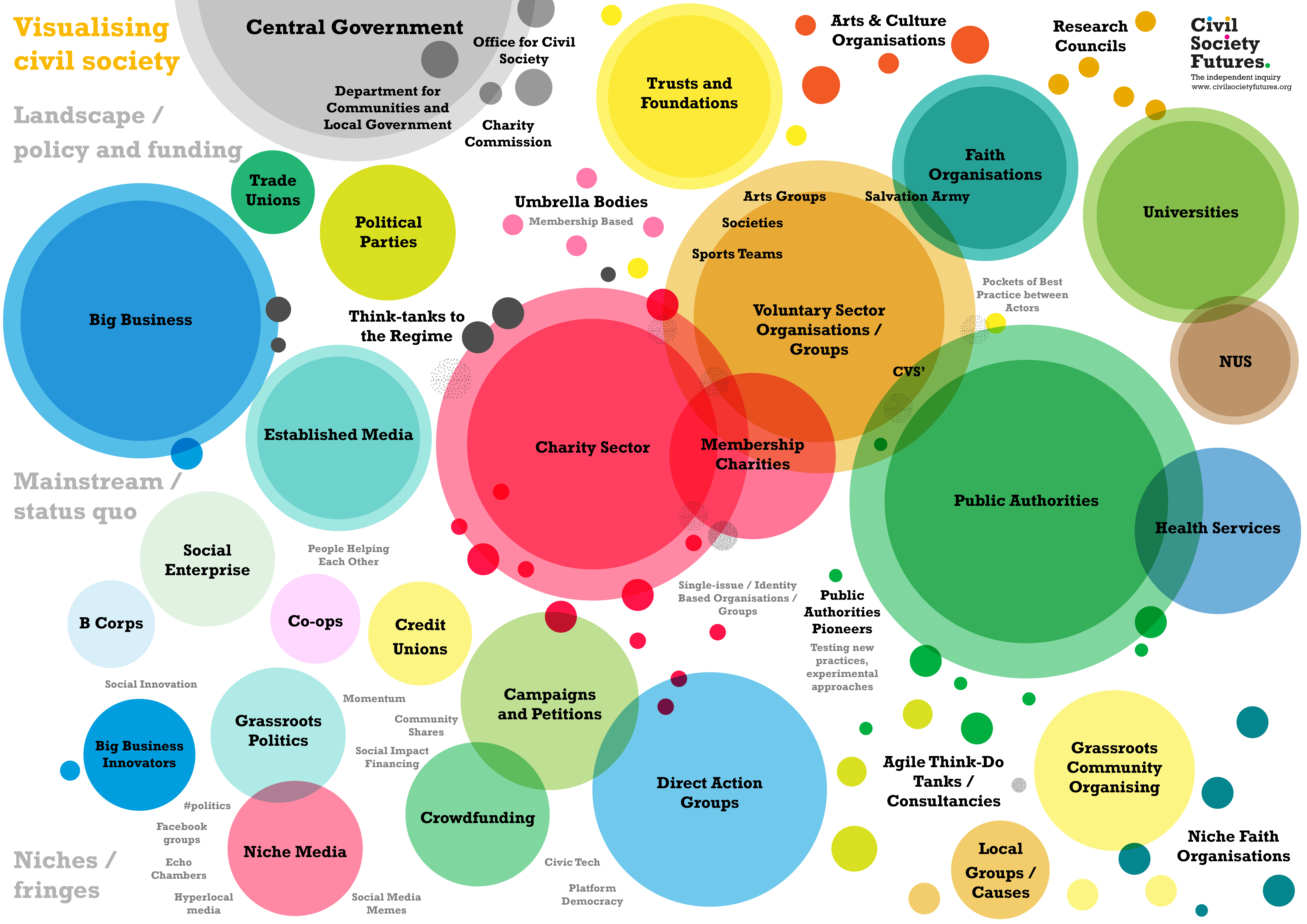
Relatively speaking, how much of a role does the central government play in our overall civil society?
Relatively speaking, how much of a role does the central government play in our overall civil society?
1
1
1
1. Examine the Civil Society Infographic below and answer the related questions. Remember that you can enlarge the infographic to see it better.
2. Read the article titled "What is Civil Society and Why Does it Matter?" and answer the related questions.
Relatively speaking, how much of a role does the central government play in our overall civil society?
A vibrant and competent civil society is the cornerstone of a healthy and prosperous nation. It is where people themselves work to create change and build a better society, rather than rely solely on the government to do so. This notion first appeared in ancient Greece and Rome, and has become an essential component for a modern society to function anywhere in the world.
Civil society is what happens when the people themselves organize to create
The United States is the first civilization to have a civil society.
During a speech made in Kabul in 2007, Mawlana Hazar Imam defined civil society as “a realm of activity which is neither governmental nor commercial, institutions designed to advance the public good, but powered by private energies.”
What do you think is meant by the phrase "neither governmental nor commercial"?
What do you think is meant by the phrase "designed to advance the public good but powered by private energies"?
When governments are fragile, or unable to meet the needs of their citizens, civil society organisations can step into the void. Their impact can be life-changing, providing people with basic healthcare, schooling, and shelter; or helping them access credit to expand a small business for example.
In nations where the government is more established, the efforts of a robust civil society sector are equally as important; workers’ rights groups such as teachers’ unions or medical associations advocate for fair treatment, while environmental groups promote sustainable living practices.
Civil society institutions can also take the form of media outlets and arts organisations that communicate and share knowledge, or social enterprises that generate innovative ideas. They can be as small as a neighbourhood self-help scheme, or as large as an international NGO or the United Nations.
For the wellbeing of all individuals and communities, it is important that civic principles should play a leading role in the future of all populations.
Mawlana Hazar Imam has also outlined volunteering as one of the key components of a healthy civil society. In a speech at Brown University in 2014, he said “One of the energising forces that makes a quality civil society possible, of course, is the readiness of its citizens to contribute their talents and energies to the social good..."
Civil society is only necessary when governments are fragile (meaning they can't meet the needs of their students).
List some of the ways that civil society can improve both fragile governments and established governments.
List some of the civil society organizations that you have heard of before.
List some of the civil society organizations that you have never heard of before.
List any civil society organizations that you have been a part of already or that you think you could be a part of in the future.