Collisions Mixed Practice
star
star
star
star
star
Last updated almost 3 years ago
26 questions
Note from the author:
1
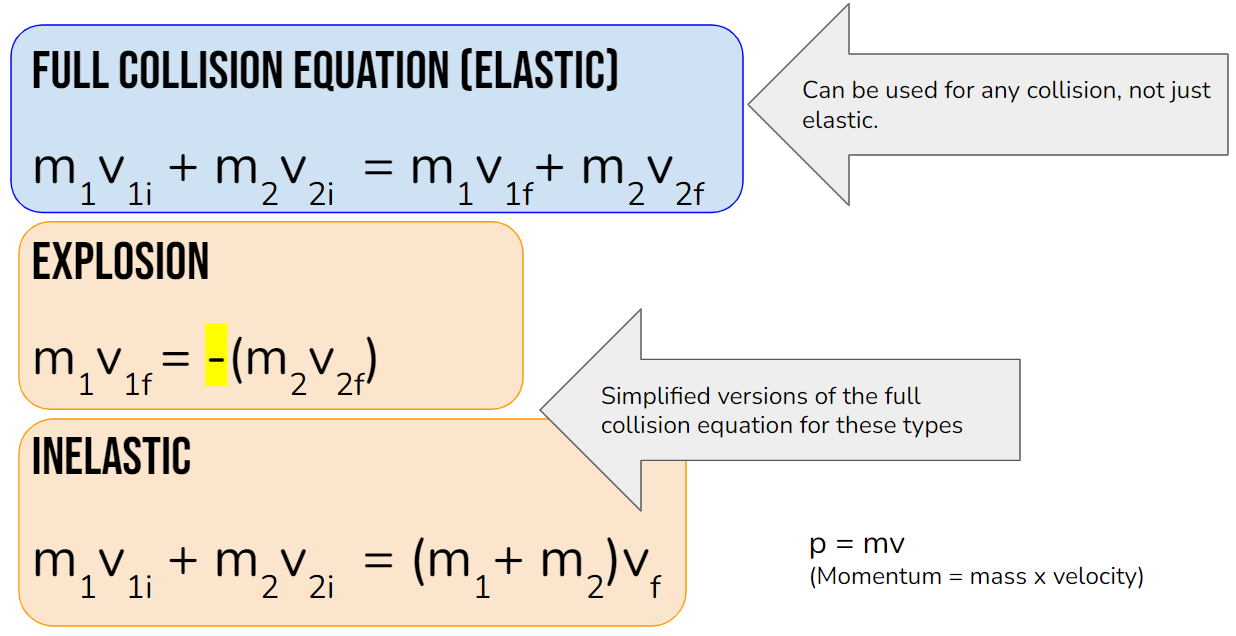
In which collisions is Momentum Conserved?
1
In which collisions is Kinetic Energy Conserved?
1
In which collision do the objects stick together after they collide?
1
In which collision do the objects always start at rest?
1
Which collisions have to have at least one object moving at the start?
1
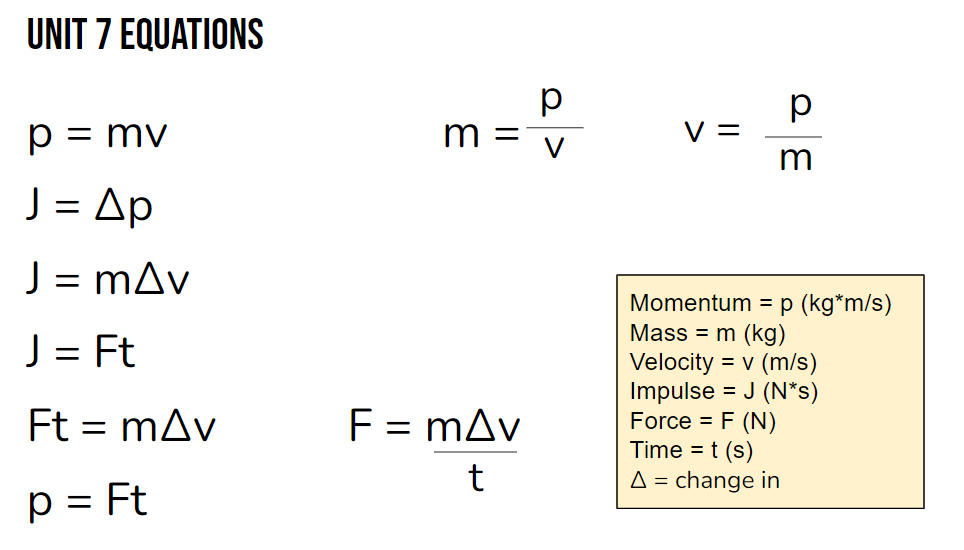
True or False: An object's initial momentum must be the exact same as its final momentum to follow Conservation of Momentum.
1
A 45.0 kg student sits at rest on a new class rolling chair. A friend tosses the student a 5.0 kg backpack at 4m/s from the left. The student freaks out and bats the backpack away moving the student backwards across the class at a speed of 0.5 m/s to the left. What type of collision is this?
1
A 45.0 kg student sits at rest on a new class rolling chair. A friend tosses the student a 5.0 kg backpack at 4m/s to the left. The student freaks out and bats the backpack away moving the student backwards across the class at a speed of 0.5 m/s to the left. What is the backpack's final velocity?
1
An astronaut at rest in space has a mass of 84 kg and fires a thruster that expels 0.035kg of hot gas at 875m/s to the right. What type of collision is this?
1
An astronaut at rest in space has a mass of 84 kg and fires a thruster that expels 0.035kg of hot gas at 875m/s to the right. What is the velocity of the astronaut after firing the thruster?
1
The cue ball and the 8 ball collide, both with a mass of 0.16kg. The cue ball moves with a velocity of 4m/s, and the 8 ball is at rest. After the collision, the cue ball comes to a complete stop. What type of collision is this?
1
The cue ball and the 8 ball collide, both with a mass of 0.16kg. The cue ball moves with a velocity of 4m/s, and the 8 ball is at rest. After the collision, the cue ball comes to a complete stop. What is the velocity of the 8 ball after the collision?
1
A skydiver (54 kg) is coming in for a landing at a brisk speed of 13 m/s. An unknowing child (22 kg) is watching the landing before getting hit. The skydiver luckily scoops the child with minimal harm and now both are continuing to land. What type of collision is this?
1
A skydiver (54 kg) is coming in for a landing at a brisk speed of 13 m/s. An unknowing child (22 kg) is watching the landing before getting hit. The skydiver luckily scoops the child with minimal harm and now both are continuing to land. What is the final velocity of the skydiver and the child?
1
A 0.2 kg arrow is fired at 15.8 m/s towards a 15 kg target. The arrow hits the target and they move together. What type of collision is this?
1
A 0.2 kg arrow is fired at 15.8 m/s towards a 15 kg target. The arrow hits the target and they move together. What velocity does the arrow and target move together?
1
Tinkerbell (0.08 kg) finds herself stuck in the keyhole of an open drawer (3.7 kg). She pushes against the drawer to free herself and eventually goes flying to the left at 36 m/s. What type of collision is this?
1
Tinkerbell (0.08 kg) finds herself stuck in the keyhole of an open drawer (3.7 kg). She pushes against the drawer to free herself and eventually goes flying to the left at 36 m/s. How fast does the drawer move to the right?
1
A 24 kg toddler takes a running leap to jump on their 40 kg sibling's back. Once they land, both the siblings go forward at 2.3 m/s. What type of collision is this?
1
A 24 kg toddler takes a running leap to jump on their 40 kg sibling's back. Once they land, both the siblings go forward at 2.3 m/s. What is the initial velocity of the toddler?
1
During an explosion if Object A has less mass than Object B, what would be the outcome?
1
What is true about the initial velocity of a moving object during an inelastic collision?
1
Cart A collides with a stationary Cart B. In the Elastic collision, Cart A bounces back towards where it started and Cart B moves forwards slightly. What must be true about the masses?
2
Create a "Rule of Thumb" to identify which object moves faster in an Explosion
3
Create a "Rule of Thumb" to identify when an object would keep moving forwards, move backwards, or stop after colliding during an Elastic Collision
2
Create a "Rule of Thumb" to identify how initial velocity relates to the final velocity during Inelastic Collisions