Twa kɔ nsɛm atitiriw so
Log in
Sign up for FREE
arrow_back
Laabri

Unit 3 - Lesson 17 - Grade 5: Illustrative Mathematics

star
star
star
star
star
Last updated over 1 year ago
14 Nsɛmmisa
Hyɛ no nsow a efi ɔkyerɛwfo no hɔ:

Grade 5 Unit 3

Lesson 17: Fraction Multiplication and Division Situations

CC BY 2021 Illustrative Mathematics

Grade 5 Unit 3

Lesson 17: Fraction Multiplication and Division Situations

CC BY 2021 Illustrative Mathematics

Lesson: Fraction Multiplication and Division Situations

Number Talk: Multiply and Divide (Warm Up)

Info Gap: Tiles

Multiplication or Division

Solve each problem. Explain or show your reasoning.

1
1
1
1
1
1
Cool Down: How Much Milk?
1
1

Find the value of each expression mentally.

1
Asemmisa {{asɛmmisaAhyɛnsode}}
1.

1
Asemmisa {{asɛmmisaAhyɛnsode}}
2.

1
Asemmisa {{asɛmmisaAhyɛnsode}}
3.

1
Asemmisa {{asɛmmisaAhyɛnsode}}
4.

Round 1

Your teacher will give you either a problem card or a data card. Do not show or read your card to your partner.
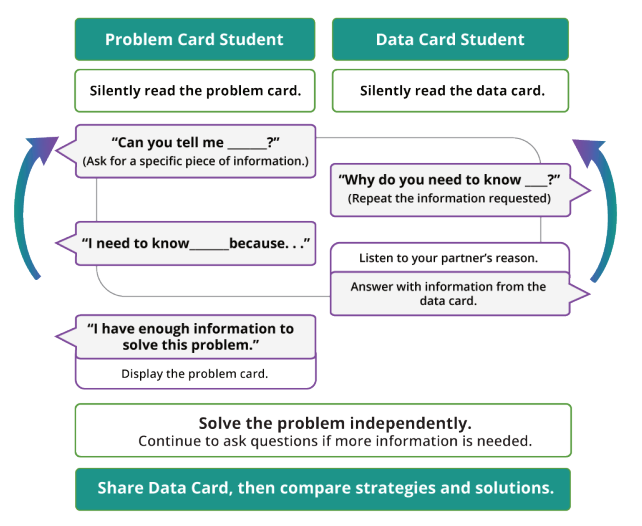
Problem Card Student: Silently read the problem card.

Data Card Student: Silently read the data card.

Problem Card Student:

"Can you tell me______?" (Ask for a specific piece of information)

Data Card Student:

"Why do you need to know _____?" (Repeat the information requested)

Problem Card Student:

"I need to know _______ because _______."

Data Card Student:

Listen to your partner's reason. Answer with information from the data card.

Problem Card Student:

Continue asking questions until you can say, "I have enough information to solve this problem."

Display the problem card.

1
Asemmisa {{asɛmmisaAhyɛnsode}}
5.

Solve the problem independently.

Data Card Student:

Share Data Card, then compare strategies and solutions.

Pause here so your teacher can review your work.

Ask your teacher for a new set of cards and repeat the activity, trading roles with your partner.

Round 2

Your teacher will give you either a problem card or a data card. Do not show or read your card to your partner.

Problem Card Student: Silently read the problem card.

Data Card Student: Silently read the data card.

Problem Card Student:

"Can you tell me______?" (Ask for a specific piece of information)

Data Card Student:

"Why do you need to know _____?" (Repeat the information requested)

Problem Card Student:

"I need to know _______ because _______."

Data Card Student:

Listen to your partner's reason. Answer with information from the data card.

Problem Card Student:

Continue asking questions until you can say, "I have enough information to solve this problem."

Display the problem card.

1
Asemmisa {{asɛmmisaAhyɛnsode}}
6.

Solve the problem independently.

Data Card Student:

Share Data Card, then compare strategies and solutions.

Pause here so your teacher can review your work.

Ask your teacher for a new set of cards and repeat the activity, trading roles with your partner.

Asemmisa {{asɛmmisaAhyɛnsode}}
7.

If 11 grains of rice weigh 1/3 gram, how much does each grain of rice weigh?

Asemmisa {{asɛmmisaAhyɛnsode}}
8.

Explain your reasoning.

Asemmisa {{asɛmmisaAhyɛnsode}}
9.

Mai’s road is 9/10 mile long. She ran 3/4 of the length of her road. How far did she run?

Asemmisa {{asɛmmisaAhyɛnsode}}
10.

Explain your reasoning.

Asemmisa {{asɛmmisaAhyɛnsode}}
11.

If each tennis ball weighs 21/16 ounces, how much do 9 tennis balls weigh?

Asemmisa {{asɛmmisaAhyɛnsode}}
12.

Explain your reasoning.

Asemmisa {{asɛmmisaAhyɛnsode}}
13.

A container has 2 cups of milk in it. How many 1/4 cups of milk are in the container? Explain or show your reasoning.

Asemmisa {{asɛmmisaAhyɛnsode}}
14.

A container has 2 cups of milk in it. The container is 1/3 full. How many cups does the

container hold? Explain or show your reasoning.