Log in
Sign up for FREE
arrow_back
Library

Unit 3.6 Reading & Classwork: Juneteenth & Thaddeus Stevens

star
star
star
star
star
Last updated over 1 year ago
12 questions
Note from the author:
Required
1
Required
1
IIWD.01
Required
1
IITE.01
Required
1
0
Content Objective: I will be able to recognize the modern and historical significance of Juneteenth.

Standard Objective: I will be able to draw reasonable inferences and logical conclusions from text.

Link to slides from class is here
Content Objective: I will be able to recognize the modern and historical significance of Juneteenth.

Standard Objective: I will be able to draw reasonable inferences and logical conclusions from text.

Link to slides from class is here
Question 1
1.

Warm Up: What was your experience like growing up with Barack Obama as the first Black President? Do you feel like his role in history directly impacted your life or community?

Required
1
Question 2
2.
The Reconstruction era refers to the period _______ the Civil War when attempts were made to redress [fix] the inequities of slavery and its political, social, and economic legacy. The U.S. federal government also needed to determine how to _______ the 11 Confederate states back into the Union.
After the war, formerly enslaved African Americans responded to freedom in different ways. After celebrating the end of the war and their new freedom, most tried to _______ with their separated families. Some set up new institutions, including schools, while participating in politics by voting and even serving in government.
Required
1
Question 3
3.
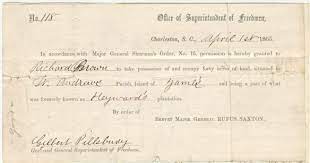
Although formerly enslaved African Americans were _______ land and resources from the government to set up their own farms, most did not receive these. Some who did receive land and resources later had them taken away. Newly freed people had to figure out how to survive and support their families.

For about 10 years after the Civil War, the federal government provided _______ such as finding employment, housing, and education to the formerly enslaved and took steps under _______ Reconstruction to protect their political and civil rights, but these advances were later overturned.
Question 4 | 01:35
Question 5 | 08:15
00:00/00:00
Question 4
01:35
keyboard_arrow_down
1
Question 4
4.

Who was Hiram Revels?

Question 5
08:15
keyboard_arrow_down
1
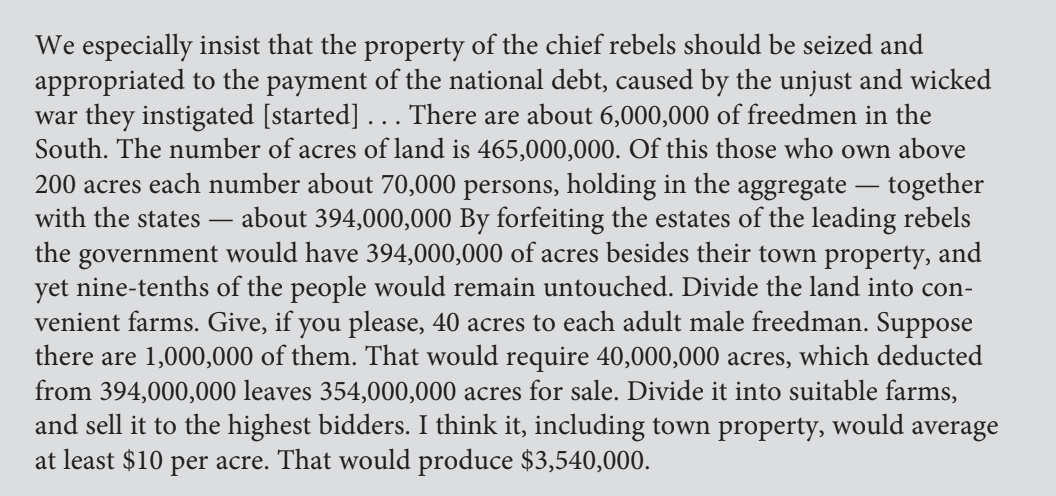
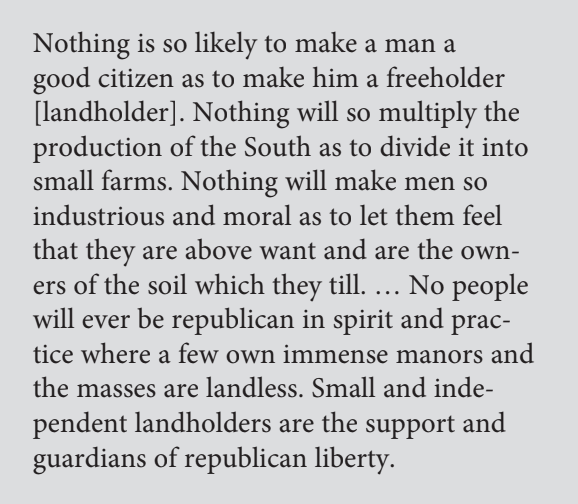
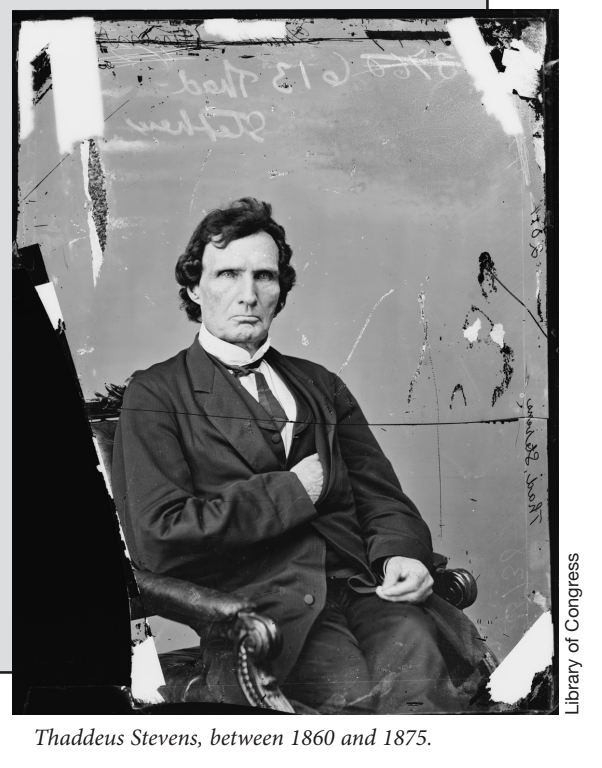
Applying Knowledge: Please read the following excerpt from the Congressional Record, Thaddeus Stevens makes the case for confiscation and redistribution of land in the South.
Required
1
Question 6
6.

IIRC.01
Question 7
7.

As used in line 8, "untouched" most nearly means
Required
1
Question 8
8.

IIRC.02
Question 9
9.

Which choice provides the best evidence for the answer to the previous question?
Required
1
Question 10
10.

RAG.02
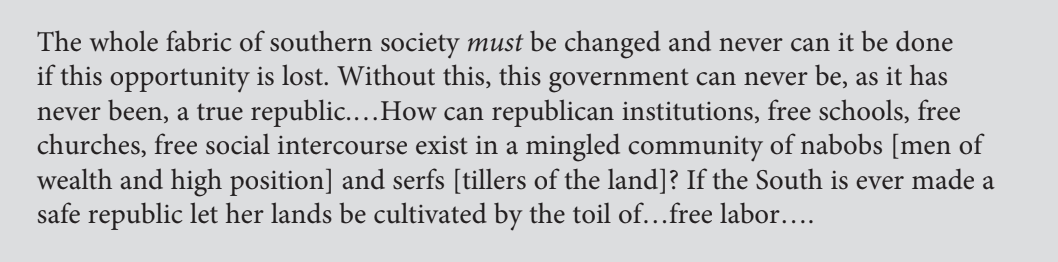
—Excerpts from speeches by Radical Republican Congressman Thaddeus Stevens, 1865, as published in the Congressional
Record


Question 11
11.

Exit Ticket: Today, we learned about successful policies that were passed during Reconstruction as well as proposals that did not come to fruition. On the one hand, Hiram Revels was elected as the first Black Senator. On the other hand, Thaddeus Stevens’ proposal did not receive much support and was, ultimately, rejected by the U.S. Congress.

What do you think should come first in the fight for true racial equity -- political or economic freedom? Explain.

Question 12
12.

Exit Ticket: Please evaluate how well you understood today’s lesson on a scale from 1 to 4:
Question 5
5.

Why do you think it is important for newly freed African Americans to be able to serve in public office?

The author indicates that the nation should handle the aftermath of the Civil War by
allowing newly freed Blacks to vote on a suitable punishment for their former enslavers.
taking land from the Confederate rebels and giving it to newly freed Blacks.
forgiving all Southern rebels who participated in the Civil War for the sake of the Union.
imprisoning the leaders of the Confederacy only and forgiving Southern citizens.

pure
As presented in the passage, Stevens would most likely agree that
the United States cannot be truly free without economic opportunity for all.
a true republic has a diverse population with people at all class levels.
we must reform the South but not necessarily change the entire social structure.
people of all colors will naturally interact now that social strife has ended with the Civil War.
Based on this passage, Stevens believes his plan will work because
it will help the South compete with the industrial factories that are booming in the North.
having land to call their own will commit newly freed Blacks to the success of the American republic.
formerly enslaved people will want be spiteful towards their previous owners.
farming is a noble way to make a living that will make a good citizen out of everyone.