[AP Statistics] 9.1 Significance Test Basics
star
star
star
star
star
Last updated about 1 year ago
25 Nsɛmmisa
1
1
1
1
1

1
1
1
1
1
1
1
1
1
1
1
1
1
1
1
1
1
1
1
1
Lumber companies dry freshly cut boards in kilns before selling them. As a result of the drying process, a certain percentage of the boards crack. The current drying procedure is known to produce cracks in 16% of the boards. The drying supervisor has a special new method that he believes will reduce the percentage of boards that will crack.
To investigate, he selected an SRS of 50 boards, dried them using the new method, and found 5 that cracked ( pˆ = 5 / 50 = 10%) .
What is the null hypothesis (H0)?
Remember, the null hypothesis is the "boring" hypothesis. Nothing is going on and the status quo/original thought is true.
What is the alternate hypothesis (Ha)?
Remember, the alternative hypothesis is the "fun" hypothesis. Something is happening and it's generally the reason we want to conduct a study.
Lumber companies dry freshly cut boards in kilns before selling them. As a result of the drying process, a certain percentage of the boards crack. The current drying procedure is known to produce cracks in 16% of the boards. The drying supervisor wants to test a new method to determine if fewer boards will crack.
To investigate, he selected an SRS of 50 boards, dried them using the new method, and found 5 that cracked ( pˆ = 5 / 50 = 0.10) .
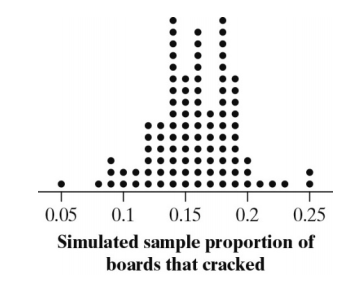
To determine if these data provide convincing evidence that less than 16% of the boards will crack when using the new method, 100 trials of a simulation were conducted. Each dot in the graph below shows the proportion of boards that cracked in a random sample of 50 boards, assuming that each board has a 16% chance of cracking
According to the simulations (conducted assuming 16% of boards crack), how many times did exactly 10% of the boards crack
How many times did 10% or fewer boards crack?
Use the simulation results to estimate the P-value of the test.
Round to the nearest hundredth.
Interpret the p-value.
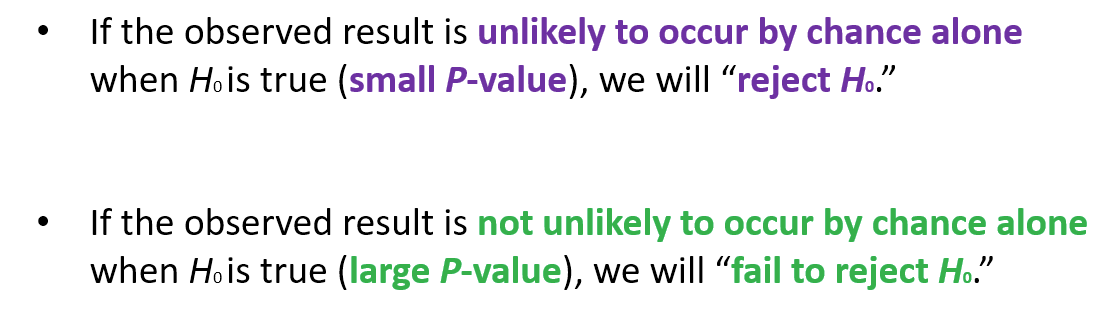
Based on the p-value above, what would you conclude at a significance level of 10%?
Based on the p-value above, what would you conclude at a significance level of 5%?
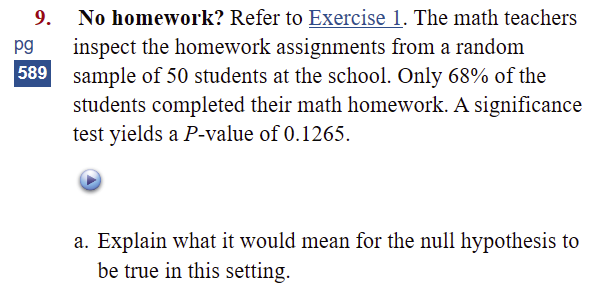
School records indicate that 75% of students complete their homework each night (across all subjects). Mr Tabor believes that less than 75% of students complete their math homework.
The math teachers inspect the homework assignments from a random sample of 50 students at the school.
What should the Null Hypothesis be?
What should the Alternative Hypothesis be?
Define p in the problem above
Is this a one-sided or two-sided test?
Based on the p-value, what should your conclusion be at the 10% significance level?
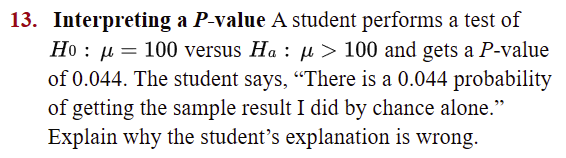
Interpret the p-value
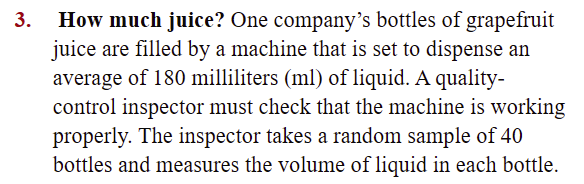
What should the Null Hypothesis be?
What should the Alternative Hypothesis be?
Is this a one-sided or two-sided test?
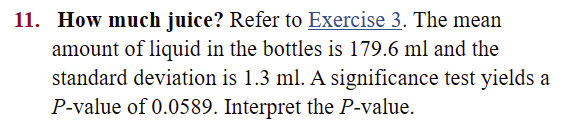
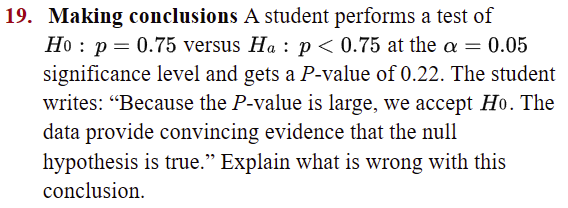
Based on the p-value, what should your conclusion be at the 10% significance level?
Interpret the p-value
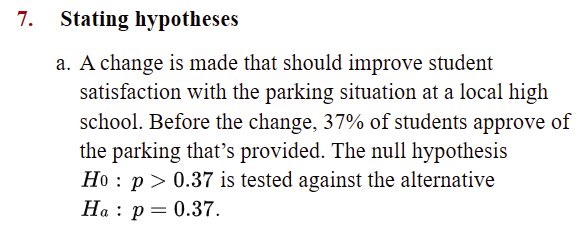
What is wrong with the stated hypotheses? What should it be?
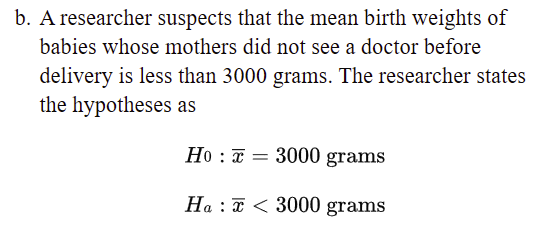
What is wrong with the stated hypotheses? What should it be?
Are there any problems above that you would like to go over in class? Indicate the question numbers below (Numbers refer to the Formative question number). I'll try to cover anything that is highly requested.