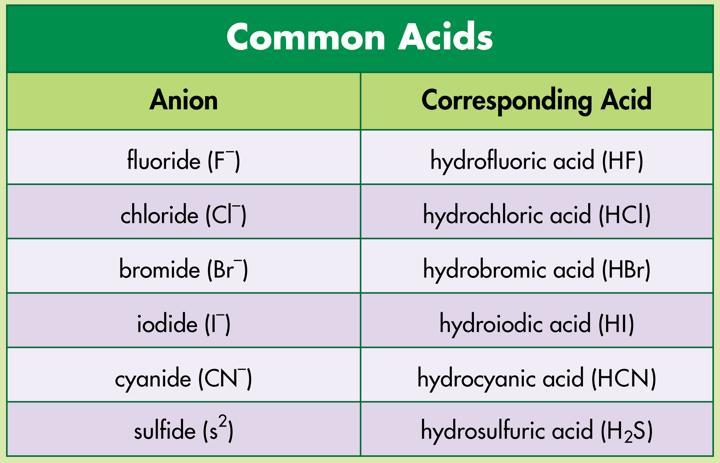
The common acids are all formed from a negative ion and a negative hydroxide ion.
The common acids are all formed from a negative ion and a negative hydroxide ion.
What do I already know about acids, bases, and salts?
What are ways in which you use acids, bases and salts in your everyday life?
Chemists rely on chemical equations that help them analyze the different
log(0.001) =
log 4 + log 3 = log
2 = log
Match each acid formula with its name.
| Draggable item | arrow_right_alt | Corresponding Item |
|---|---|---|
HClO4 | arrow_right_alt | hydrocloric acid |
HClO2 | arrow_right_alt | hypoclorous acid |
HCl | arrow_right_alt | chlorous acid |
HClO | arrow_right_alt | cloric acid |
HClO3 | arrow_right_alt | pechloric acid |
The original theory of acids and bases was proposed by Svante August Arrhenius around 1884. An Arrhenius is any substance that increases the number of hydrogen ions (H+) in an aqueous solution. An Arrhenius base is any substance that increases the number of in an aqueous solution.
What will hydrochloric acid form when added to water?
What will sodium hydroxide form when added to water?
Not all acids and bases produce hydrogen or hydroxide ions in solutions. The
For the Brønsted-Lowry definition of acids and bases, a donated proton is
Gilbert Lewis proposed a different mechanism for acid-base theory, also around 1923. The Lewis theory is based on the
The common acids are all formed from a negative ion and a negative hydroxide ion.
What is a precipitation reaction?
A precipitation reaction can sometimes occur when two are mixed together in an aqueous solution.
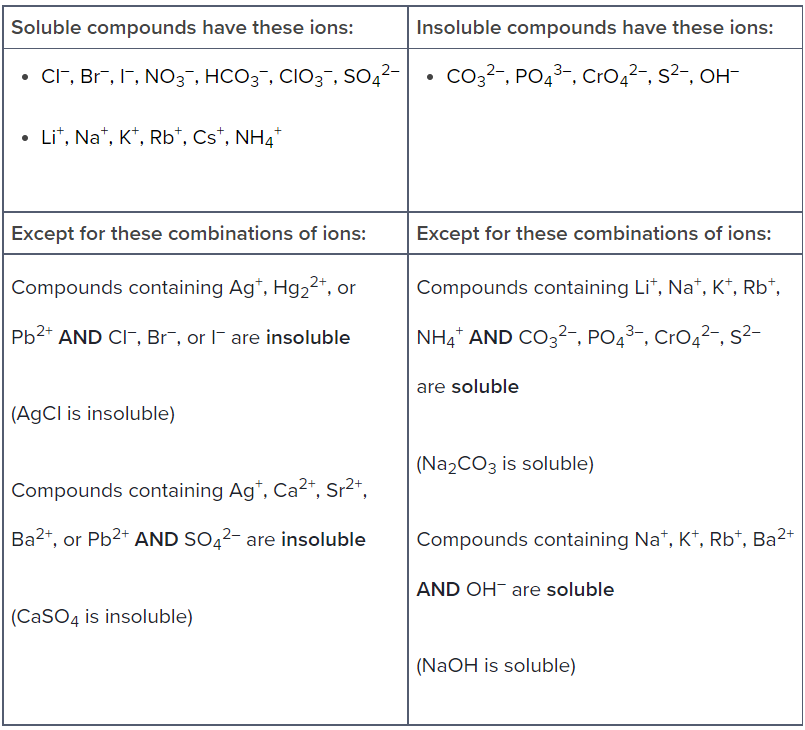
These are guidelines that help you to identify insoluble compounds known as
Use the solubility rules and the dropdown menus to indicate whether each compound is aqueous or solid.
Rb2S() + CuI2() -> 2RbI() + CuS()
This is the ionic equation for question 16.
2Rb+1(aq) + S-2(aq) + Cu+2(aq) + 2I-1(aq) -> 2Rb+1(aq) + 2I-1 (aq) + CuS(s)
Fill in the dropdown menus with the correct net ionic equation by removing the spectator ions.
+ =
According to the Arrhenius definition of acids and bases, the strength of an acid or base is defined as
All acids dissociate, but only some will ionize.
Strong acids and bases dissociate
Categorize the following statements.
Forms a conjugate acid
Ka
HA = H+ + A-
Kb
Forms a conjugate base
B = OH- + BH+
Acid Reactions
Base Reactions
Which of these compounds is an amphoteric substance?
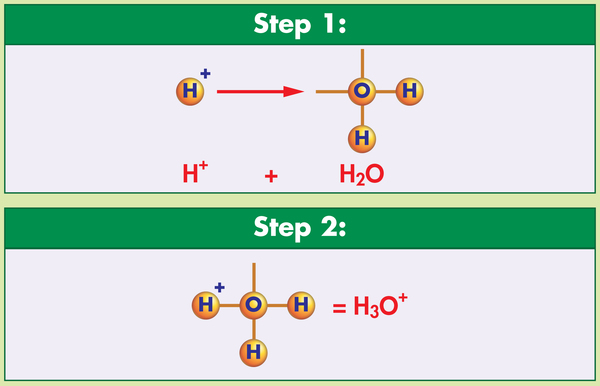
When a water molecule accepts a proton, hydronium is formed. Where does this extra proton come from?
Match the correct reaction type to the corresponding chemical equation.
| Draggable item | arrow_right_alt | Corresponding Item |
|---|---|---|
strong acid-weak base | arrow_right_alt | HCl (aq) + NaOH (aq) → NaCl (aq) + H2O (aq) |
strong acid-strong base | arrow_right_alt | HC2H3O2 (aq) + KOH (aq) → H2O (aq) + KC2H3O (aq) |
weak acid-weak base | arrow_right_alt | HCl (aq) + NH3 (aq) ⇄ NH4Cl (aq) |
weak acid-strong base | arrow_right_alt | NH3 (aq) +H2O (aq) ⇄ NH4+ (aq) + OH- (aq) |
Consider the following left-hand side of a chemical reaction:
HClO4 + KOH →
Select the correct right hand side from the list below.
Complete the following chemical reaction when ammonia acts as a base.
NH3 + H20 →
How can chemists maintain a constant concentration of the pH of a solution?
Acidic buffer solutions are made from a
Conversely, acid or alkali buffer solutions are made from a
*The text is incorrect for this part.
During neutralization, an acid and a base will react to form what?
What is the equation for Neutralization?
What volume, in milliliters, of a 0.997 M KOH solution is needed to neutralize 30.0 mL of 0.400 M HCL?
A student pipets 10.0 mL 0.0500 M H3PO4 into a flask. What volume of 0.0200 M Mg(OH)2 could be added that will completely neutralize the acid?
An unknown volume of 0.200 M acetic acid (HC2H3O2) was completely neutralized by 22.0 mL 0.140 M ammonia (NH3) in water. What was the original volume of the acetic acid before neutralization?
The term pH is a mathematical way of comparing the strength of acids and bases. A difference of one on the scale will mean a difference in strength of 10.
That means, an acid with a pH of 2 will be
pH will describe the quantity of
We can use the negative logarithm (pH = -log[molarity]) in order to find the pH of weak acids/bases.
Organize the following substances in decreasing order from highest pH to lowest pH.
Bleach with a pH of 12.6
1mM of KOH
5 g of distilled water
4 kg of HCl with a molarity of 1mM
What is the name of the compound that is insoluble in the reaction shown in the video.
What is an indicator used for in a titration reaction?