Log in
Sign up for FREE
arrow_back
Library
Unit 10 Review
By NICHOLAS GLAESER
star
star
star
star
star
Share
share
Last updated over 2 years ago
12 questions
Add this activity
1
3.6.A
1
3.6.A
1
3.6.E
1
3.6.B
3
3.6.A
3
3.6.A
2
3.6.A
2
3.6.B
3
3.6.B
1
3.6.B
1
3.6.B
1
3.6.A
Question 1
1.
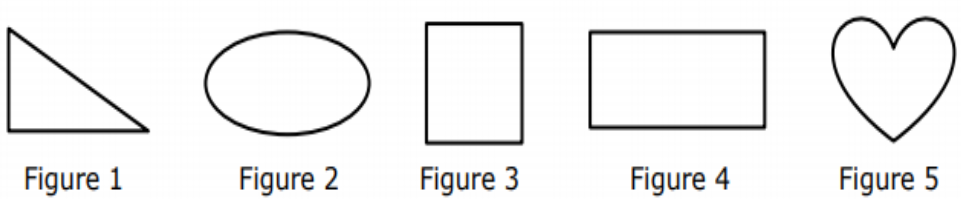
Chao found the following figures in a book.
What do these figures have in common?
Each figure has the same number of edges as it does vertices.
Each figure has the same number of vertices as it does faces.
These figures have no vertices, faces, or edges.
Each figure has the same number of faces as it does edges.
visibility
View drawing
Question 2
2.
The figures below are sorted into two groups.
Which statement about the two groups of figures is NOT true?
Each figure in Set A is a polygon.
Each figure in Set A has no vertices.
Each figure in Set B has four vertices.
Each figure in Set B has four straight edges.
visibility
View drawing
Question 3
3.
The two figures below represent fractions.
Which of the following statements about the figures is NOT true?
The figures are congruent, because they each represent 2/4 shaded.
The figures are congruent, because two of the four equal areas are shaded.
The figures are congruent, because they show different amounts shaded.
The figures are congruent, because two of the four equal areas are unshaded.
visibility
View drawing
Question 4
4.
Phoebe made up a riddle about a figure for her friend to solve.
- A shape has two congruent edges.
- The shape has exactly one set of parallel sides.
- The shape is a quadrilateral.
Which could be the shape that Phoebe is describing?
Question 5
5.
A puzzle has six pieces, as shown below.
How many
triangles
are in the puzzle? _______
How many
quadrilaterals
are in the puzzle? _______
How many
pentagons
are in the puzzle? _______
visibility
View drawing
Question 6
6.
A group of figures are shown below.
Select all the
polygons
.
Question 7
7.
A group of figures are shown below.
Select all the
quadrilaterals
.
Question 8
8.
A group of figures are shown below.
Select all the
parallelograms
.
Question 9
9.
A group of figures are shown below.
Select all the
quadrilaterals
.
Question 10
10.
Pari sorted figures into groups based on their attributes. Some of the figures belong in more than one of the groups.
Which statement about parallelograms is true based on the table?
A parallelogram would belong in groups 1, 2, and 4.
A parallelogram would NOT belong in any of the groups.
A parallelogram would belong in all of the groups.
A parallelogram would belong in groups 1, 3, and 4.
visibility
View drawing
Question 11
11.
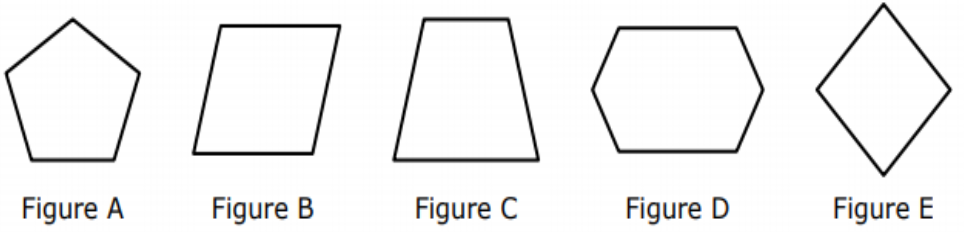
Atonia made a set of figures that only included rhombuses, parallelograms, trapezoids, rectangles, and squares.
Which could be the set that she made?
visibility
View drawing
Question 12
12.
Thomas sorted the figures shown into two groups.
What terms could Thomas use to describe his two groups?
Rectangles and hexagons
Quadrilaterals and pentagons
Quadrilaterals and rectangles
Pentagons and hexagons
visibility
View drawing