Log in
Sign up for FREE
arrow_back
Library
4.a Graphs of Polynomial Functions
By Tim Schwickerath
star
star
star
star
star
Share
share
Last updated over 3 years ago
33 questions
Add this activity
A 5th degree polynomial has a positive leading coefficient. Identify the following:
1
1
1
A linear polynomial has a negative leading coefficient. Identify the following:
1
1
1
A 4th degree polynomial has a negative leading coefficient. Identify the following:
1
1
1
A quadratic polynomial has a positive leading coefficient. Identify the following:
1
1
1
Given the equation: y = -2x
3
+ 3x + 1
Identify the following:
1
1
1
Given the equation: f(x) = 4x - 2 + 5x
7
Identify the following:
1
1
1
Given the equation: f(x) = 1 + 2x
6
+ x
2
- 2x
6
Identify the following:
1
1
1
zoom_in
1
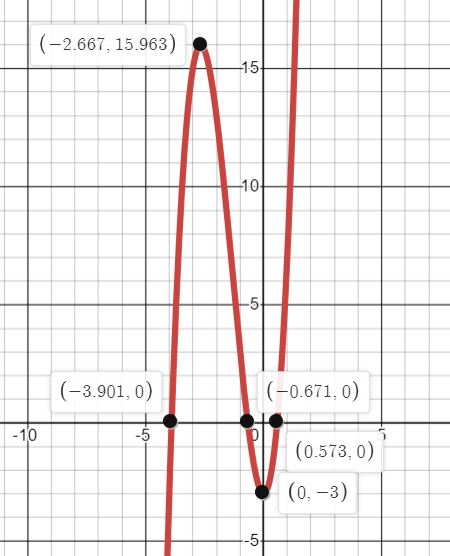
Question 22
22.
What are the interval(s) where the function is increasing?
Write your answers as
with no spaces and reading left to right.
1
1
1
zoom_in
1
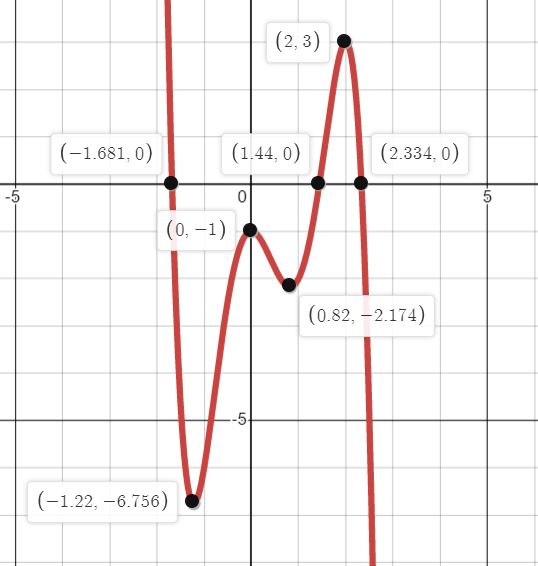
Question 26
26.
What are the interval(s) where the function is increasing?
Write your answers as
with no spaces and reading left to right.
1
1
1
zoom_in
1
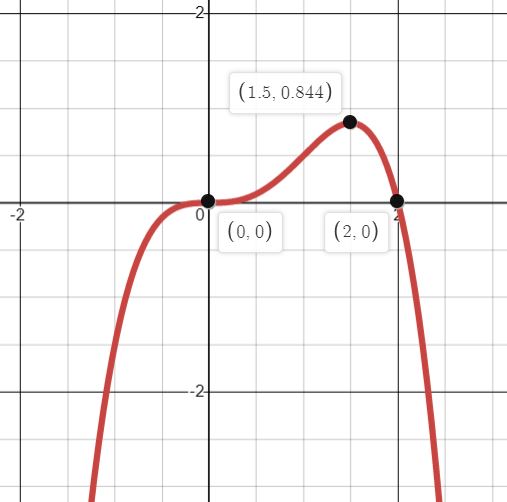
Question 30
30.
What are the interval(s) where the function is increasing?
Write your answers as
with no spaces and reading left to right.
1
1
1
Question 1
1.
Maximum number of relative maxima/minima.
Question 2
2.
Maximum number of x-intercepts.
Question 3
3.
Question 4
4.
Maximum number of relative maxima/minima.
Question 5
5.
Maximum number of x-intercepts.
Question 6
6.
Question 7
7.
Maximum number of relative maxima/minima.
Question 8
8.
Maximum number of x-intercepts.
Question 9
9.
Question 10
10.
Maximum number of relative maxima/minima.
Question 11
11.
Maximum number of x-intercepts.
Question 12
12.
Question 13
13.
Maximum number of relative maxima/minima.
Question 14
14.
Maximum number of x-intercepts.
Question 15
15.
Question 16
16.
Maximum number of relative maxima/minima.
Question 17
17.
Maximum number of x-intercepts.
Question 18
18.
Question 19
19.
Maximum number of relative maxima/minima.
Question 20
20.
Maximum number of x-intercepts.
Question 21
21.
Question 23
23.
What are the interval(s) where the function is decreasing?
Write your answers as
with no spaces and reading left to right.
Question 24
24.
Question 25
25.
What is the minimum degree of the polynomial?
Question 27
27.
What are the interval(s) where the function is decreasing?
Write your answers as
with no spaces and reading left to right.
Question 28
28.
Question 29
29.
What is the minimum degree of the polynomial?
Question 31
31.
What are the interval(s) where the function is decreasing?
Write your answers as
with no spaces and reading left to right.
Question 32
32.
Question 33
33.
What is the minimum degree of the polynomial?
End behavior of the polynomial.
As x → -∞, f(x) → ∞
As x → -∞, f(x) → -∞
As x → ∞, f(x) → ∞
As x → ∞, f(x) → -∞
End behavior of the polynomial.
As x → -∞, f(x) → ∞
As x → -∞, f(x) → -∞
As x → ∞, f(x) → ∞
As x → ∞, f(x) → -∞
End behavior of the polynomial.
As x → -∞, f(x) → ∞
As x → -∞, f(x) → -∞
As x → ∞, f(x) → ∞
As x → ∞, f(x) → -∞
End behavior of the polynomial.
As x → -∞, f(x) → ∞
As x → -∞, f(x) → -∞
As x → ∞, f(x) → ∞
As x → ∞, f(x) → -∞
End behavior of the polynomial.
As x → -∞, f(x) → ∞
As x → -∞, f(x) → -∞
As x → ∞, f(x) → ∞
As x → ∞, f(x) → -∞
End behavior of the polynomial.
As x → -∞, f(x) → ∞
As x → -∞, f(x) → -∞
As x → ∞, f(x) → ∞
As x → ∞, f(x) → -∞
End behavior of the polynomial.
As x → -∞, f(x) → ∞
As x → -∞, f(x) → -∞
As x → ∞, f(x) → ∞
As x → ∞, f(x) → -∞
End behavior of the polynomial.
As x → -∞, f(x) → ∞
As x → -∞, f(x) → -∞
As x → ∞, f(x) → ∞
As x → ∞, f(x) → -∞
End behavior of the polynomial.
As x → -∞, f(x) → ∞
As x → -∞, f(x) → -∞
As x → ∞, f(x) → ∞
As x → ∞, f(x) → -∞
End behavior of the polynomial.
As x → -∞, f(x) → ∞
As x → -∞, f(x) → -∞
As x → ∞, f(x) → ∞
As x → ∞, f(x) → -∞