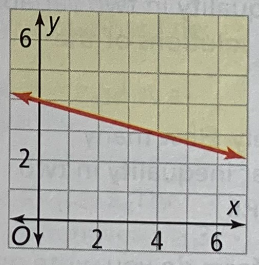
What is the y-intercept of the graph?
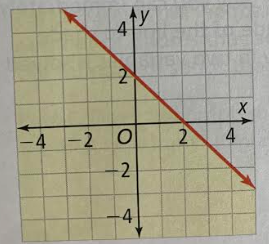
What is the y-intercept of the graph?
Answer the following questions
Is the ordered pair (0,1) a solution to the inequality y > x + 1 ?
(Hint: Sub in for x and y and see if it yields a true statement or not)
Is the ordered pair (3,5) a solution to the inequality y > x + 1 ?
(Hint: Sub in for x and y and see if it yields a true statement or not)
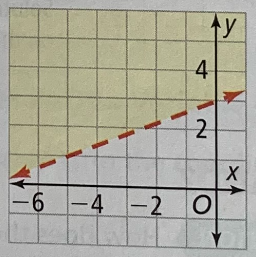
What is the y-intercept of the graph?
What is the slope shown by the graph?
What symbol should be used to write the inequality of the graph?
What is the inequality shown by the graph?
What is the y-intercept of the inequality
What is the slope of the inequality
What type of line should be used to graph the inequality ?
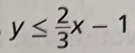
Graph the linear inequality
To Graph: Label axes, add numbers to each axis to show scale, add arrows to lines, line is dashed or solid, and shade.
What is the y-intercept of the linear inequality
(Hint: Remember y = mx+b )
What is the slope of the linear inequality
(Remember y = mx+b )
Graph the linear inequality
(Hint: Remember y = mx+b and if no 'b' then b=0 )
To Graph: Label axes, add numbers to each axis to show scale, add arrows to lines, line is dashed or solid, and shade.
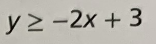
Graph the linear inequality
To Graph: Label axes, add numbers to each axis to show scale, add arrows to lines, line is dashed or solid, and shade.
Graph the linear inequality
To Graph: Label axes, add numbers to each axis to show scale, add arrows to lines, line is dashed or solid, and shade.
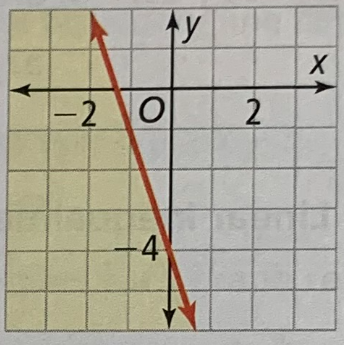
What is the y-intercept shown by the graph?
What is the slope shown by the graph?
Since the line in the graph is solid and that the shading is below, what symbol should be used in the inequality ?
What is the inequality shown by the graph?
What is the inequality shown by the graph?
What is the inequality shown by the graph?
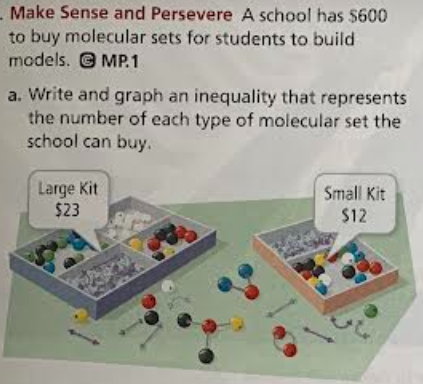
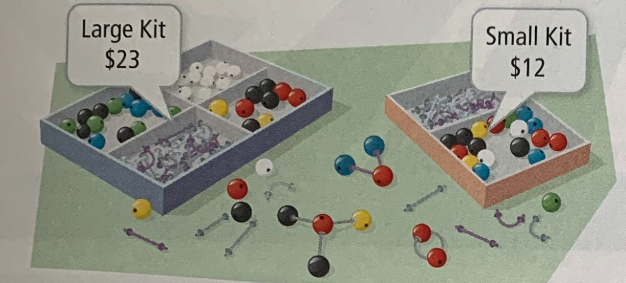
A school is spending exactly $600 when purchasing large kits and small kits. This is described as: $600 = cost of large kits + cost of small kits.
If the school could spend up to and including $600 but no more than $600, what symbol should replace the equal sign in the equation above?
(hint: it may help to plug in amounts for the kits to figure out the answer)
Let x represent the Large Kits and y represent the Small Kits.
Choose the inequality that represents the situation.
Suppose the school decides to buy 20 of the large kits, How many of the small kits can the school now afford?. The school still can spend no more than $600. Let x represent the Large Kits and y represent the Small Kits.
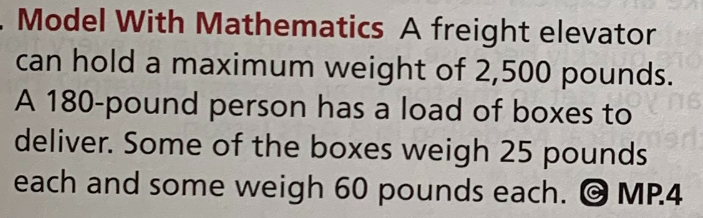
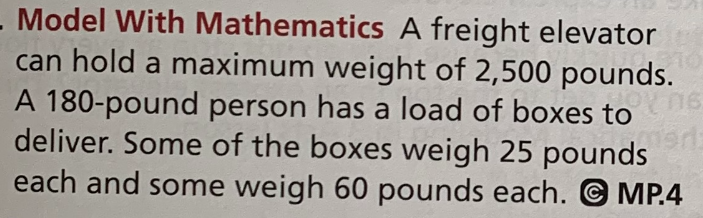
See the word problem below.
If the person and the boxes in elevator weighed exactly 2500 lbs, the following equation would represent the situation:
2500 = weight in elevator
Since the elevator can hold a maximum of 2500 lbs, what symbol should replace the equal sign in the equation above?
Which inequality represents the number of boxes that the elevator can hold in one trip if the person is not on the elevator. Let x represent the number of 25 lb boxes and let y represent the number of 60 pound boxes.
To graph the inequality in question 26, you would first have to
Which inequality represents the number of boxes that the elevator can hold in one trip if the person is on the elevator. Let x represent the number of 25 lb boxes and let y represent the number of 60 pound boxes.