Week 2 Unit 2 Lesson 1 (SQA Mental Health)
star
star
star
star
star
Last updated almost 3 years ago
12 questions

Required
1
What is the definition of 'coping strategies'?
25
List as many emotions that you can think of.
7
| Draggable item | arrow_right_alt | Corresponding Item |
|---|---|---|
Diversions | arrow_right_alt | Watching funny films on YouTube, having a bath, reading a book, playing computer games, engaging in social media, listening to music, etc. |
Physical | arrow_right_alt | Talking to a friend, playing with a pet, helping a friend in need, etc. |
Social and interpersonal | arrow_right_alt | Making a pros and cons list, inspirational quotes, brainstorming solutions, etc. |
Cognitive coping | arrow_right_alt | Punching a punch bag, crying, humour, exercise, etc. |
Spiritual | arrow_right_alt | Healthy routines, healthy food, getting enough sleep, deep breathing exercises etc. |
Tension releasers | arrow_right_alt | Praying, meditating, getting involved in a worthy cause etc. |
Limit setting | arrow_right_alt | Prioritising important tasks, being assertive, building confidence around responsibility, ‘me time’ etc. |
1
During adolescence statistically, who is more likely to experience depression, eating disorders and engage more in suicidal ideation and suicide attempts than boys?
1
Who is more likely to experience problems with anger, engage in high-risk behaviours (such as criminal behaviour or drugs and alcohol) and commit suicide more frequently?

4
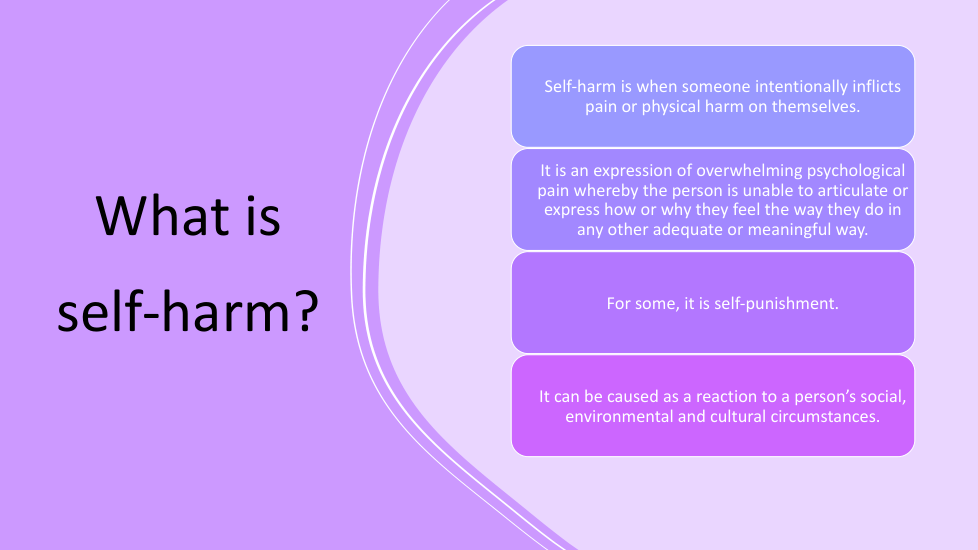
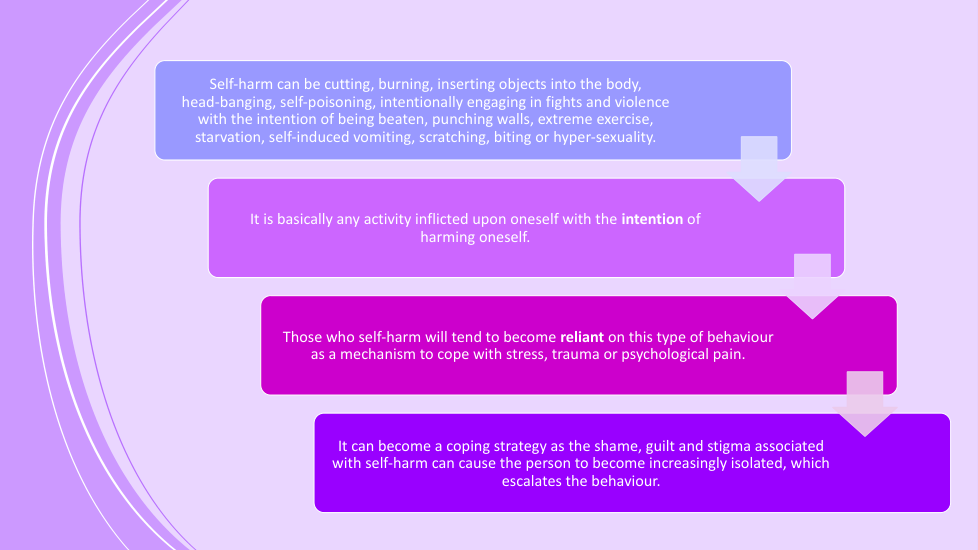
What is self-harm?
What is self-harm?

13
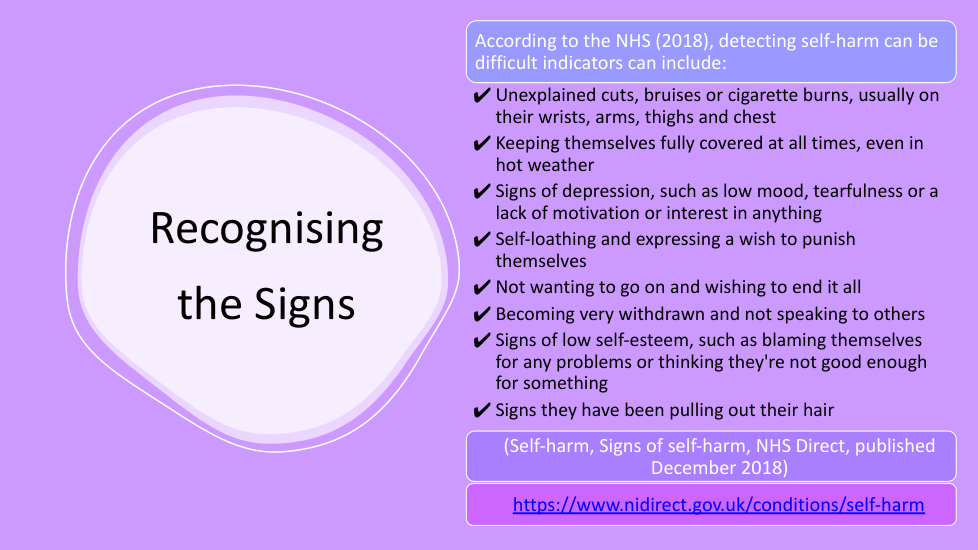
Identify four examples of self-harm.

1
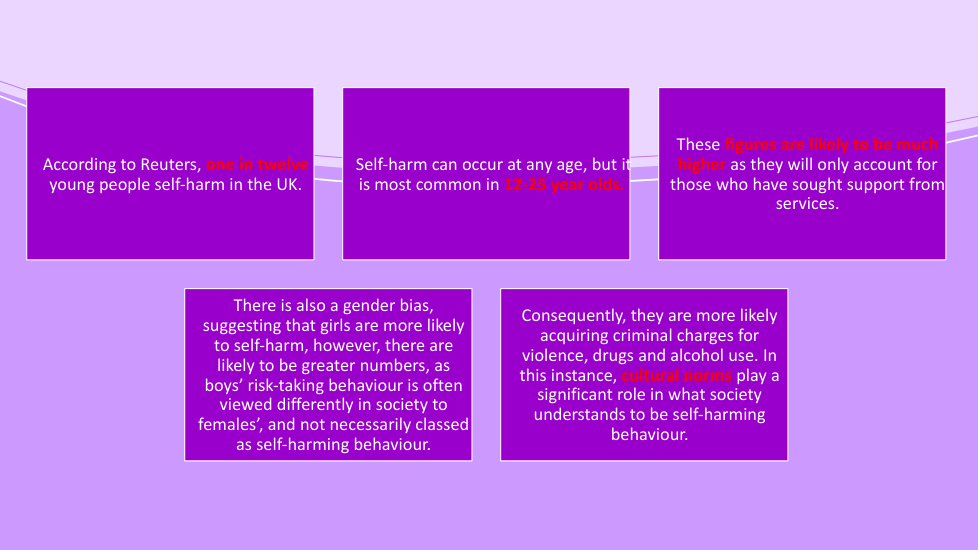
According to Reuters, how many young people self harm int he UK?
1
When is self-harm most common?
1
Why are figures likely to be much higher than those shown?

6
| Draggable item | arrow_right_alt | Corresponding Item |
|---|---|---|
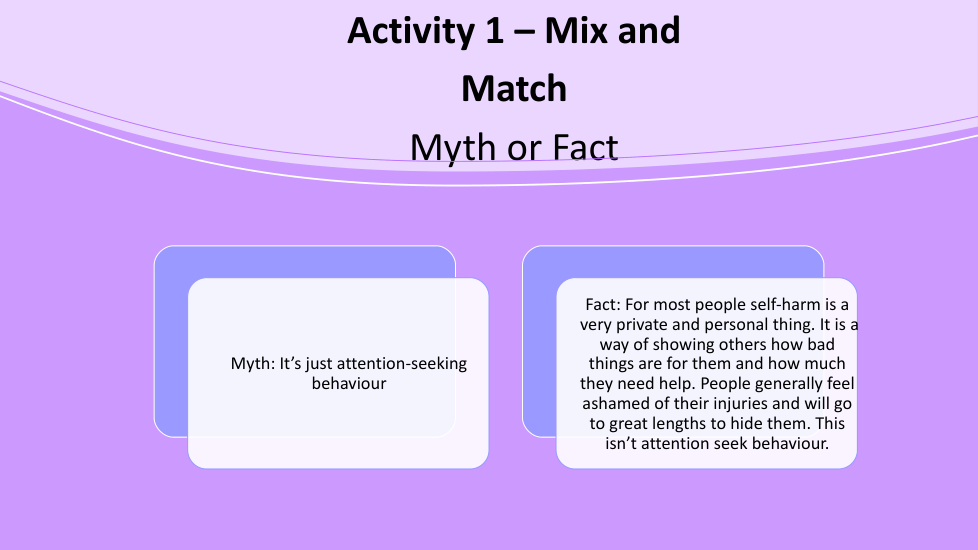
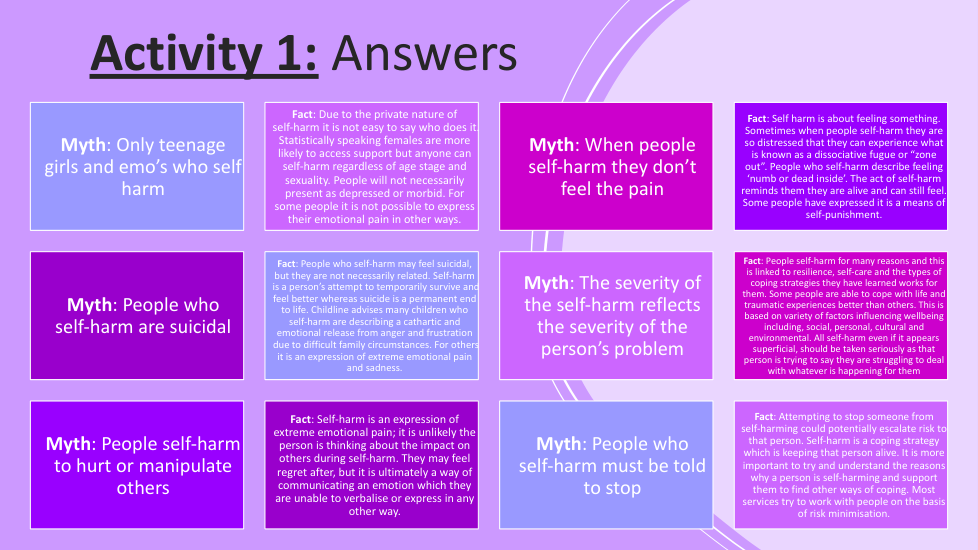
Myth: The severity of the self-harm reflects the severity of the person’s problem | arrow_right_alt | Fact: Due to the private nature of self-harm it is not easy to say who does it. Statistically speaking females are more likely to access support but anyone can self-harm regardless of age stage and sexuality. People will not necessarily present as depressed or morbid. For some people it is not possible to express their emotional pain in other ways. |
Myth: People self-harm to hurt or manipulate others | arrow_right_alt | Fact: People who self-harm may feel suicidal, but they are not necessarily related. Self-harm is a person’s attempt to temporarily survive and feel better whereas suicide is a permanent end to life. Childline advises many children who self-harm are describing a cathartic and emotional release from anger and frustration due to difficult family circumstances. For others it is an expression of extreme emotional pain and sadness. |
Myth: Only teenage girls and emo’s who self harm | arrow_right_alt | Fact: Self-harm is an expression of extreme emotional pain; it is unlikely the person is thinking about the impact on others during self-harm. They may feel regret after, but it is ultimately a way of communicating an emotion which they are unable to verbalise or express in any other way. |
Myth: People who self-harm are suicidal | arrow_right_alt | Fact: Self harm is about feeling something. Sometimes when people self-harm they are so distressed that they can experience what is known as a dissociative fugue or “zone out”. People who self-harm describe feeling ‘numb or dead inside’. The act of self-harm reminds them they are alive and can still feel. Some people have expressed it is a means of self-punishment. |
Myth: When people self-harm they don’t feel the pain | arrow_right_alt | Fact: People self-harm for many reasons and this is linked to resilience, self-care and the types of coping strategies they have learned works for them. Some people are able to cope with life and traumatic experiences better than others. This is based on variety of factors influencing wellbeing including, social, personal, cultural and environmental. All self-harm even if it appears superficial, should be taken seriously as that person is trying to say they are struggling to deal with whatever is happening for them |
Myth: People who self-harm must be told to stop | arrow_right_alt | Fact: Attempting to stop someone from self-harming could potentially escalate risk to that person. Self-harm is a coping strategy which is keeping that person alive. It is more important to try and understand the reasons why a person is self-harming and support them to find other ways of coping. Most services try to work with people on the basis of risk minimisation. |

1
Is self care a helpful or unhelpful coping strategy?