You can feel the prick of a pin because specialized nerve cells in the skin rely information to your __________.
1 point
1
Question 2
2.
Auditory receptors detect light.
1 point
1
Question 3
3.
What is detected by chemoreceptors?
1 point
1
Question 4
4.
All parts of the sensory system use __________.
1 point
1
Question 5
5.
Of the following, which is NOT a sense organ?
3 points
3
Question 6
6.
Choose the correct order of events for the picture below.
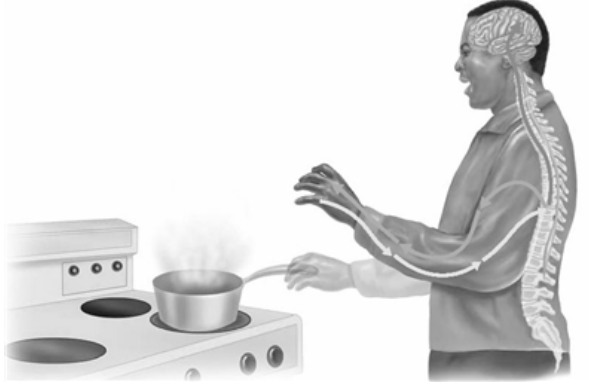
Receptors in your hand detect the heat and send signals to the spinal cord
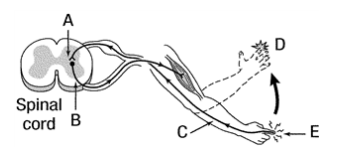
You feel pain.
A memory is created to prevent you from touching a hot pot again.
Nerve signals travel from your spinal cord to your arm muscles and you pull your hand away.
Nerve signals travel from the spinal cord to the brain.
1 point
1
Question 7
7.
Where in your body do you find nerve cells? Choose the best answer.
1 point
1
Question 8
8.
If an area of your body is particularly sensitive, what can you conclude about that area?
1 point
1
Question 9
9.
Place the following events in sequence:
Your eardrum begins vibrating
The hammer, anvil, and stirrup begin moving
Electrical impulses travel along nerve fibers
4 points
4
Question 10
10.
Draggable item
arrow_right_alt
Corresponding Item
retina
arrow_right_alt
in the retina, receives images that have passed through the lens of the eye
iris
arrow_right_alt
colored part of the eye
cornea
arrow_right_alt
the clear tissue that covers the front of the eye
pupil
arrow_right_alt
the adjustable opening in the center of the eye through which light enters
rods and cones
arrow_right_alt
the transparent structure behind the pupil that changes shape to help focus images on the retina
lens
arrow_right_alt
the light-sensitive inner surface of the eye, containing the receptor rods and cones plus layers of neurons that begin the processing of visual information
1 point
1
Question 11
11.
A finger picking up a message is identified by__________.
1 point
1
Question 12
12.
The movement of fluid in the ear helps to signal the brain to help it control balance.
1 point
1
Question 13
13.
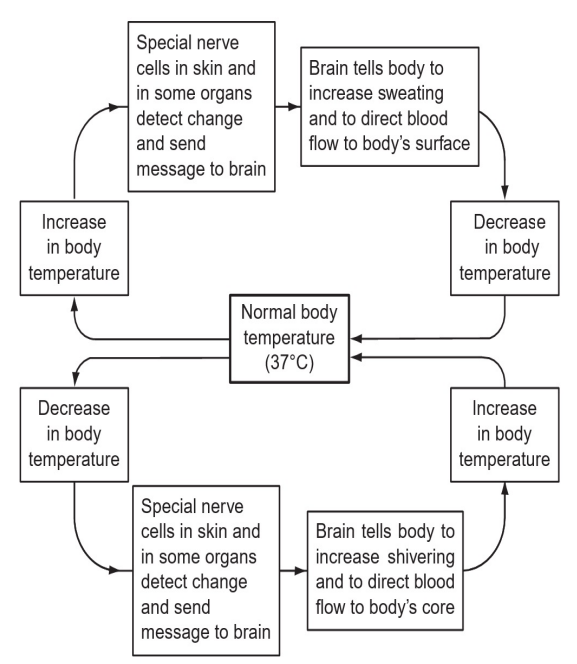
Humans are warm-blooded organisms that maintain a constant body temperature of around 37°C (98.6°F). The diagram shows the changes that take place to keep the human body temperature constant.
Brian claims that only the muscular system is involved when body temperature drops. He says that shivering occurs when the body’s muscles contract rapidly, producing heat, and that this muscle action keeps the body warm.
Using complete sentences, identify two pieces of evidence from the diagram that either support or refute Brian’s claim.