D) Imagine, the north pole of the magnet is the positive side. PREDICT, how would the negative electrons in the metal react to the electric force of the positive pole of the magnet?
A) . Imagine you can see the electrons in the wire (below on left). Draw the electrons in the wire “after” the magnet (north pole) comes near the wire.
Part 2: Magnet Review
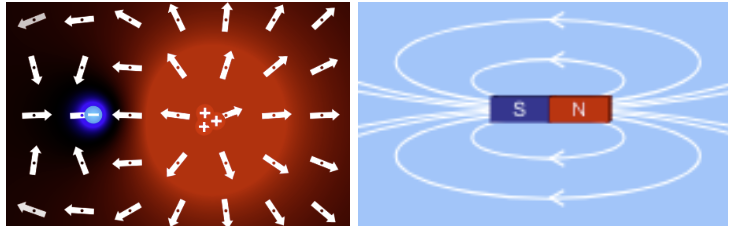
Notice: Magnets have North and South poles. These poles create a magnetic field that is similar to electric fields. In fact, this is why you will hear the term electromagnetic field.
A magnetic field (β), changes with distance from an object, just like an electric field.
Notice too: Only when metal is looped, like in the simulation, can it produce a voltage (also known as an electromotive force). That voltage, which produces current (seen by the lightbulb). However, the looped wire needs a moving magnetic field (β) to do this. The change in the field’s strength causes the wire to induce voltage.
1 point
1
1 point
1
Question 4
4.
III. Explain
A) How do you increase the magnetic field strength?
B) How do you induce voltage without a battery? (How did you get the light bulb to work?) ____________________________________________________________________________________________________________________________________________________________________________________________________________________________________________________
1 point
1
Question 5
5.
IV.-V. Extend w/ Engineering Design
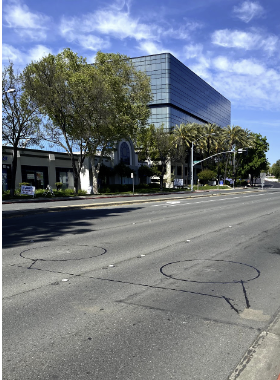
A) Some traffic lights use “induction loops” to detect cars. (search on your browser to see more). Using your knowledge of Faraday’s Law, explain how an induction loop detects cars to relay a signal to change the light.
C) On the freeway, there are also induction loops to detect cars’ speed. Use your observations from A and B to explain how an induction loop may detect a car’s speed.