6.3 INSURANCE & PROBABILITY (Due 3/8/23)

Last updated 12 months ago
32 questions
IN THIS LESSON, YOU WILL:
  • Distinguish between theoretical and experimental probability
  • Explain how the number of trials impacts the accuracy of a prediction
  • Apply the addition rule
  • Use the theoretical probability of an event to calculate its expected value
  • Evaluate and compare strategies using expected values
  • Use expected value to calculate the value of an insurance policy
  • Analyze age as a factor that impacts auto insurance premiums

VIDEO: Probability Part 1: Rules and Patterns

You likely hear about probability in everyday life - maybe looking at a weather prediction, hearing about the risks of texting while driving, or studying the stats on your favorite athlete. But what is probability? Watch the video through 3:34 to learn some basic probability terms, notation, and rules. Then, answer the questions.


Required
20

After watching the video, complete the missing cells in the table below with either an explanation or example for each vocabulary word.

Required
3

You flip a fair coin 4 times and get tails once. Which answer correctly identify both the empirical probability and theoretical probability of getting tails on a single coin flip?

Practice: Intro to Probability

Required
15
Imagine your teacher has a grab bag with an equal number of pens, pencils, highlighters, and markers. You get to choose one at random.

What is P(highlighter)?
_______

What is P(marker)?
_______

What is P(highlighter or marker)?
_______
Required
15
You have a bowl of gummy bears: 5 are blue, 15 are red, 15 are green, and 15 are yellow.

How many total gummy bears are there?
_______

What is the probability of getting a blue gummy bear?
_______

What is the probability that you do NOT get a blue gummy bear? This is called the complement and can be represented with the symbol ‘.
P(blue’) = _______
Required
10
Imagine you roll a fair 6-sided die.

What is the probability of rolling a 1 or a 5?
_______

What is the probability of rolling a number that is NOT a 1 or a 5? This is called the complement and can be represented with the symbol ‘.
P((1 or 5)’)=
_______
Required
10
Imagine you roll a fair 10-sided die 5 times. Here are your results: 2, 8, 9, 10, 5.

What is the theoretical probability of rolling a number less than or equal to 3?
P(less than or equal to 3)_______

What is the experimental probability (also called empirical probability) of rolling a number less than or equal to 3?(roll a 10-sided die 10 times and record the experimental probability.)
_______

If you rolled the die 100 more times, what would you expect to happen to the experimental probability?_______

VIDEO: Probability Part 2: Rules and Patterns

Now that you’ve practiced the addition rule, let’s look at a slightly trickier example: what happens when the events are NOT mutually exclusive? Resume the video and answer the questions.


Required
6

Which of the following events are mutually exclusive?

Required
10

Consider the example from the video where you flip a coin and roll a 6-sided die. Which equation correctly represents the probability of getting a tails or rolling a 6?

Required
10
The image below shows the sample space for flipping a coin and rolling a 6-sided die. Answer the questions to find the probability of getting tails or an even number.

a. Put a rectangle around all the possible outcomes where you get tails.

b. Using a different color or shape, put a rectangle around all the possible outcomes where you get an even number.

Define the following probabilities:
P(tails) =_______

P(even number) =_______

P(tails AND even number) =_______

What is the probability of getting tails OR an even number?
P(tails OR even number)_______

Practice: Addition Rule

Required
10
There are 120 9th graders at Mountain Day High School. They all get to choose one of three possible electives: choir, computer science, or student council. 72 students choose choir, 27 choose computer science, and 21 choose student council. If you chose one student randomly…

What is P(computer science)?_______

What is P(choir)?_______

What is P(computer science or choir)?_______
Required
10

Assume that A and B or not mutually exclusive:
If P(A) = 0.43, P(B) = 0.09, and P(A and B) = .0387, what is P(A or B)?

Required
10

In a group of 48 students, 30 play video games and 36 have a pet. 27 students both play video games and have a pet. If you randomly choose one student, what is the probability that they play video games or have a pet?

Required
10

Imagine you are picking one card from a standard deck of playing cards, like the one shown below. What is the probability that you pick either a King or a Club? Note: A standard deck of playing cards has 52 total cards. It is split into four different groups of cards, called “suits”: clubs, spades, hearts, and diamonds. Each suit has 13 cards, including the numbers 1-10, one Jack, one Queen, and one King.

Day 2 3/8/23

LEARN IT: Expected Value

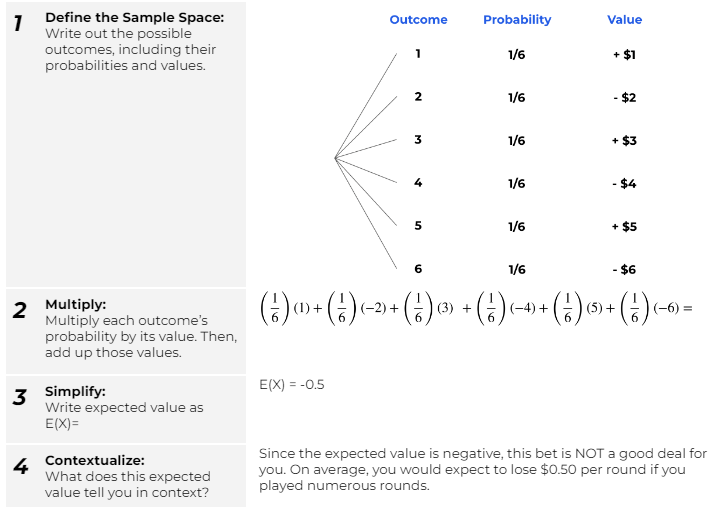
You've been learning about events with uncertain outcomes. Expected value is one tool we can use to make sense of probability and to make decisions when the outcome is uncertain. Expected value is a way to think about all the possible future events using a single number. It includes both the likelihood of each outcome and the value.
Your friend proposes a bet: he’ll roll a fair six-sided die. If it’s an odd number, he’ll give you that many dollars. If it’s an even number, you have to pay him that number of dollars. Should you accept?


Required
20

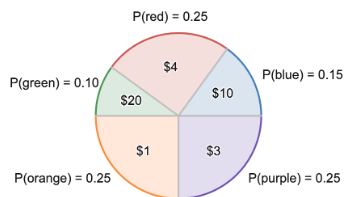
Here is the prize wheel. Calculate the expected value of spinning the wheel once.


APPLICATION:

Expected Value and Insurance

Phone Insurance

Because expected value tells you more about the risks and costs you face, it can be helpful when evaluating different insurance options. Read about Hira’s situation below and answer the following questions.


Hira is buying a new phone for $700 and wants to know whether it's worth paying for the additional insurance plan from the phone company. She has the option to add an insurance plan that costs $180 for one year and covers 100% of the cost of repairs.

Hira faces the following risks of damaging her phone over the next year:
  • P(no damage) = 0.30, costing $0
  • P(screen damage only) = 0.35, costing $100
  • P(minor damage) = 0.30, costing $200
  • P(major damage) = 0.05, costing $500
Note: for simplicity, assume these outcomes are mutually exclusive: only one of them will happen.
Required
5

What is the probability that Hira has to pay for some kind of phone repair over the next year (either for screen damage, minor damage, or major damage)?

P(screen damage or minor damage or major damage)=?

Required
40

Calculate the expected value for the outcomes above. This tells how much Hira should expect to pay in repairs over the next year.

E(repairs for the year)=


Required
10

How does the expected cost of repairs compare to the cost of the insurance plan?

Required
10

Hira decides NOT to buy the insurance plan. Instead, she saves $15 per month to put towards phone repairs in case something happens. Do you think that was a good decision? Why or why not?

Age, Car Accidents, and Insurance

Age is one of the biggest factors that impacts your car insurance premium. Let’s dive into some data to see how your driving risks and insurance costs change over time.
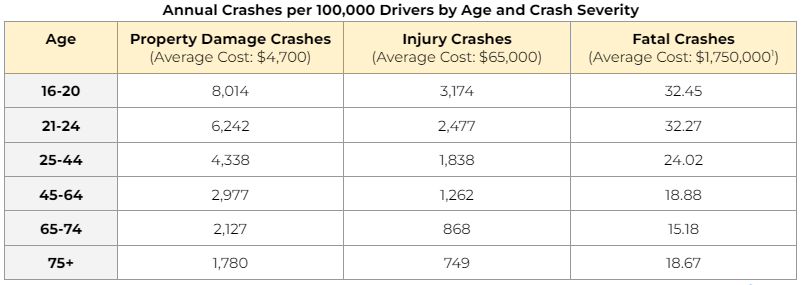
The table below shows the annual number of crashes that happen in each age group per 100,000 drivers. It includes three different types of crashes and their average costs: crashes that cause property damages, injuries, or fatalities. Use the table to answer the following questions.


Required
25
For a driver who is between 16 and 20 years old, what is the probability that they have….
(Round answers to 3 decimal places or two significant digits)
P(A property damage crash)=_______

P(An injury crash)=_______

P(A fatal crash)=_______

P(property damage, injury, or fatal crash)=_______

P(no crashes)=_______


Required
40

What is the expected cost of crashes for a driver between 16 and 20 years old?

E(expected cost of crashes for a driver between 16 and 20 years old)=


Required
40

What is the expected cost of crashes for a driver between 45 and 64 years old?

E(cost of crashes for a driver between 45 and 64 years old)=

Required
10

Hypothesize: If a law were passed saying that car insurance companies were not allowed to charge different premiums based on age, who do you think would end up paying MORE? Who do you think would end up paying LESS?

Required
10
Imagine an insurance company is insuring 5,000 drivers between 16 and 20 years old and will pay 100% of any car accident costs.


What is the minimum monthly premium they could charge each driver and expect to break even (not lose any money)?
_______

If they charged each of the 5,000 drivers a $275 monthly premium, what would their expected profits or losses for the year be?
_______

Is the insurance company guaranteed to make exactly that much money? Why or why not?
_______

Day 3 3/9/23

Expected Value

Required
40

Your school is holding a fundraising raffle. They are giving away one prize worth $100 and four prizes worth $25. You buy one ticket for $2 and calculate that you have a 0.00125 chance of winning $100 and a 0.005 chance of winning $25. What is the expected value of your ticket?

E(value of a winning ticket)=


Required
10

What does your answer from question 24 mean?

Is the Lottery Worth It?

Millions of Americans play the lottery every year. Apply your knowledge of probability and expected value to figure out exactly how much a lottery ticket is worth.

Part 1: Your Odds of Winning

What are your chances of winning the Powerball jackpot? Read the rules and answer the questions below.
The Rules of Powerball:
  • Players select five numbers from 1 to 69 and one Powerball number from 1 to 26
  • To win $1 million: match the five numbers in any order
  • To win the jackpot: match the five numbers in any order AND match the Powerball number
  • There are 11,238,513 different combinations of picking sets of 5 numbers
Required
5

What is the probability of choosing the 5 winning numbers to win $1 million?


Required
5

What is the probability of winning the jackpot?


Required
5

What is the probability of winning $1 million OR winning the jackpot?


10

Assume the jackpot is currently $350 million and a Powerball ticket costs $2. What is the expected value of a single Powerball ticket?

Required
10

What is the most you would be willing to pay for a Powerball ticket? Why?

Required
10

The jackpot value changes each week. How much would the jackpot need to be for a $2 ticket to have a positive expected value?

Required
10

Your friend Ethan says, “I know your odds of winning the lottery are pretty low. But what if you were really rich? Then, you could buy thousands - or even millions! - of tickets and be pretty much guaranteed to win big.” How would you respond?