Unit 5: Convection, Conduction and Radiation (LT 1, 2, 3)
star
star
star
star
star
Last updated about 3 years ago
10 questions
Required
1
Required
1
Required
1
Required
1
Required
1
Required
1
Required
1
Required
1
Required
1
Required
1
Use your knowledge of convection, conduction and radiation to complete each question. Make sure you read each question and the instructions carefully. Lastly, each question has an audio play button that plays a recording of the text read aloud for you. Use your headphones if you plan on using this feature. Your exam score will be released once submitted. Good Luck!
Question 1
1.
Question 2
2.
Question 3
3.
Question 4
4.
Question 5
5.
Question 6
6.
Question 7
7.
Question 8
8.
Question 9
9.
Question 10
10.
(LT 3) Which best explains how the Earth’s atmosphere is warmed?
Radiation from the sun warms the surface and the atmosphere is heated through conduction and convection.
Radiation from the sun warms the surface and the atmosphere is heated through evaporation and convection.
Convection from the sun warms the surface and the atmosphere is heated through conduction and radiation.
Convection from the sun warms the surface and the atmosphere is heated through evaporation and conduction.
(LT 3) What two processes of heat transfer would cause the water in a pot on the stove to boil?
radiation and convection
conduction and radiation
radiation and evaporation
conduction and convection
(LT 3) What is the transfer of heat by the circular movement of molecules?
Convection
Conduction
Radiation
Condensation
(LT 1) What is the main source of energy that drives all weather patterns?
Sun
Moon
Oceans
Mountains
(LT 3) A student must choose three items to demonstrate conduction, convection, and radiation from solar energy. The student quickly chooses water and a metal bowl. Which of the following items should the student choose to complete the experiment?
Rubber ball
food coloring
heat lamp
ice cube
(LT 3) In convection, warm water or air ___________, because it is _____________ dense
rises, less
sinks, less
sinks, more
rises, more
(LT 2) Why is the equator the warmest?
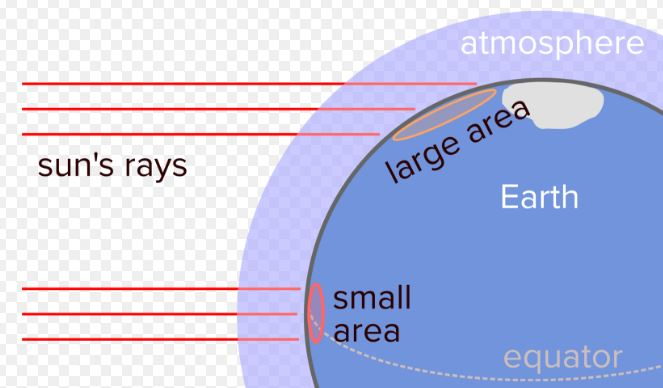
Because it is closest to the sun.
Because no clouds form here.
Because it recieves the most direct sunlight.
Because it is far from the sun.
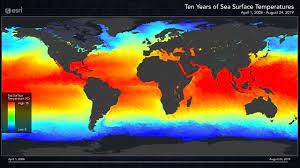
(LT 2) The patterns in the sea surface temperatures below are due to the fact that
the earth is wider at the equator, so this area spins faster than the poles.
the equator receives more of the Sun's radiation than other parts of the Earth.
the salt content is greater at the poles than at the equator.
the warm, less dense water near the equator sinks, while the colder water rises.
(LT 3) Heat flow (convection current) in the ocean and the atmosphere is...
cool flows down - warm flows up
cool flows up - warm flows down
cool flows up - warm flows up
cool flows down - warm flows down
(LT 2) Winds in our atmosphere are created as a result of which of the following processes?