Log in
Sign up for FREE
arrow_back
Library

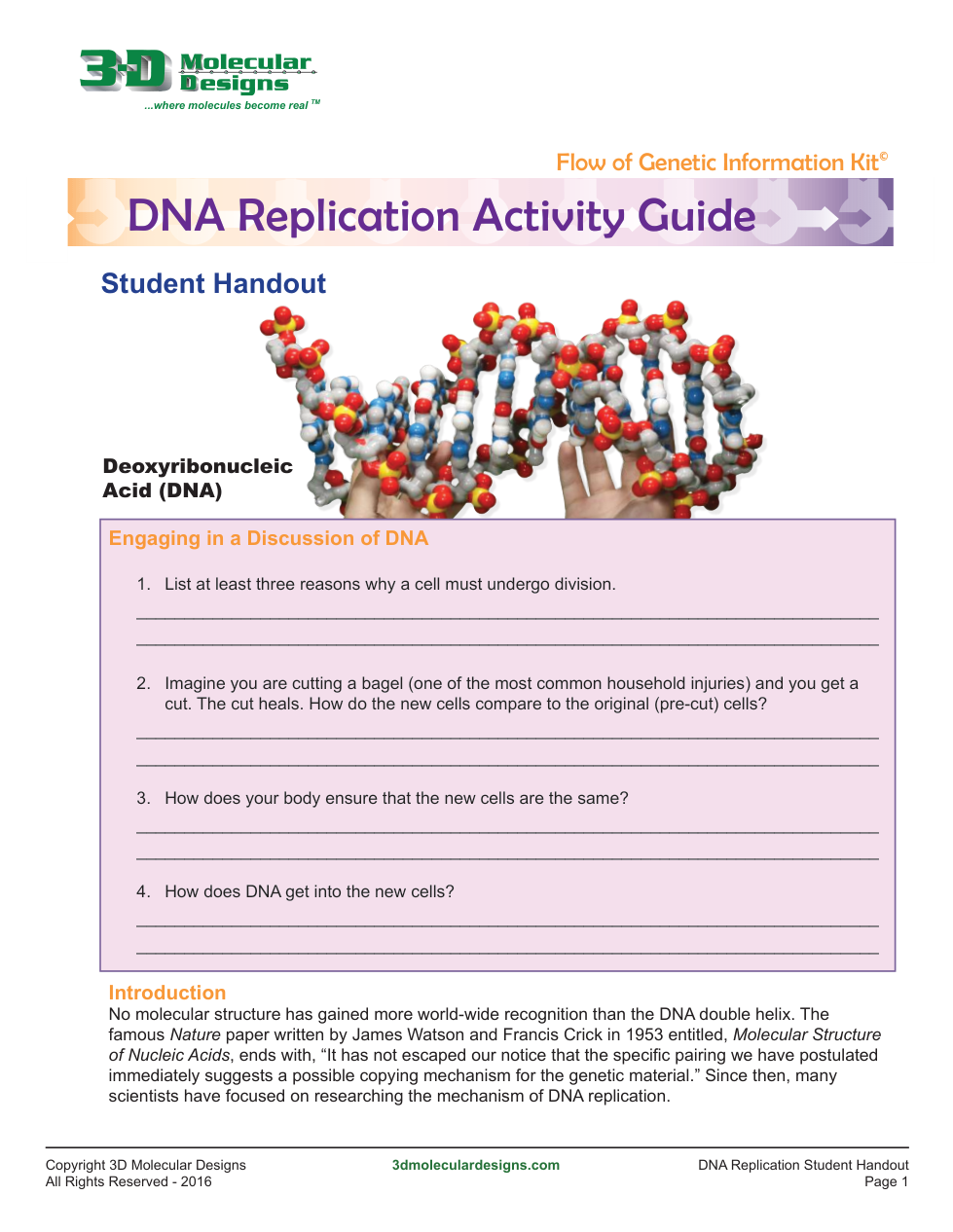
DNA Replication Activity Guide

star
star
star
star
star
Last updated 16 days ago
27 questions
Note from the author:
use with flow of genetic information kit
Use with the 3-D Molecular Designs 'Flow of Genetic Information Kit'.
Students should be modeling replication with the foam pieces and answering the questions in this formative.
Discuss the 4 questions on this page with your table group before you write your answers.
1
Question 1
1.

List at least three reasons why a cell must undergo division.

1
1
Question 3
3.

How does your body ensure that the new cells are the same?

1
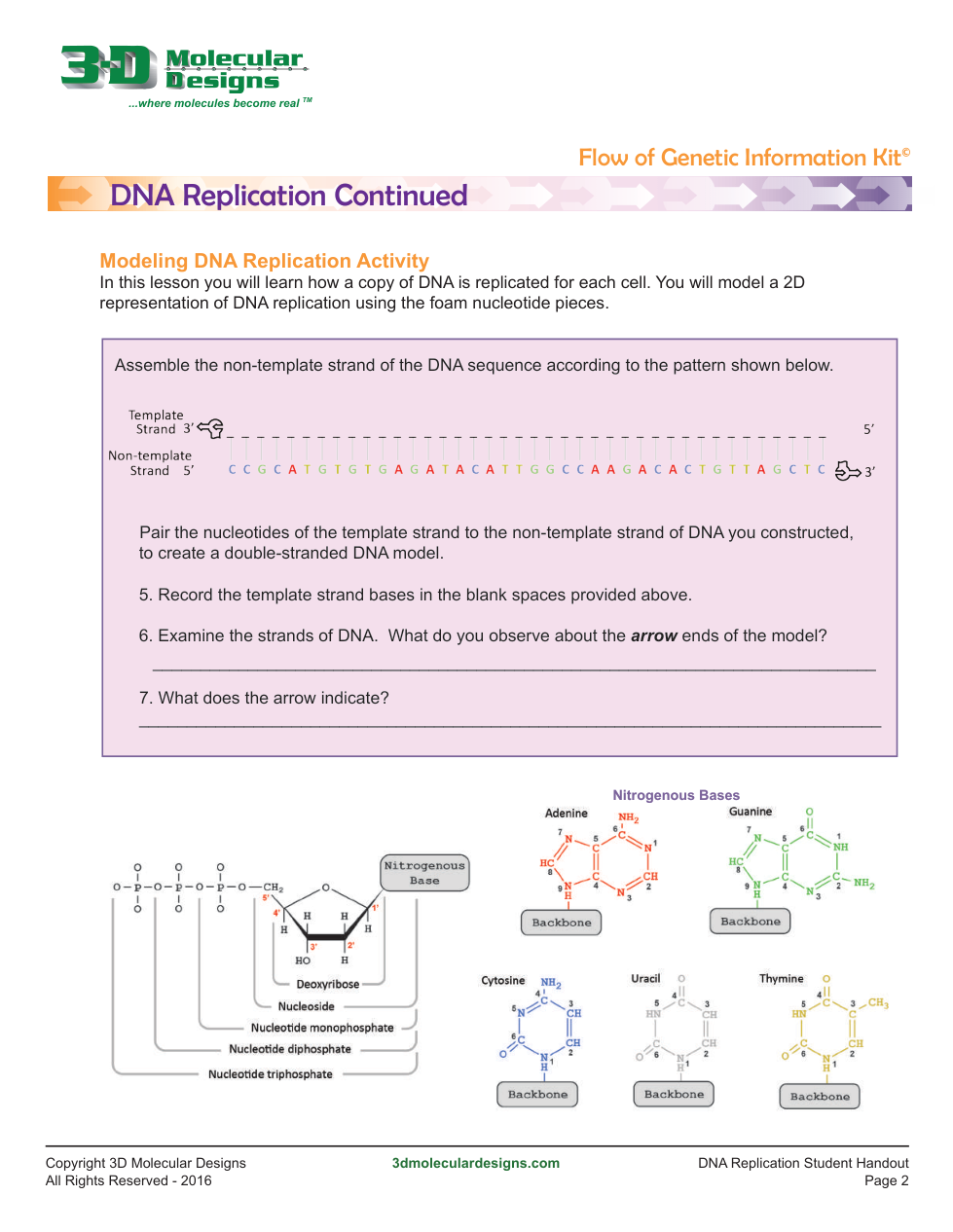
Follow the directions in the pink box to assemble the double stranded DNA molecule using the foam pieces.
1
Question 5
5.

Record the template strand bases. Start at the 3' end. Do not leave spaces between the nucleotides.

1
1
1
Question 8
8.

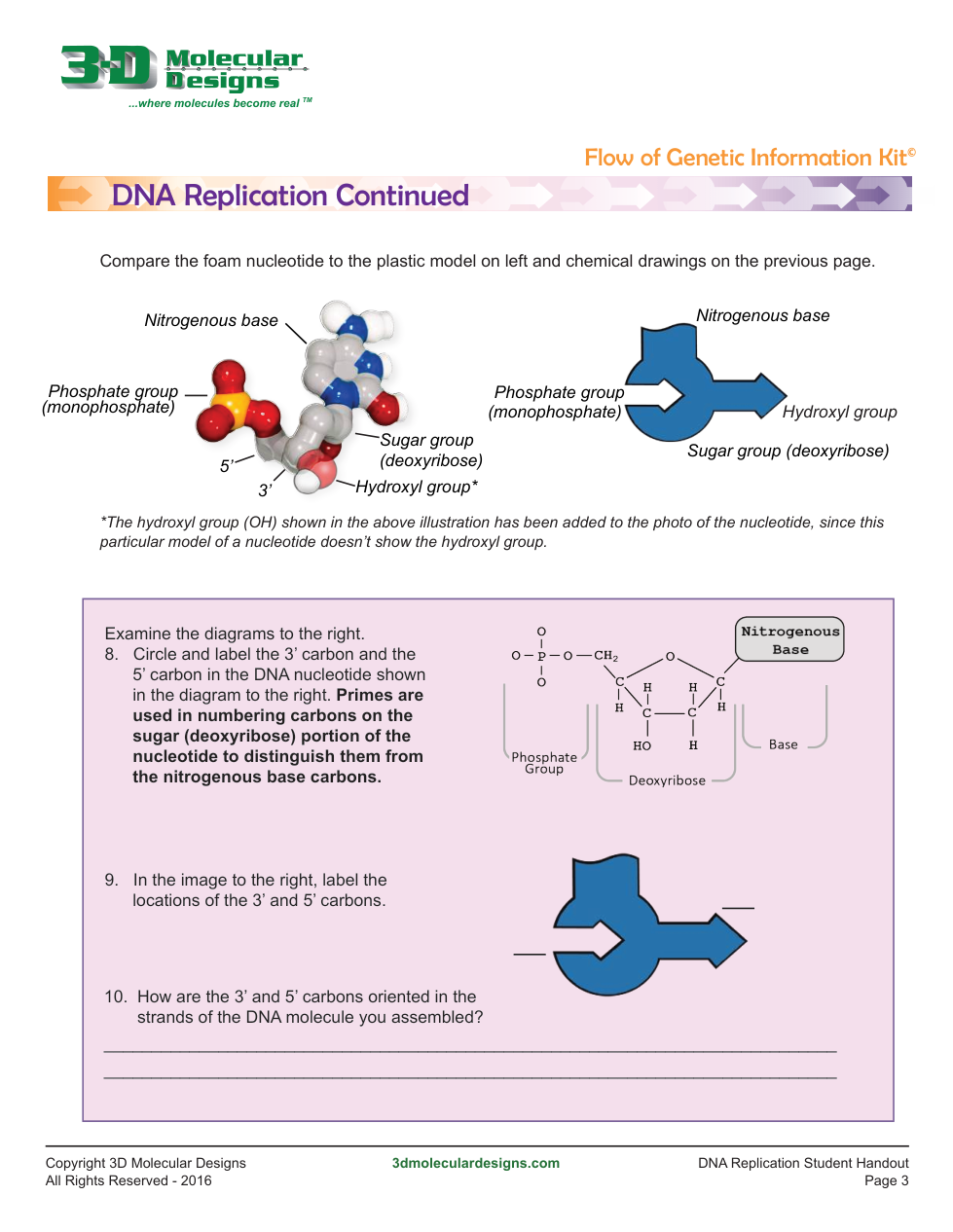
What is attached to the 5' Carbon?

1
1
1
Question 11
11.

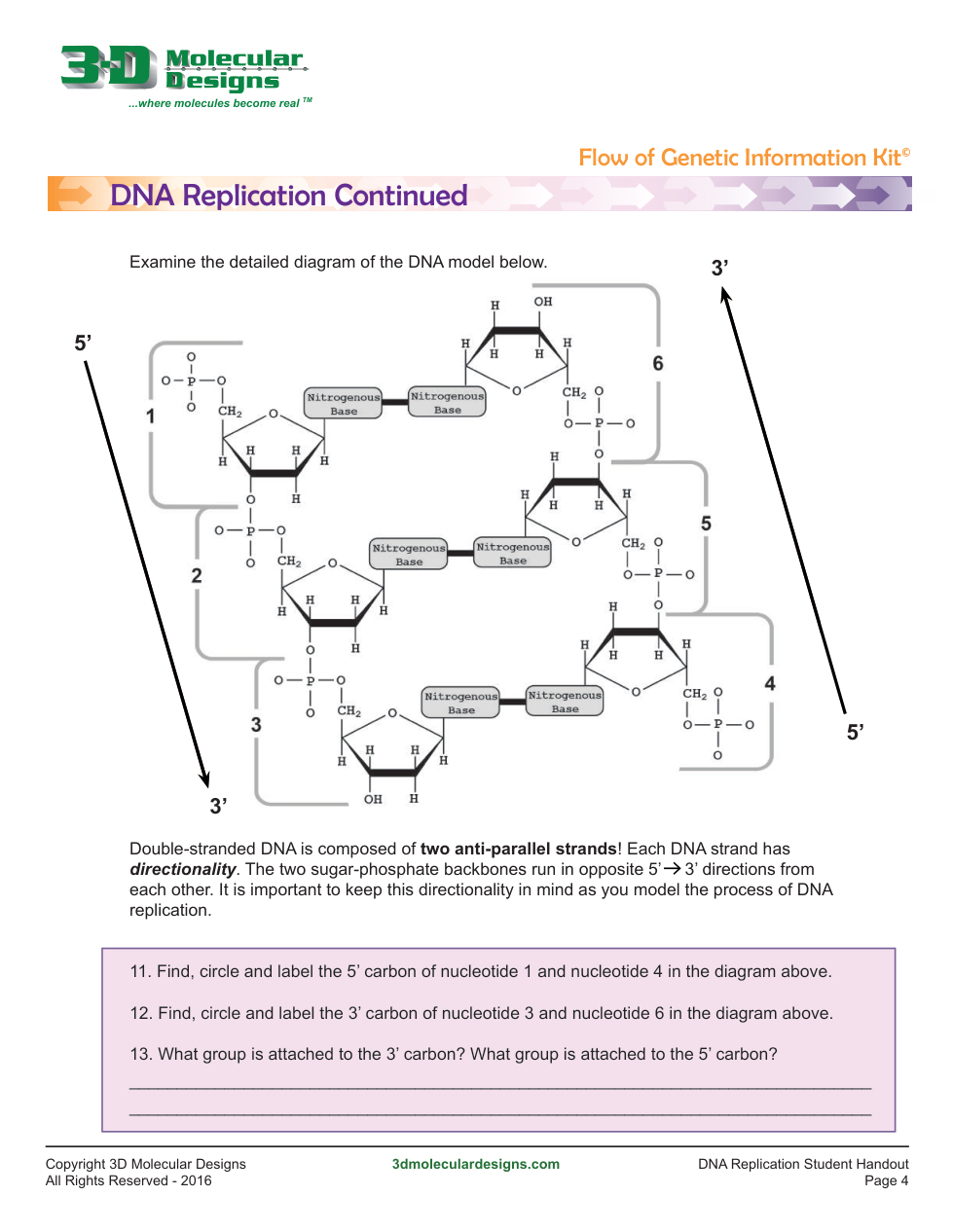
Find, circle, and label the 5’ carbon of BOTH nucleotide 1 and nucleotide 4 in the diagram.

1
Question 12
12.

Find, circle, and label the 3’ carbon of nucleotide 3 and nucleotide 6 in the diagram.

1
1
Question 14
14.

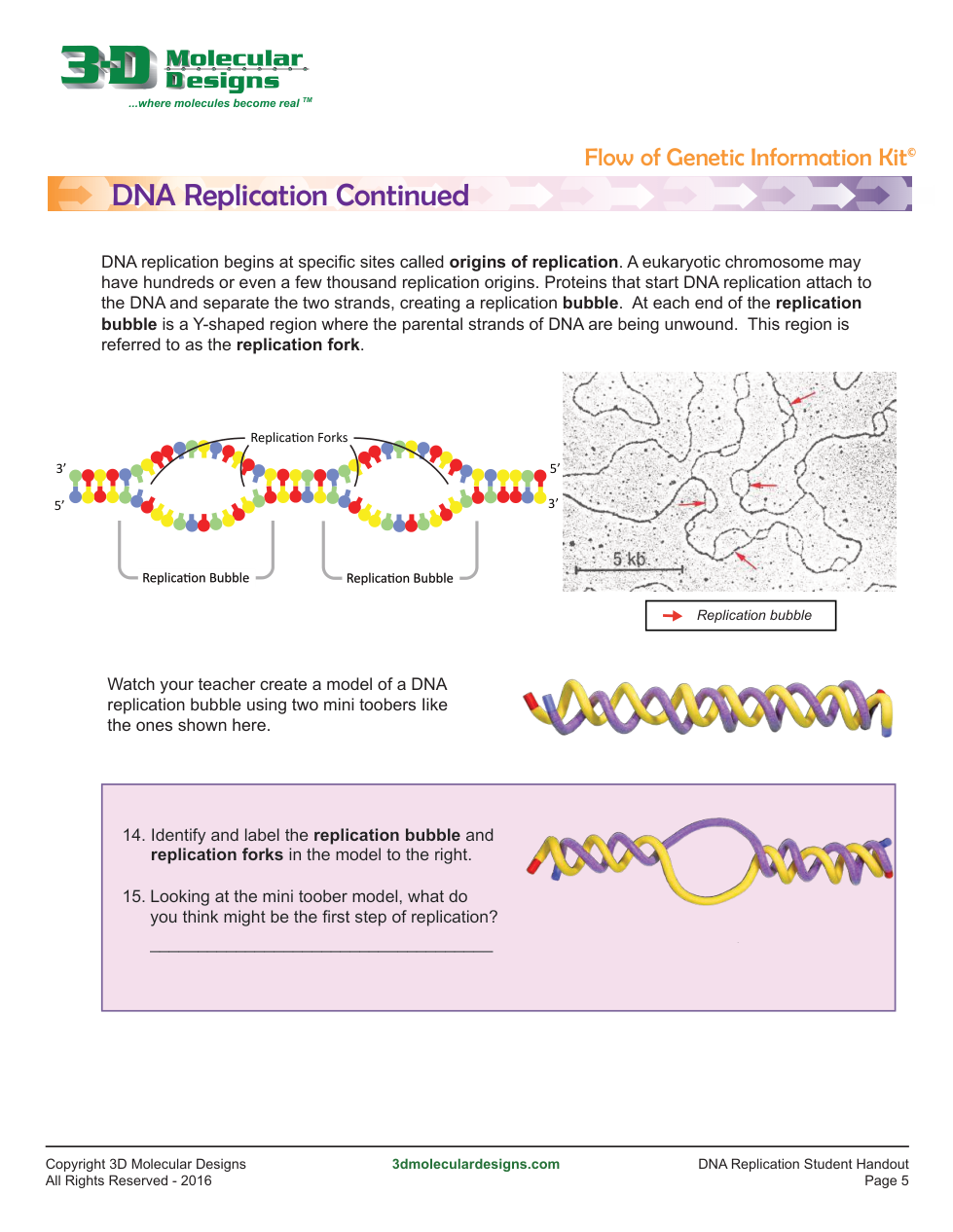
Circle the replication bubble and draw arrows pointing to the replication forks in the model.

1
Question 15
15.

Looking at the mini toober (flexible foam tubes) model, what do you think might be the first step of replication?

0
Question 16
16.

Nucleotides are added at an approximate rate of 50 nucleotides per second in eukaryotic cells. The human genome contains 6.4 billion nucleotides (3.2 billion base pairs), which must be copied. Calculate the length of time in days that it would take to copy the human genome. Show all calculations including units. There is a hint available.

1
1
1
1
1
1
Question 22
22.

Draw an arrow indicating the directionality of the newly replicated leading strand of DNA.

1
1
Question 24
24.

Sketch and indicate the directionality of the fragments composing the lagging strand of DNA.

1
0
Question 26
26.

When you are satisfied that you know how to answer this question ask your teacher for a paper copy of this question.

1
Question 2
2.

Imagine you are cutting a bagel (one of the most common household injuries) and you get a cut. The cut heals. How do the new cells compare to the original (pre-cut) cells?

Question 4
4.

How does DNA get into the new cells?

Question 6
6.

Examine the strands of DNA. What do you observe about the arrow ends of the model?

Question 7
7.

What does the arrow indicate?

Question 9
9.

The blank on the left is the ___ carbon and the blank on the right is the ___ carbon

Question 10
10.

How are the 3’ and 5’ carbons oriented in the strands of the DNA molecule you assembled?

Question 13
13.

What functional group is attached to the 3’ carbon? What group is attached to the 5’ carbon?

Question 17
17.

Why do you think multiple replication bubbles form during the process of DNA replication?

Question 18
18.

What does the helicase appear to be doing?

Question 19
19.

Identify which type of bond is broken.

Question 20
20.

What part of the helicase enzyme is represented by the pointed orange wedge?

Question 21
21.

As a new nucleotide is added to the growing DNA strand, which part of the new nucleotide forms a bond with the 3’ OH (hydroxyl) group?

Question 23
23.

Why won't you be able to synthesize the other strand of DNA in a continuous manner when using the model?

Question 25
25.

Why is DNA replication considered to be a semi-discontinuous process?

Question 27
27.

How do these two new strands compare to the original (parental) strand? (may be more than 1 correct answer)