Log in
Sign up for FREE
arrow_back
Library

DE_CH_5.6_Ocean Water

star
star
star
star
star
Last updated over 2 years ago
20 questions
Background Knowledge
1
1
1
2
Characteristics of Ocean Water (1)
1
3
4
Ocean Acidification (2)
1
Movement of Ocean Water (3)
1
1
2
3
1
1
1
1
Question 1
1.

How does ocean water participate in the water cycle?

Question 2
2.

Select each statement that correctly summarizes and compares properties of the ocean.

Question 3
3.

Which statement about Earth's weather is true?

Question 4
4.
  • warmer
  • darker
  • cooler
  • lower density
  • higher pressure
  • lighter
  • more species of life
  • lower pressure
  • fewer species of life
  • higher density
  • Surface Ocean Layers
  • Deep Ocean Layers
Question 5
5.

The most abundant dissolved gases in ocean water are

Question 6
6.

Categorize the following statements with the corresponding factor that affects the distribution of marine organisms.

  • Deep ocean water is less affected by evaporation and precipitation, and runoff only happens near the shore.
  • Warmer water is able to dissolve solids faster than cold water.
  • Property of matter that describes its mass per unit of volume.
  • The ______ of ocean water usually decreases as depth increases.
  • Ice can float since it has a lower ____ than water.
  • Controlling factor is the total volume of water compared to the amount of dissolved solids in water
  • Colder liquids are capable of holding more dissolved gases.
  • At lower temperatures, water molecules are moving slower and are packed more tightly together.
  • Salinity
  • Density
  • Temperature
Question 7
7.
The ocean has many different characteristics. Determine which area best reflects the characteristics noted in each sentence below.

__________ is probably comprised of about 96% water and 4% salt.
__________ is freshwater.
__________ probably has a lot of phytoplankton.
__________ has the most salinity.
__________ has the least density.
__________ is the warmest area of the three pictures.
__________ has no salinity.
__________ could be a carbon sink.
Question 8
8.

This group of organisms play an important role in the carbon cycle, conducting most of the photosynthesis that occurs on our planet.

Questions 9-11 | 01:11
00:00/00:00
Questions 9-11
01:11
Question 12
12.

Name some of the factors that affect the movement of water within the world's oceans.

Question 13
13.

Read the following excerpt from the text. Select the sentence that explains why the Coriolis Effect differs how close you are to the equator.

The Coriolis effect is the result of Earth’s rotation. Because Earth rotates on its axis, any free-moving fluid on Earth is unable to travel in a completely straight line. In the Northern Hemisphere, all ocean and wind currents are deflected to the right by this effect. In the Southern Hemisphere, all currents are deflected to the left. This causes the curvature of ocean currents and prevailing winds. The Coriolis Effect is stronger at the equator, because Earth is rotating fastest there. Although the equator and the poles complete a single rotation in the same amount of time, a point on the equator will move a much longer distance in that time than a point near the poles. Because speed equals distance traveled divided by time, the speed at which objects at the poles are rotating is much lower.
Question 14
14.
Water currents at or near the ocean surfaces are usually generated by _______. These currents move _______ compared to cold, deep ocean currents. Currents deep within Earth's oceans are driven by water _______ differences. Deep ocean currents are also connected and are part of the worldwide oceanic circulation system, often referred to as the global _______, that helps regulate Earth's average surface temperature.
Question 15
15.

Match the corresponding parameters that can be measured to describe waves with the correct definition.

Draggable itemarrow_right_altCorresponding Item
wavelength
arrow_right_alt
amount of time between two wave crests (from a fixed reference point)
wave height
arrow_right_alt
measurement of the vertical distance between the wave's crest and trough
wave period
arrow_right_alt
horizontal distance between two wave crests, or two wave troughs
wave speed
arrow_right_alt
dividing the wavelength by the wave period
crest
arrow_right_alt
lowermost point of a wave
trough
arrow_right_alt
uppermost point of a wave
Question 16
16.

An observer sitting in an anchored boat in a bay is watching waves go by. She notices that there is a distance of 10 meters between wave crests, and that a new wave crest passes her boat every 5 seconds. What is the wave speed?

Question 17
17.

An observer sitting on the shore sees four waves with equal wavelengths travel by. The distance between the first and fourth wave crests is 30 meters. It takes 21 seconds for all four wave crests to pass. What is the wave speed?

Question 18
18.

As a fishing boat travels through the ocean, crew members watch as they pass two wave crests. The distance between the crests is 15 meters. The time it takes to travel from the first crest to the second is 7.5 seconds. What is the wave speed?

Question 19
19.

As a wave approaches the edge of the land, drag against the ocean floor causes the side closer to land to slow down while the rest of the wave continues forward. This causes a bend in the wave's overall path and this phenomenon is known as

2
Question 20
20.
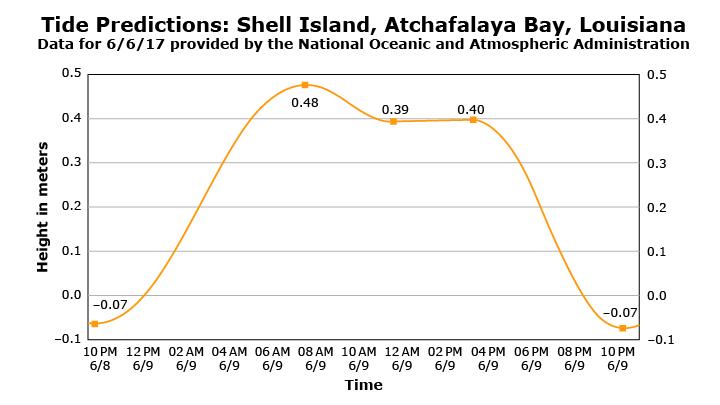
For this day at Shell Island, in the Gulf of Mexico, the tides are predicted to reach__________ at high tide, and__________ as compared to sea level at low tide. This represents a total change in water level of__________. Tide tables are printed annually for the entire year. The reason tides can be predicted so far in advance is because of known factors affecting the ocean water, such as __________. However, the actual tides on any given day may vary from the predictions. This is due to unpredictable factors, such as __________.