a) determine the value of the median and the quartiles.
b) calculate the mean.
c) determine with justification whether there are any outliers.
d) state with justification if there is any type of skew.
e) draw a suitably labelled box plot.
3 points
3
Question 2
2.
The % marks, rounded to the nearest integer, of a recent Mathematics test taken by 16 students, were summarised in an ordered stem and leaf diagram.
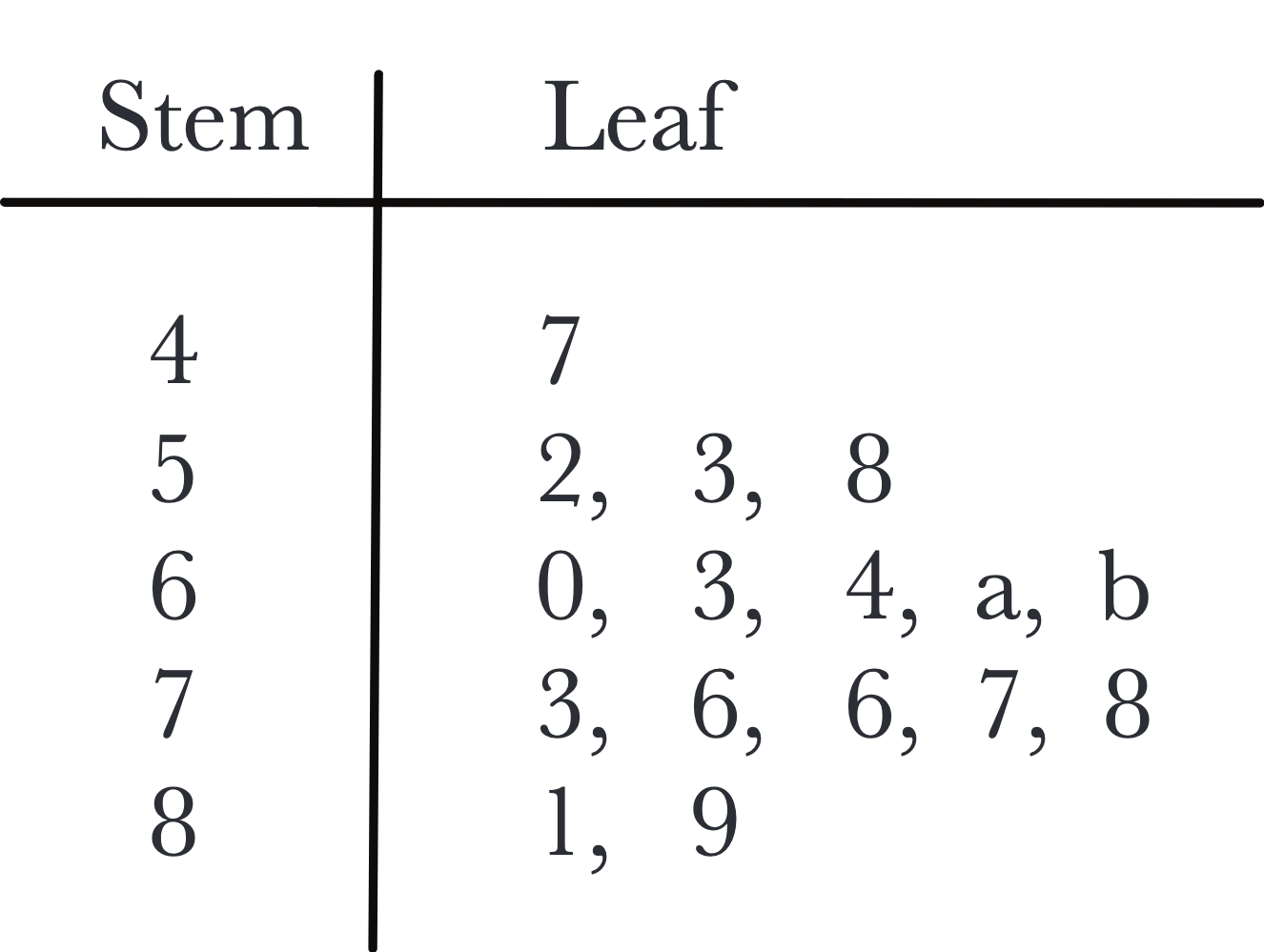
Where 8|1 is 81 %
a) Determine the lower quartile of the data.
b) Given the median is 68 and a≠b, find the value of a and the value of b.
4 points
4
Question 3
3.
A group of patients with a certain respiratory condition were asked to hold their breath for as long as they could. The results are summarized in the table below.
Time t (in seconds) Frequency
0 < t ≤ 10 30
10 < t ≤ 15 35
15 < t ≤ 18 33
18 < t ≤ 20 20
20 < t ≤ 30 25
30 < t ≤ 50 10
a) Draw an accurate histogram to represent this data using sheets. Attach the image in the space given below.
b) Use the histogram to estimate the number of patients that managed to hold their breath between 24 and 36 seconds.
c) What is the modal class of the data given here?
d) What is the class interval?
3 points
3
Question 4
4.
The events A and B are such so that:
P(A) = 0.3; P(B) = 0.5 and P(A∪B) = 0.6
Determine:
a. P(A∩B)
b. P(A'∩B)
c. P(A∩B')
4 points
4
Question 5
5.
The quality controller in a factory examined 250 components for three types of minor faults, known as fault A, fault B and fault C. His results are summarized as follows.
4 components with type C fault only.
8 components with type A and C but no B fault.
9 components with type A fault only.
7 components with type B and C but no A fault.
1 component with type B fault only.
5 components with type A and B but no C fault.
2 components with all three types of fault.
a) Draw a fully completed Venn diagram to represent this information. A component is selected at random from the quality controller's sample.
b) Find the probability that the selected component has a type C fault.
6 points
6
Question 6
6.
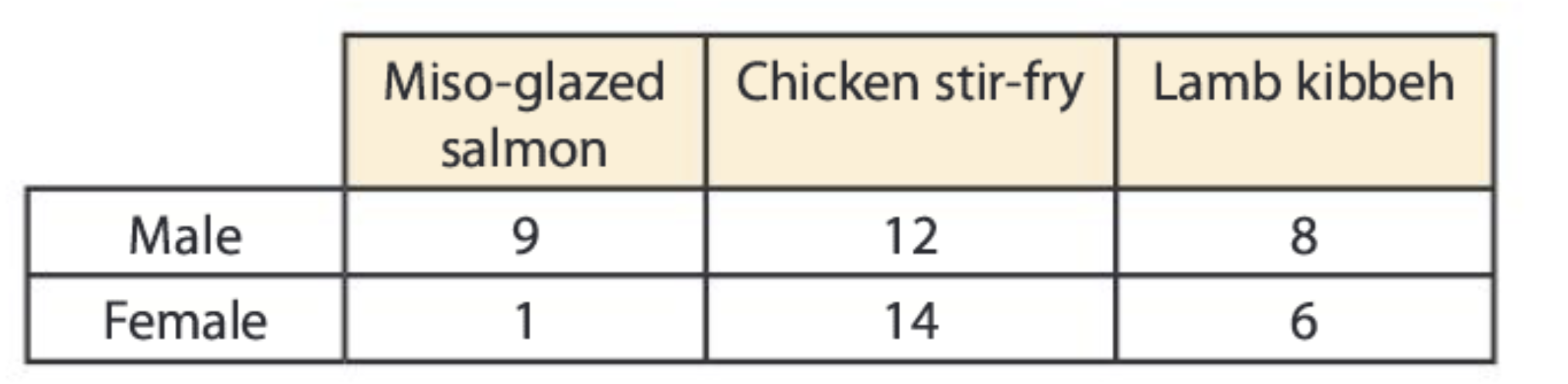
The table shows customers' menu choices at a restaurant.
Determine
a. The number of male diners at the restaurant.
b. The number of diners who ordered chicken stir fry
c. The probability of picking a table where the ordered food is a lamb kibbeh
d. The probability that a female diner ordered a miso glazed salmon.
e. The probability of picking a table where miso-glazed salmon was ordered and then finding the neighbouring table has ordered lamb kibbeh. (You may assume that the customers are not influenced by each other,.)