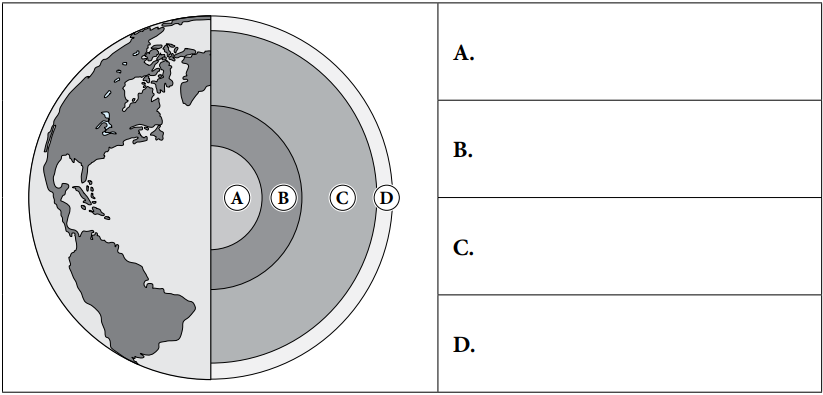
Mmuae Afoforo a Wobɛpaw:
outer core
crust
inner core
mantle
The study of the makeup of the earth and the processes that change and shape it is called .
Which statement best explains the theory of plate tectonics?
Which of the following is the most accurate statement about myths?
| Draggable item | arrow_right_alt | Corresponding Item |
|---|---|---|
outer core | arrow_right_alt | Earth’s largest and thickest layer; consists of very hot, very dense rock |
mantle | arrow_right_alt | solid; made of very hot metal; may be nearly as hot as the sun’s surface; innermost layer |
inner core | arrow_right_alt | thin; rocky; outermost layer; two types: oceanic and continental |
crust | arrow_right_alt | liquid; made of very hot metal |
Select Yes if it is a characteristic of tsunamis or No if it is not.
Yes | No | |
|---|---|---|
Tsunamis form when earthquakes occur in oceanic crust, causing the seafloor to shift. | ||
Tsunamis travel fast—as much as 500 miles per hour. | ||
Tsunamis are easy to stop as long as scientists have enough warning when they begin to form. | ||
Tsunamis can grow to become as tall as a three- or four-story building. |
Read the statement in the “What is the cause?” column. Choose the statement that best relates to the information in the “What is the cause?” column.

Volcano myths often explain volcanic activity by ____________.
Label each of the following volcano descriptions with the appropriate word
active | dormant | extinct | |
|---|---|---|---|
a volcano that has not erupted for at least 10,000 years and is not likely to erupt again | |||
a volcano that has erupted in the past 10,000 years and is likely to erupt again | |||
a volcano that hasn’t erupted for a long time but could erupt again |
Which of the statements best explains the relationship between earthquakes and faults?
Select Yes next to each item in the chart that Alfred Wegener’s continental drift hypothesis helped explain and No next to each item it did not help explain.
Yes | No | |
|---|---|---|
long ago, Earth had one huge landmass called Pangaea | ||
as continents moved apart, their climates changed | ||
drifting continents actually moved due to tectonic plates | ||
groups of plants and animals that once lived together were separated as the continents moved apart |
Seafloor spreading is the process of oceanic plates moving apart very slowly. When the seafloor dips down as one tectonic plate slides under another, a narrow, extremely deep valley called a(n) is created. When oceanic plates move away from one another and form cracks in Earth’s crust, an underwater mountain called a(n) is created.
Moving apart, colliding, and sliding sideways past one another are three ways in which move.
| Draggable item | arrow_right_alt | Corresponding Item |
|---|---|---|
Seismograph | arrow_right_alt | Numbers describe the intensity of earthquakes based on the largest seismic wave recorded. |
Richter scale | arrow_right_alt | Jagged up-and-down lines show the energy of seismic waves. |
Scientists observed that ________, which provided evidence of changes over time on Earth’s surface.
Which of the following do geysers, volcanoes, and hot springs have in common?