3.1Excerpt from “Earth’s Layers and Moving Plates”

Last updated almost 3 years ago
5 questions
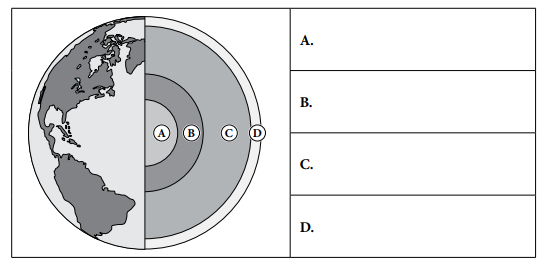
Read the following excerpt and use it to label Earth’s layers in the diagram that follows.
Earth’s deepest layer is a solid inner core of very hot metal. This metal may be nearly as hot as the sun’s surface. The outer core is also made of hot metal, but it’s liquid, not solid. The mantle surrounds the outer core. The mantle is Earth’s largest and thickest layer and consists of very hot, very dense rock. The rock is solid in the lower and upper parts of the mantle. In between, however, is a region where the rock is neither liquid nor solid. The slow movement and behavior of this material, caused by heat and pressure, have an impact on Earth’s surface. Above the mantle is Earth’s outermost layer, the thin, rocky crust. There are two types of crust: oceanic crust and continental crust. Oceanic crust is covered by ocean water. Most of the continental crust is dry land, but some of the crust around the edges is covered by water. Oceanic crust is thinner but heavier than continental crust.
1
1
1
1
1
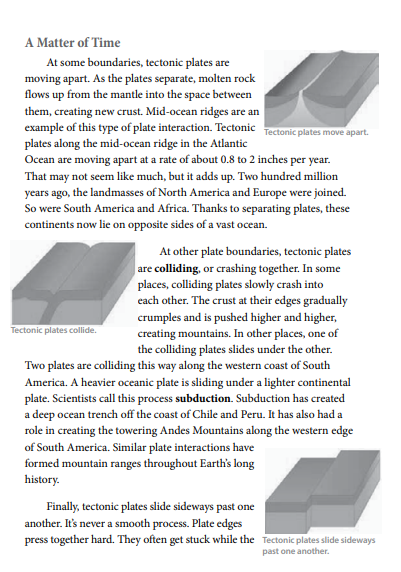
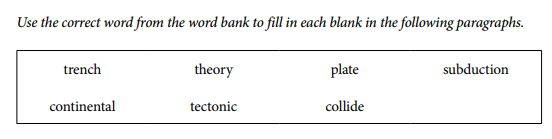
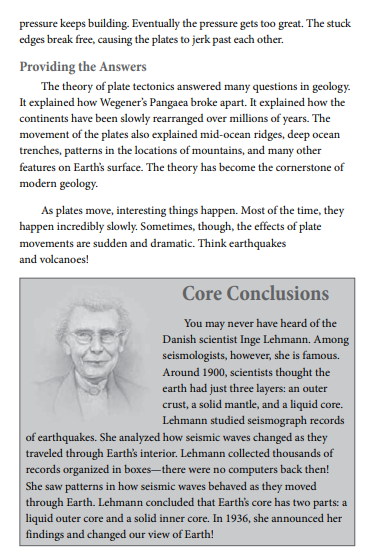
Sam is excited to tell his family what he is reading and learning about geology at school. His cousins live in the South American country of Chile, and today he learned that there is a deep ocean _______ along Chile’s coast. He explained, “There are two _______ plates that meet along the western coast of South America. One is a _______ plate and one is an oceanic plate. The heavier oceanic plate is sliding beneath the lighter continental _______ . And, this process has a big name I learned today—it’s called _______ !”

“I think I know how the Andes Mountains of South America are formed,” exclaimed Sam’s dad. “When the plates _______ at plate boundaries along the Pacific Coast, I bet the continental crust crumples and gets pushed higher and higher to form the mountains. I learned about the _______ of plate tectonics when I was in school, too.”
Sam’s dad described an earthquake that the country of Chile had recently experienced. Sam said, “Hmmm . . . I wonder if earthquakes have anything to do with moving tectonic plates?”
What do you think?