Log in
Sign up for FREE
arrow_back
Library
2021- 3rd Grade ELA
By Stephanie Rubenfeld
star
star
star
star
star
Share
share
Last updated almost 3 years ago
18 questions
Add this activity
zoom_in
zoom_in
zoom_in
Required
1
L.3.4.a
Required
1
RL.3.3
Required
1
RL.3.3
zoom_in
Required
1
RL.3.4
Required
1
RL.3.5
Required
1
RL.3.2
zoom_in
Required
1
RI.3.3
Required
1
RI.3.2
Required
1
RI.3.7
zoom_in
Required
1
RI.3.4
Required
1
RI.3.5
Required
1
RI.3.3
zoom_in
Required
1
RL.3.4
Required
1
RL.3.6
Required
1
RL.3.3
zoom_in
Required
1
RL.3.2
zoom_in
Required
1
Question 17
17.
How does paragraph 31 connect to the problem in paragraph 26?
It shows the solution to the problem.
It gives an effect of the problem.
It explains the cause of the problem.
It gives an example of the problem.
RL.3.5
zoom_in
Required
1
RL.3.2
Question 1
1.
What does the word “crouched” mean as it is used in paragraph 6?
spun around
bent down
stood up
fell over
Question 2
2.
In paragraph 9, what is the
most likely
reason Riley stays quiet as she and Craig walk home?
She is thinking about how well she played hockey.
She is upset with Craig because he hurt her back.
She is thinking about how to get skates for Craig.
She is tired from skating in the hockey game.
Question 3
3.
What does paragraph 12 help the reader understand about Craig?
Craig is too young to learn how to skate.
Craig is very excited about learning to skate.
Craig is unable to take the skates off by himself.
Craig is worried that his sister will take the skates back.
Question 4
4.
In paragraph 16, what does the phrase “like being a snail” help the reader to understand about Craig?
He skates very slowly.
He moves in a crooked line.
He searches for a place to hide.
He looks like all the other skaters.
Question 5
5.
Which sentence
best
describes how paragraph 6 relates to paragraph 23?
Paragraph 6 provides a problem and paragraph 23 provides a solution.
Paragraph 6 asks a question and paragraph 23 provides an answer.
Paragraph 6 provides a cause and paragraph 23 shows an effect.
Paragraph 6 provides similarities and paragraph 23 shows differences.
Question 6
6.
Which sentence
best
describes a central message of the story?
Change is normal and an important part of life.
Friendships often become stronger over time.
New experiences can be exciting and wonderful.
Natural talent is more important than practice
Question 7
7.
According to paragraph 5, what happens
right before
thunder can be heard?
Little drops of water move around in the sky.
Dark clouds appear in the sky.
Rain droplets start to fall from the clouds.
The air spreads because of heat from lightning.
Question 8
8.
What is the main idea of paragraph 6?
Lightning can reach from the sky to the ground.
A bolt of lightning can travel up to nine miles
Flashes of lightning can jump from one cloud to another.
Lightning can move over large distances very quickly
Question 9
9.
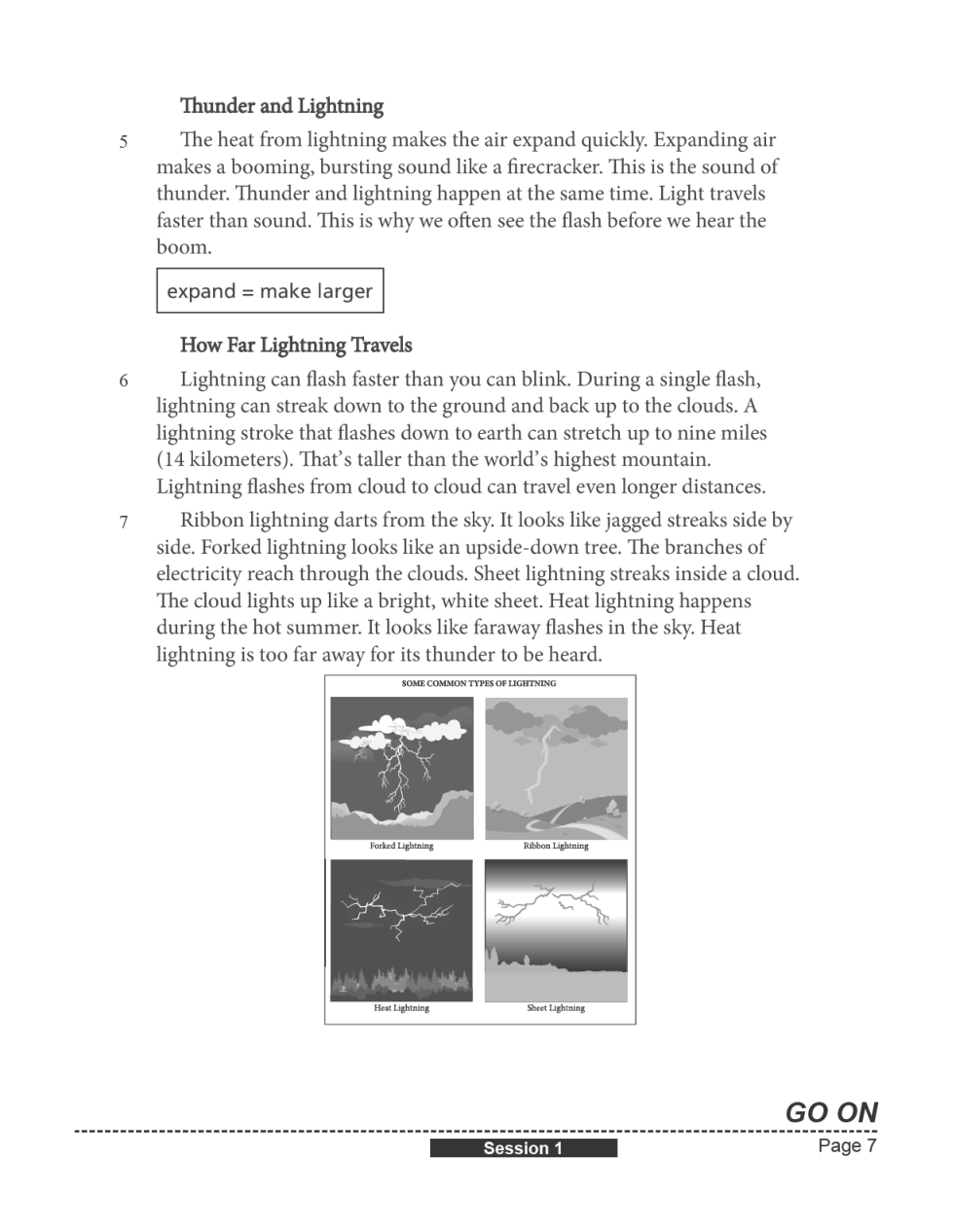
Which idea from the passage does the second illustration
best
support?
Lightning can be helpful for nature.
Lightning moves very quickly
Lightning appears in different ways in the sky
Lightning may strike before or after it rains.
Question 10
10.
What does the word “nutrient” mean as it is used in paragraph 10?
a type of lightning
a supply of heat
a kind of plant
a form of food
Question 11
11.
Which question does the section “Fast Facts” help to answer?
How does lightning help the earth?
How is lightning different in the summer?
How is electricity created in clouds?
How can someone avoid an electrical shock?
Question 12
12.
Which sentence shows a cause and effect relationship that is stated in the passage?
People see lightning before they hear thunder.
Wildfires can start when lightning touches the ground.
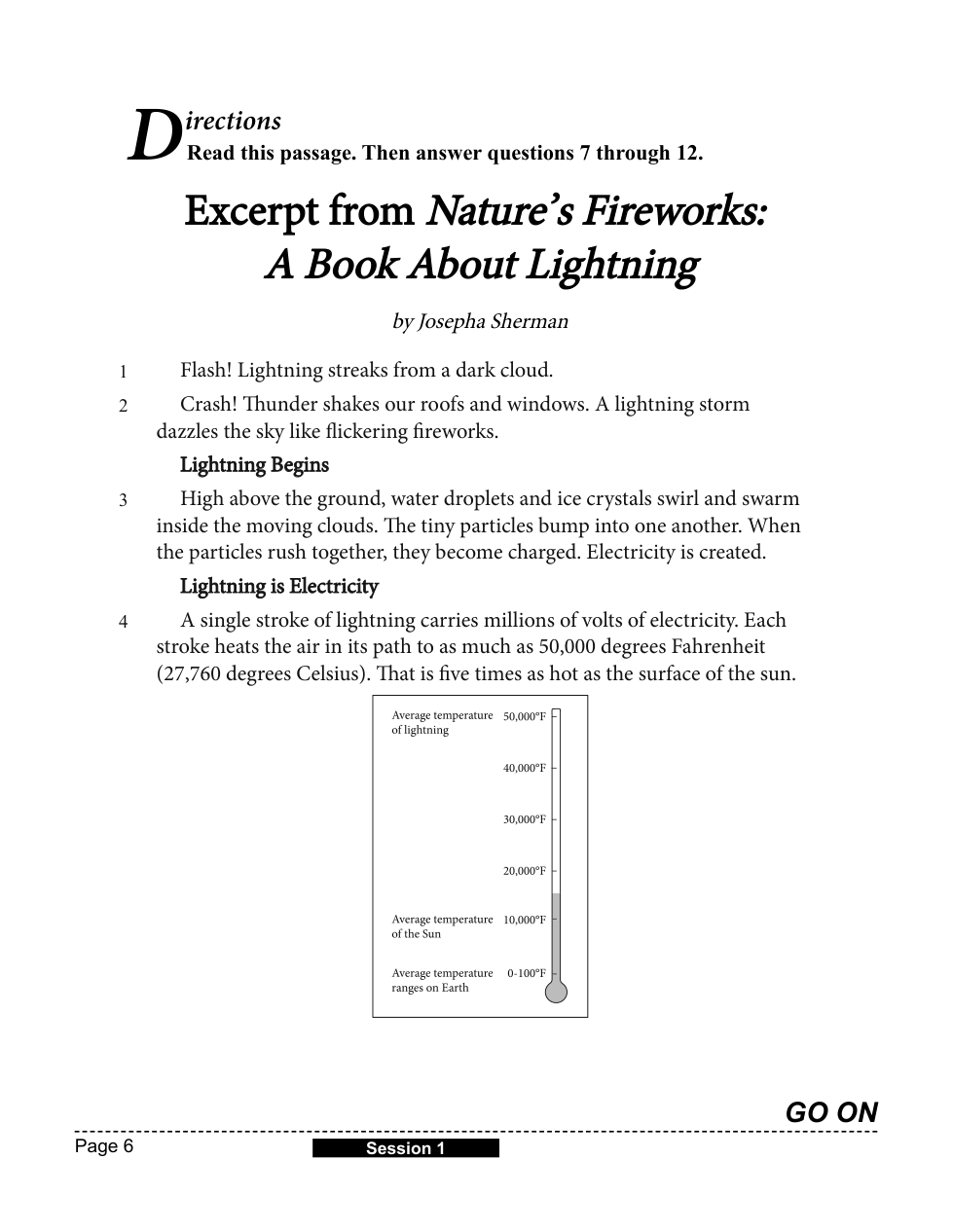
Heat from electricity is hotter than the surface of the sun.
Lightning bolts can hit tall trees and buildings.
Question 13
13.
What does the word “clamped” mean as it is used in paragraph 4?
smelled
lowered
moved
grabbed
Question 14
14.
Which detail from the story
best
shows the narrator’s point of view about catching crabs for supper?
“My clothes were already sticking to me, and sweat trickled down our faces.” (paragraph 7)
“This smells disgusting. How can they eat this?” (paragraph 8)
“. . . cracking the shells and pulling out the sweet white meat. We had to keep trying.” (paragraph 11)
“. . . but that crab was all claws and those mad pincers were waving all over the place!” (paragraph 15)
Question 15
15.
Which detail from the story
best
shows why Paulie and the narrator keep trying to catch a crab?
“Crabs love stinky old fish, so our first crab didn’t take long to come.” (paragraph 4)
“ ‘Crabs are scaredy-cats,’ I said, pulling up the line to check the bait.” (paragraph 8)
“I could tell he was trying not to cry.” (paragraph 19)
“We both thought about broccoli casserole.” (paragraph 21)
Question 16
16.
What happens
right before
Paulie and the narrator reach the porch in paragraph 30?
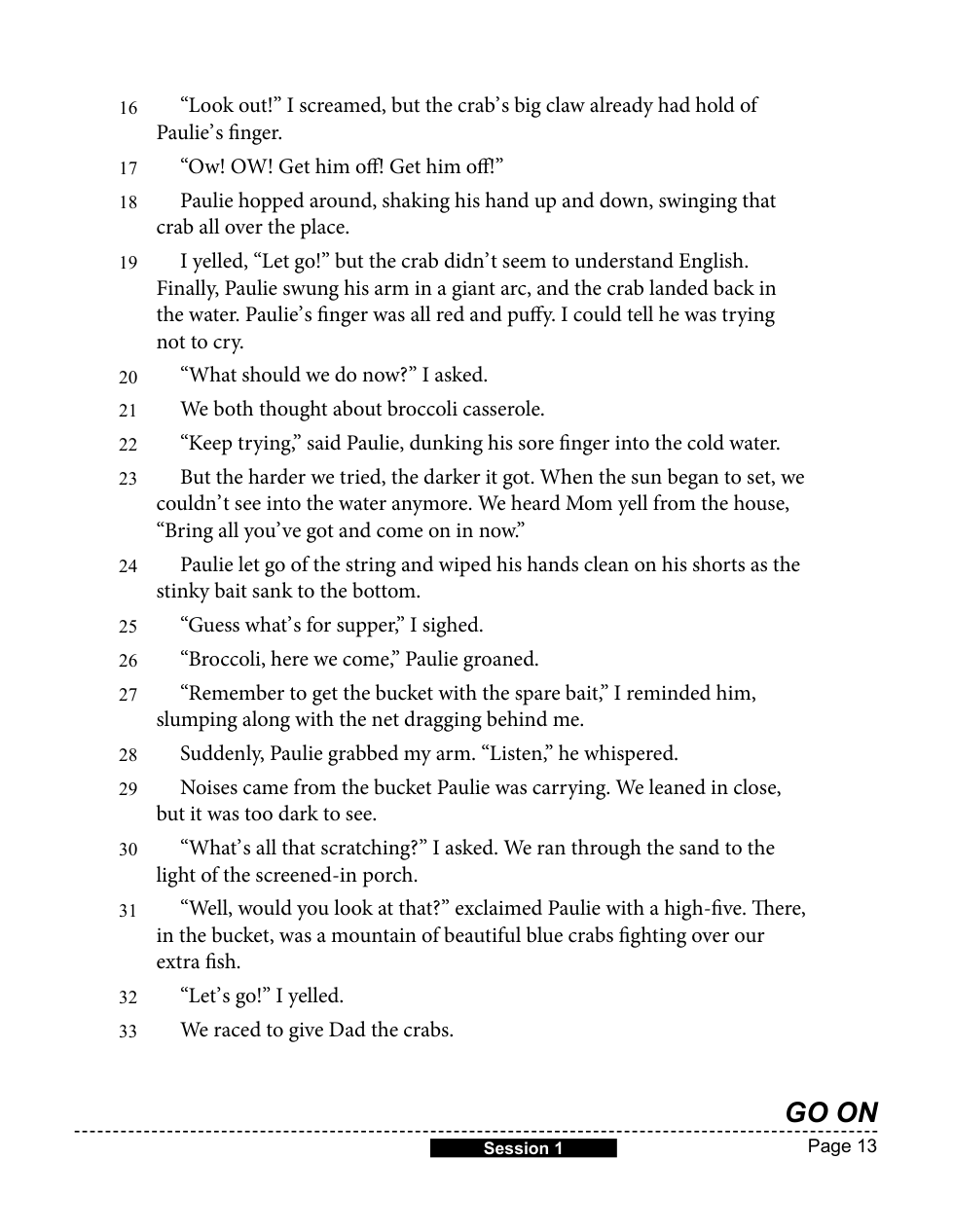
They learn that they will have broccoli casserole for dinner.
They hand a bucket of crabs to their father.
They find out that something is moving in the bucket.
They hear their mother calling them to come home.
Question 18
18.
What best states the lesson of paragraphs 27 through 31?
Hard work and a strong will can solve almost any problem.
Good things can happen even when all hope seems lost.
Staying calm is important when faced with a problem.
Working with and trusting others can help to finish any job.