1
ADD question
ADD question
ADD question
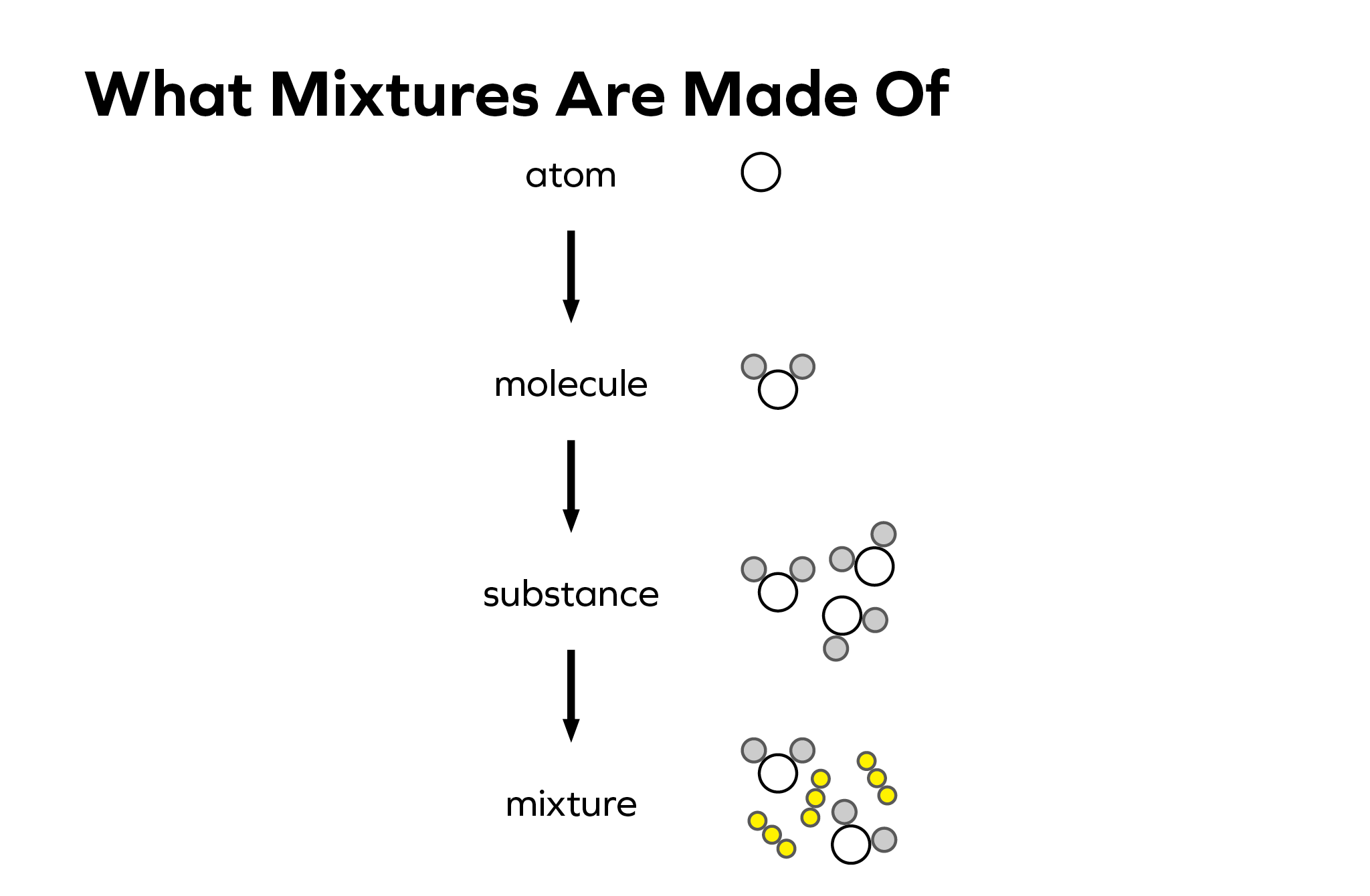
Using the chart (picture above) to help you if you need it, match the vocabulary word to the correct definition by writing the letter of the word in the box.
| Draggable item | arrow_right_alt | Corresponding Item |
|---|---|---|
Mixture | arrow_right_alt | Matter that is made of only one kind of atom or molecule |
Atom | arrow_right_alt | Matter that is made of more than one substance |
Substance | arrow_right_alt | The stuff that things are made of |
Molecule | arrow_right_alt | A tiny piece of matter that is too small to see |
Matter | arrow_right_alt | A group of atoms joined together in a particular way |
In the previous lesson, we realized that it is not always possible to figure out whether or not a chemical reaction has happened just by observing changes in properties. Today, we’ll look at the nanoscale to figure out if a chemical reaction has happened or not.
Chemical Reaction - Substances are mixed and at least one new substance with different properties (with different molecules) is formed.
Directions:
Analyze each diagram. Look carefully at both the observable scale and the nanoscale.
Think about whether there is evidence that a chemical reaction happened.
Answer the question below each diagram.
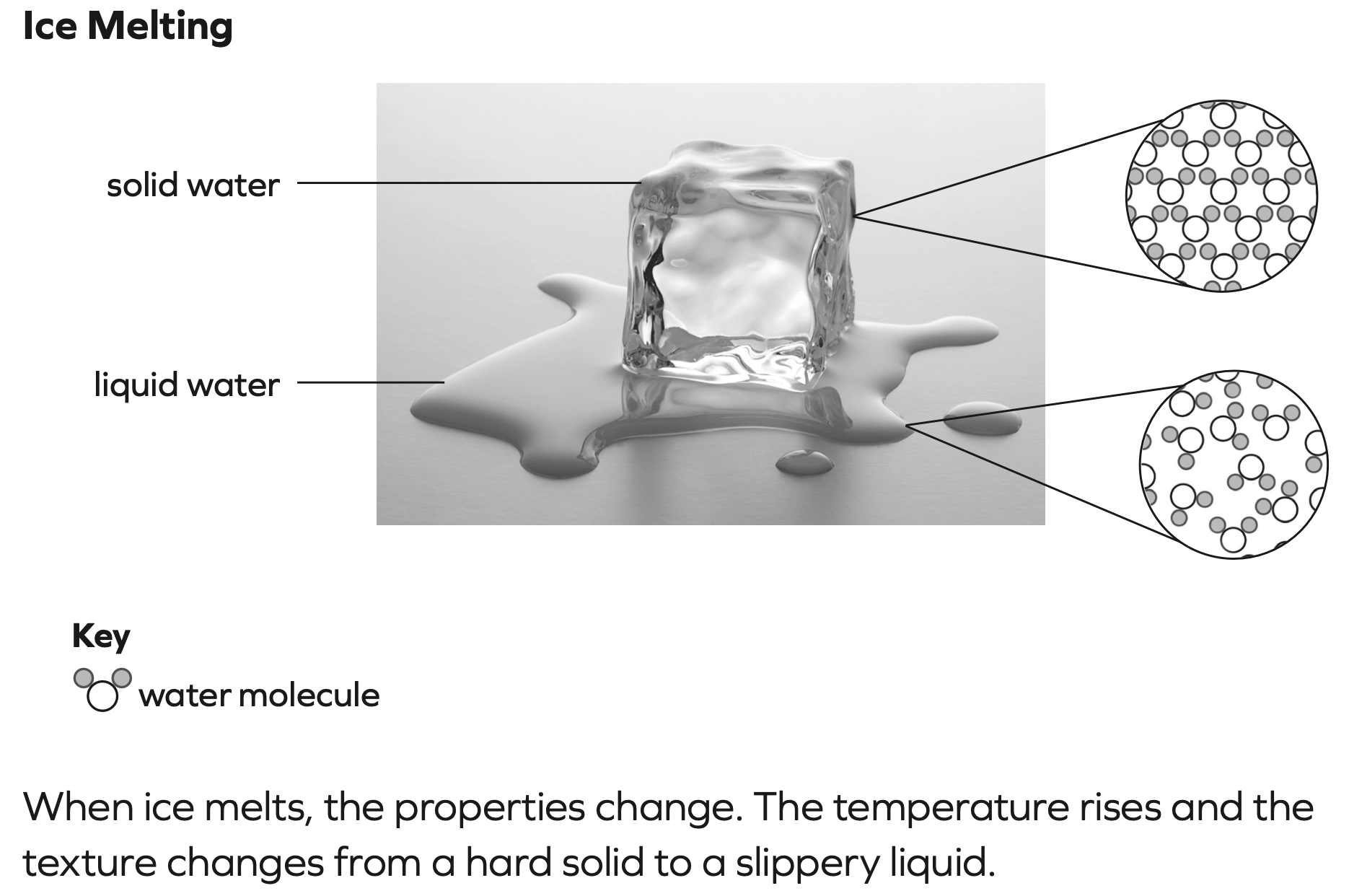
Ice Melting: Is there evidence of a chemical reaction?
Ice Melting: Is there evidence of a chemical reaction?
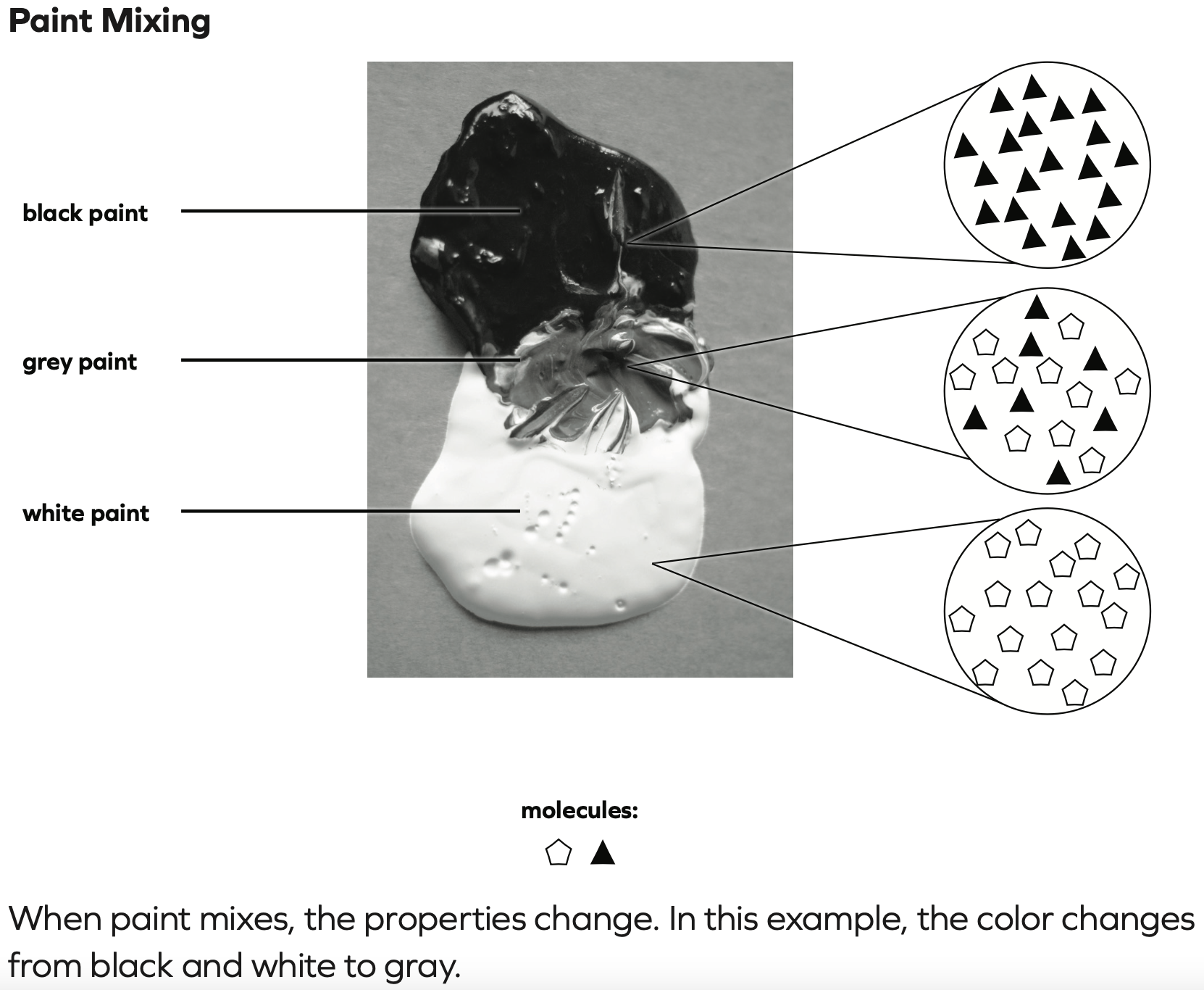
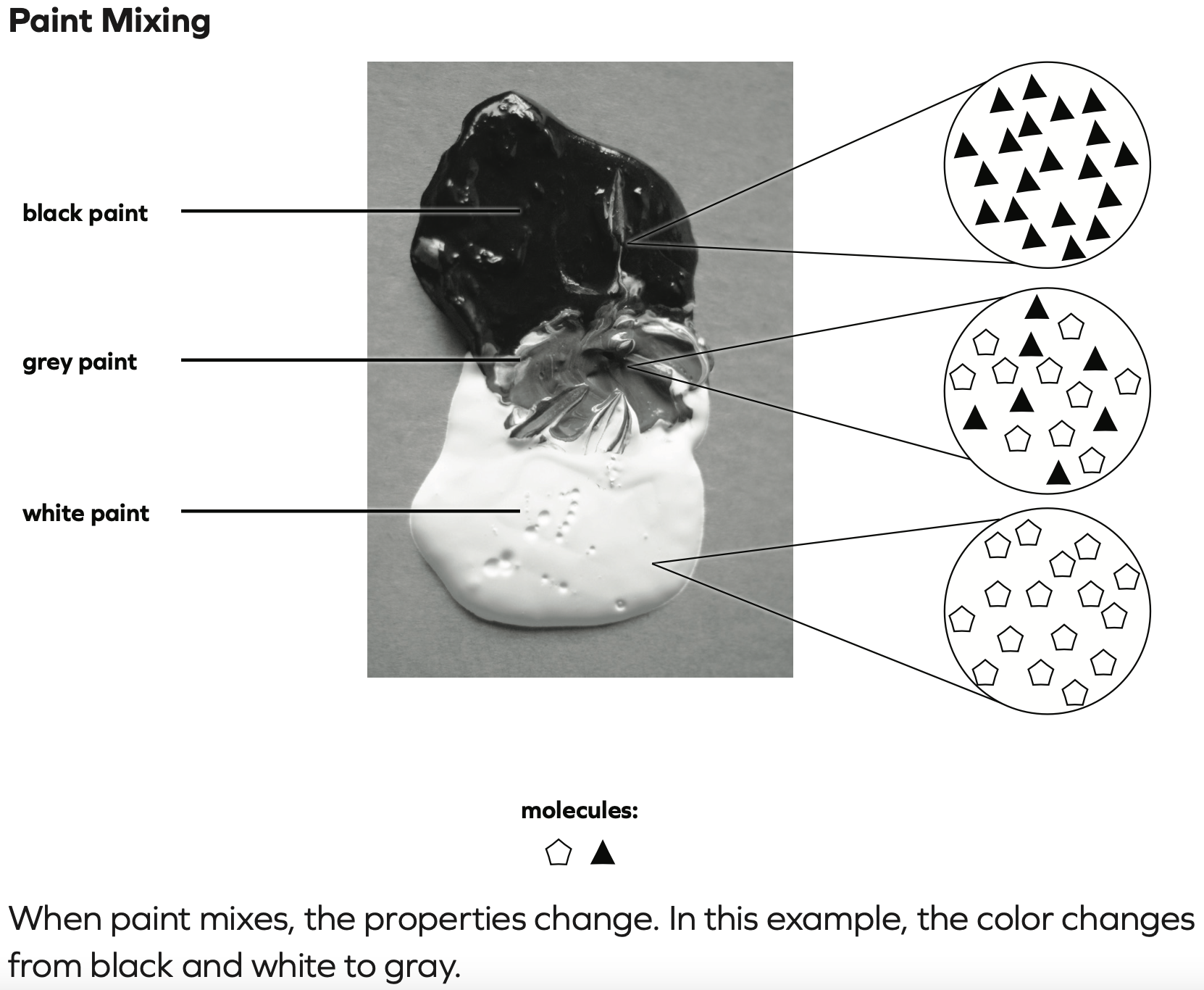
Paint Mixing: Did a new substance (with new molecules) form?
Paint Mixing: Is this a chemical reaction?
Chemical Reaction - Substances are mixed and at least one new substance with different properties (with different molecules) is formed.
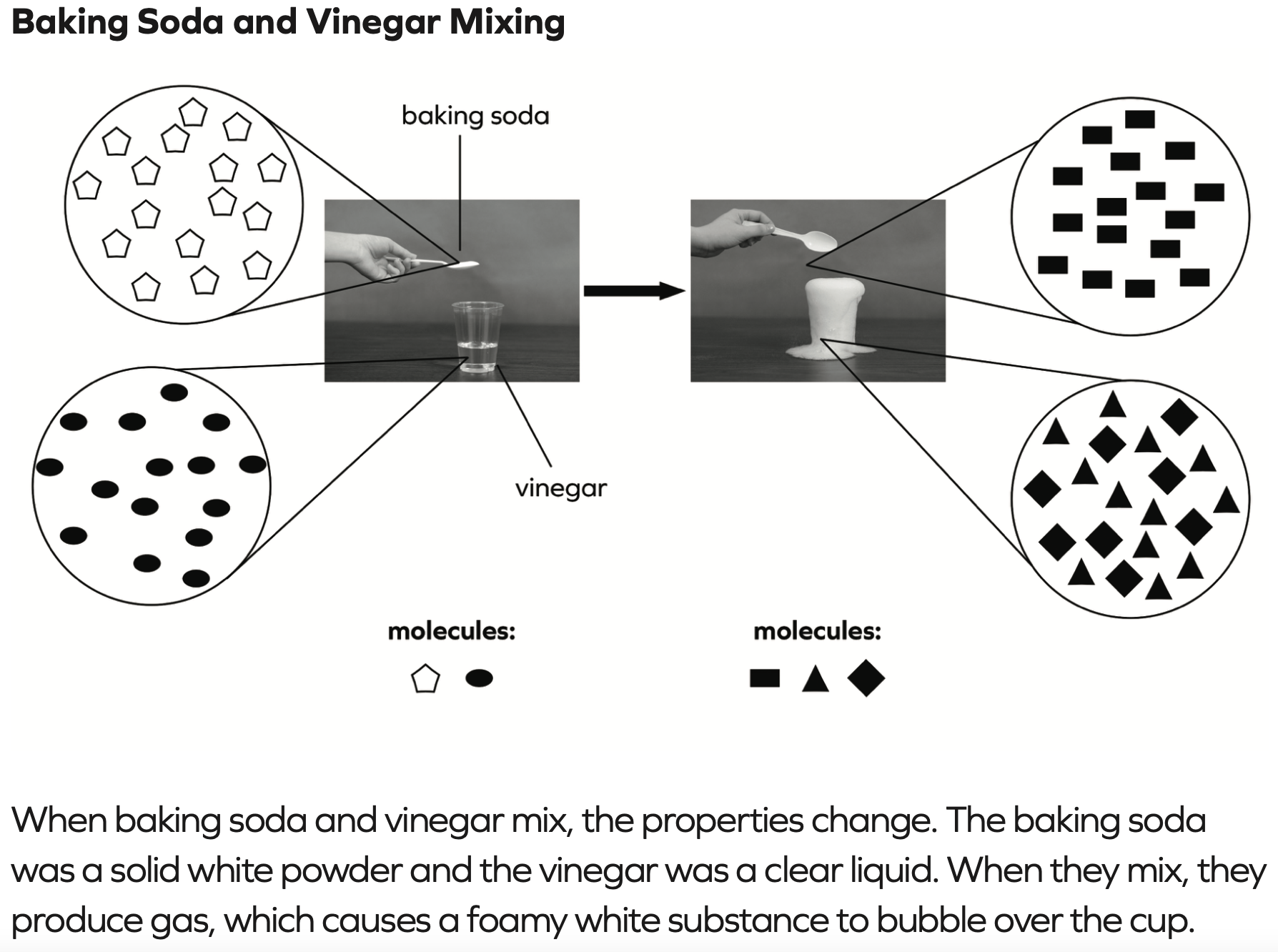
Baking Soda and Vinegar Mixing: Did a new substance (with new molecules) form?
Baking Soda and Vinegar Mixing: Is this a chemical reaction?
Chemical Reaction - Substances are mixed and at least one new substance with different properties (with different molecules) is formed.
Chemical Formula: CH3COOH + NaHCO3 → CH3COONa + CO2 + H2O.
Do this model-->
Baking Soda and Vinegar
Go to the amplify model by clicking this link: https://apps.learning.amplify.com/modelingtool/#/tool/175/level/53_Baking_Soda_and_Vinegar_id_2970
1. Together with your class, use the Baking Soda and Vinegar Model to show which atoms make up the molecules that form after baking soda and vinegar react.
2. Look at the molecule key to see which atoms are in each molecule.
Sodium acetate molecule - 1 sodium atom, 2 carbon atoms, 2 oxygen atoms, 3 hydrogen atoms
Water molecule - 1 oxygen atom, 2 hydrogen atoms
Carbon dioxide - 1 carbon atom, 2 oxygen atoms

Use this diagram / model to answer the questions below:
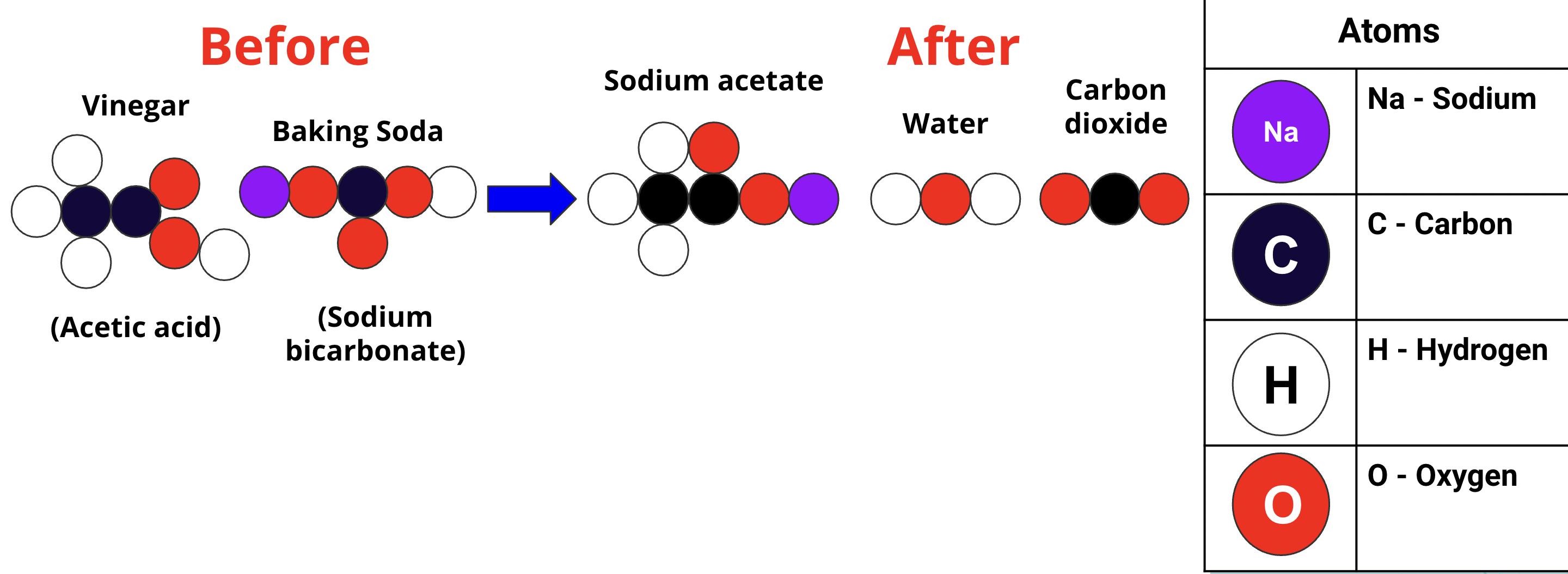
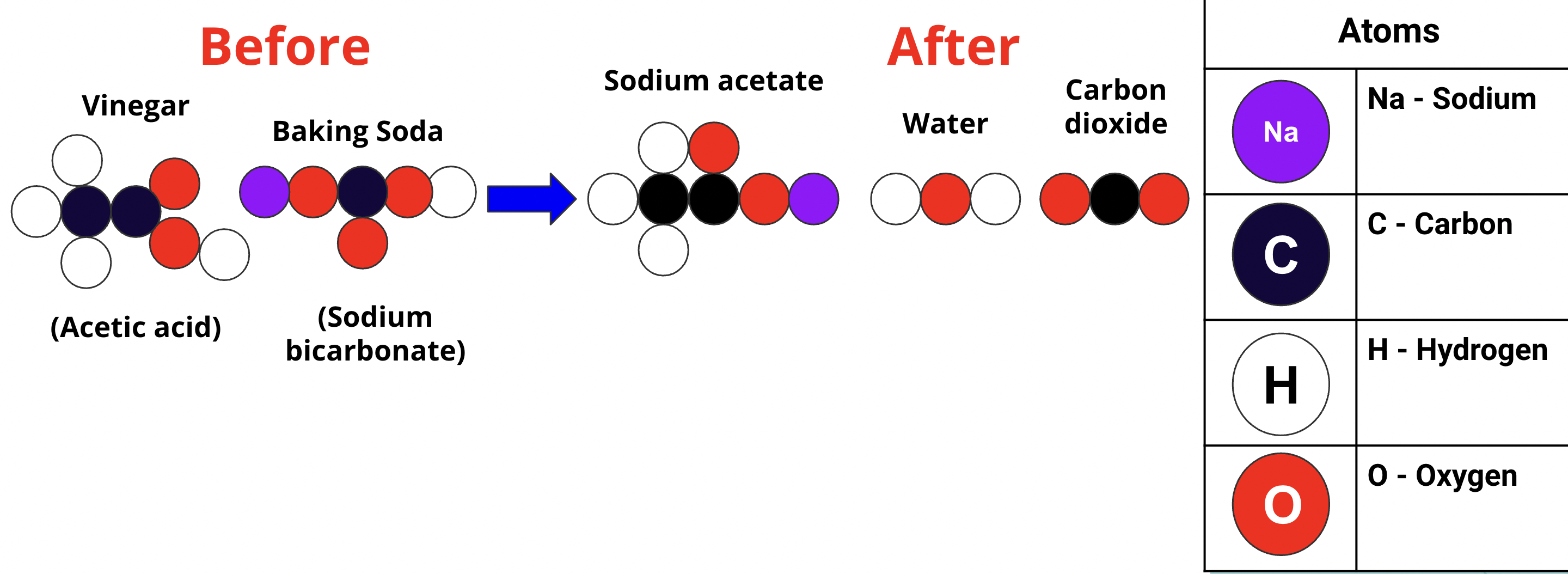
What do you notice about the number of atoms of each substance (chemical) BEFORE and AFTER the chemical reaction?
Was there a chemical reaction? How do you know?
Do any atoms appear or disappear during a chemical reaction? How do you know?
What did you notice at the nanoscale?
Ice Melting: Is this a chemical reaction?
What did you notice at the nanoscale?
Ice Melting: Is this a chemical reaction?
Paint Mixing: Is there evidence of a chemical reaction?
Paint Mixing: Explain why this is not a chemical reaction?
Sentence starter: Paint mixing is not a chemical reaction because _____________
Baking Soda and Vinegar Mixing: Is there evidence of a chemical reaction?
Baking Soda and Vinegar Mixing: Explain why this is not a chemical reaction?
Sentence starter: Baking Soda and Vinegar mixing is a chemical reaction because _____________
How many Sodium (Na) atoms are there BEFORE the chemical reaction?
How many Sodium (Na) atoms are there AFTER the chemical reaction?
How many Carbon (C) atoms are there BEFORE the chemical reaction?
How many Carbon (C) atoms are there AFTER the chemical reaction?
How many Hydrogen (H) atoms are there BEFORE the chemical reaction?
How many Hydrogen (H) atoms are there AFTER the chemical reaction?
How many Oygen (O) atoms are there BEFORE the chemical reaction?
How many Oygen (O) atoms are there AFTER the chemical reaction?