Log in
Sign up for FREE
arrow_back
Library
APUSH Period 7.2 (Ch. 31-32) Quiz - SY23
By Haiyen Truong
star
star
star
star
star
Share
share
Last updated over 1 year ago
11 questions
Add this activity
Required
1
IICI.01
KC 7.3.II
WOR 2.0
Required
1
IIUR.01
KC 7.3.II
WOR 2.0
Required
1
IIUR.01
KC 7.1.I
WXT 2.0
Required
1
IIUR.01
KC 7.1.III
Required
1
KC 7.3.I
RPV.01
WOR 2.0
Required
1
IIRC.01
KC 6.3.II
POL 3.0
Required
1
IICI.01
KC 7.1.III
Required
1
IICI.01
KC 7.1.II
WXT 2.0
Required
1
IIUR.01
KC 7.1.III
WXT 2.0
Required
1
KC 7.1.II
RAG.01
WXT 2.0
0
Question 1
1.
Review:
According to the principle of “popular sovereignty,” the question of slavery in the territories
the Supreme Court.
the vote of the people in the given territory.
a national referendum of the Electoral College.
the state legislature after a territory was admitted to the Union.
Chapter 31:
The Politics of Boom and Bust (1920-1929)
Question 2
2.
As a result of America's insistence that all Allied WWI (not WWII) debts be repaid,
the Allies raised tariff rates on American products even higher.
the French and British demanded enormous reparations payments from Germany.
the French and British people were subjected to ruinous tax rates.
the British and French governments froze all U.S. bank accounts in their countries.
Question 3
3.
The Great Depression can be blamed in part on the
excessive foreign trade.
over taxation of businesses.
overextension of credit.
repeated crop failures in the 1920s.
Question 4
4.
In America, the onset of the Great Depression in 1930 caused
an increase of foreign investment because prices were so low with the decline of the United States economy.
people to blame, at first, the economic system, not their own personal failings for their catastrophic economic and social problems.
a decade-long decline in the birthrate as many Americans were no longer in a place where they could financially support children.
a growing acceptance by business and Wall Street of the need for federal regulation of financial markets and business practices.
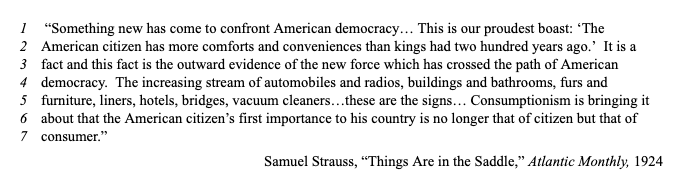
Questions 5-6 refer to the following excerpt.
Question 5
5.
Which of the following economic developments most directly contributed to the situation described in the passage?
The expansion of the nation’s resource base
The success of Progressive reforms
The decline of large corporations
The development of assembly line production
Question 6
6.
The rise of the society described in the passage occurred amidst a general
decline in social conflict.
reduction of business profits.
expansion of civil rights.
rise in the standard of living.
Chapter 32:
The Great Depression and the New Deal (1933-1939)
Question 7
7.
Franklin Roosevelt’s New Deal was most notable for
undermining state and local governments through the expansion of the federal government.
being the sole reason for the end of the Great Depression.
providing moderate reforms to the U.S. economy and relief to those affected by the Great Depression.
attacking the American capitalist system with little-to-no provocation.
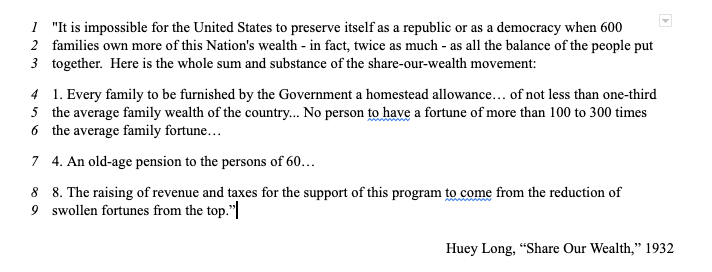
Questions 8-10 refer to the following excerpt.
Question 8
8.
Which of the following events prompted the reforms called for in this passage by Huey Long?
The Gilded Age
The Great Depression
The Roaring 20s
The rise of segregation
Question 9
9.
Calls for reform such as the one in the passage would lead to
conflict between urban and rural interests
the expansion of New Deal reforms.
official restrictions on freedom of speech.
calls for federal regulation of the environment.
Question 10
10.
Statements such as this one reflected the concerns of some Americans that
corporations had too much power in national politics.
the financial regulatory system needed to be strengthened significantly.
the federal government’s reform efforts were not extensive enough to address the crisis.
the Democratic Party had gone too far to advance the interests of the working class.
Question 11
11.
Almost done with Period 7 (1890-1945)! How are you feeling? Any feedback, questions or concerns about the upcoming AP Exam (Friday, May 5th, 2023)?
visibility
View drawing