Content Objective: I will be able to determine the short-term and long-term success of the Missouri Compromise.
Standard Objective: I will be able to draw reasonable inferences and logical conclusions from text.
Content Objective: I will be able to determine the short-term and long-term success of the Missouri Compromise.
Standard Objective: I will be able to draw reasonable inferences and logical conclusions from text.
Warm Up Question:
Question 1
1.
If a compromise resolves (fixes) conflict short-term, but not long-term, is it still beneficial to compromise? Why or why not?
Building Knowledge Together: Guided Notes
Let's make sure we're all on the same page before moving forward!
0
Question 2
2.
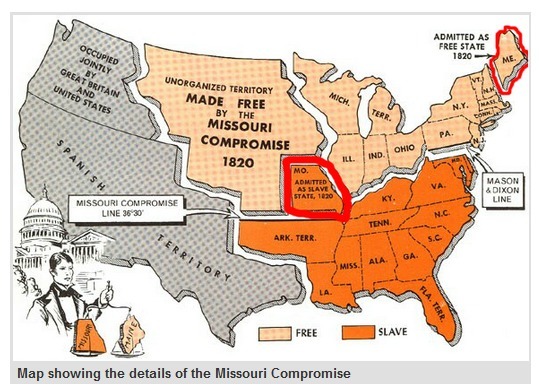
Examine the details of the secondary source map to the left. Based on the map, what can you infer (gather) about the terms of the Missouri Compromise in 1820?
Question 3
3.
When Missouri applied to become a state in 1820, there were currently _______ free states and 11 _______ states.
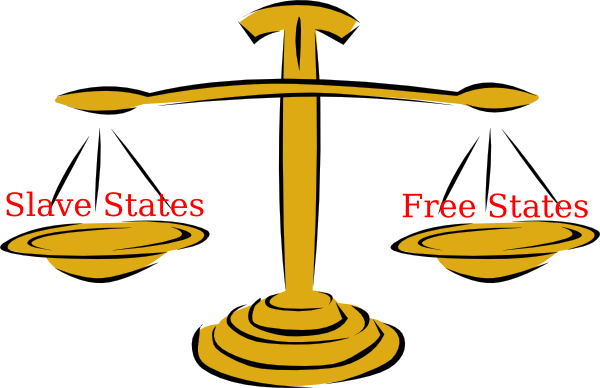
The addition of Missouri into the United States would have upset the _______ of free states and slave states, so Henry Clay proposed a compromise which allowed Missouri to join as a _______ state if Maine joined as a free state, thereby keeping the balance between Northern and _______ state representation equal in the _______ .
This agreement is known by historians as the Missouri Compromise that established the 36°30' line, which determined that all states _______ the line would become free states - except for _______ - while all states below the line would become slave states.
Applying Knowledge: Partner Read
Now it's your turn to read up on the Missouri Compromise and its historical significance.
1
CCSS.ELA-LITERACY.RH.11-12.1
IIRC.01
1
CCSS.ELA-LITERACY.RH.11-12.5
RPU.01
1
CCSS.ELA-LITERACY.RH.11-12.3
IIUR.01
1
CCSS.ELA-LITERACY.RH.11-12.1
IIRC.02
1
CCSS.ELA-LITERACY.RH.11-12.1
IIRC.02
Required
1
IIRC.02
Required
1
CCSS.ELA-LITERACY.RH.11-12.1
IITE.01
1
CCSS.ELA-LITERACY.RH.11-12.4
IIWD.01
1
CCSS.ELA-LITERACY.RH.11-12.5
RTS.02
Still feeling confused? Check out this 2 minute video for more support!
Question 13
13.
Close Out: After completing the reading and guided notes, explain what the Missouri Compromise was in your OWN words in at least one complete sentence.
Question 4
4.
According to the passage, the reaction to the Missouri Compromise can best be described as
Question 5
5.
The MOST likely reason for including information about the Kansas-Nebraska Act is to show
Question 6
6.
Which answer choice BEST describes the central tension that led to the Missouri Compromise?
Question 7
7.
It can be reasonably inferred that "self-determination" is
Question 8
8.
The passage indicates that Thomas Jefferson believed that the question over slavery would eventually lead to
Question 9
9.
Based on the information in the passage, it can be reasonably inferred that
Question 10
10.
Which choice provides the best evidence for the answer to the previous question? (from Paragraph 4)
Question 11
11.
As used in the sentence, "sentiment" most nearly means
Question 12
12.
The final paragraph develops a key concept of the article by
Northern states believed permitting more slave states to join the union would encourage more slaves to rebel; slave states argued allowing more slave states would prevent any further rebellion.