**3.1 Classwork & Homework: The Missouri Compromise
star
star
star
star
star
Last updated almost 2 years ago
12 questions
Note from the author:
0
0
Required
0
0
Content Objective: I will be able to determine the short-term and long-term success of the Missouri Compromise.
Standard Objective: I will be able to draw reasonable inferences and logical conclusions from text.
Content Objective: I will be able to determine the short-term and long-term success of the Missouri Compromise.
Standard Objective: I will be able to draw reasonable inferences and logical conclusions from text.
Warm Up Questions:
Question 1
1.
What is a compromise? Note: this was a vocabulary term last semester and should be review!
Question 2
2.
If a compromise resolves (fixes) conflict short-term, but not long-term, is it still beneficial to compromise? Why or why not?
Building Knowledge Together: Guided Notes
Let's make sure we're all on the same page before moving forward!
Required
0
Question 3
3.
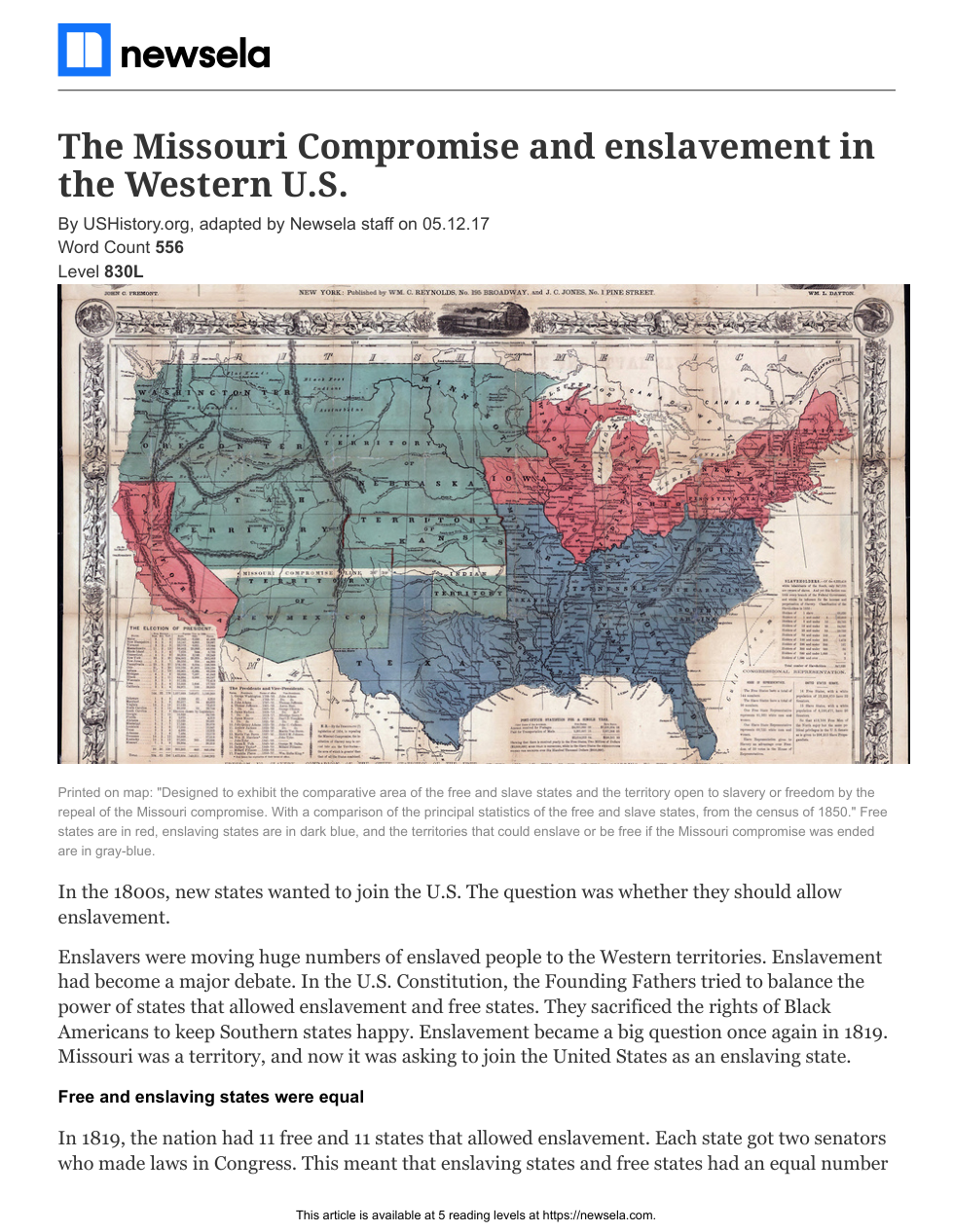
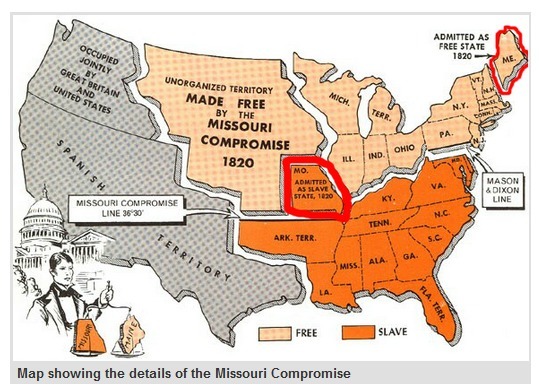
Examine the details of the secondary source map to the left. Based on the map, what can you infer (gather) about the terms of the Missouri Compromise in 1820?
Question 4
4.
When Missouri applied to become a state in 1820, there were currently _______ free states and 11 _______ states.
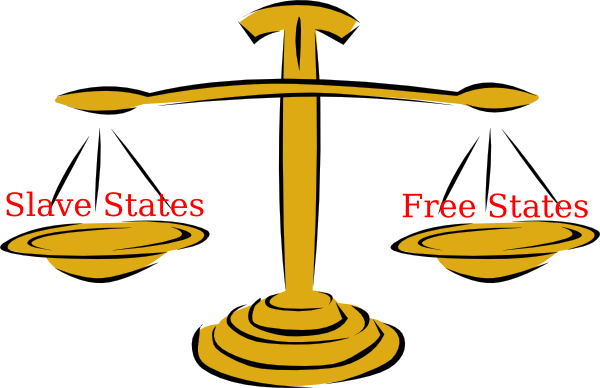
The addition of Missouri into the United States would have upset the _______ of free states and slave states, so Henry Clay proposed a compromise which allowed Missouri to join as a _______ state if Maine joined as a free state, thereby keeping the balance between Northern and _______ state representation equal in the _______ .
This agreement is known by historians as the Missouri Compromise that established the 36°30' line, which determined that all states _______ the line would become free states - except for _______ - while all states below the line would become slave states.
Applying Knowledge: Group Read Together and Answer the Questions
Now it's your turn to read up on the Missouri Compromise and its historical significance.
Required
1
Required
1
Required
1
Required
1
Required
1
Required
1
Required
1
Still feeling confused? Check out this 2 minute video for more support!
Question 12
12.
Close Out: After completing the reading and guided notes, explain what the Missouri Compromise was in your OWN words in at least one complete sentence.
Question 5
5.
Read the map- what color are the free states?
Question 6
6.
Question 7
7.
Question 8
8.
Question 9
9.
Question 10
10.
Question 11
11.
The blue states- enslaved states- where located mostly in the-
North
West
South
What was the author's purpose of writing this article?
The author wrote this article to persuade readers that the Missouri Compromise did not work
The author wrote this article to explain how the debate about slavery created a lot of conflict in the development of the United States.
The author wrote this article to describe different opinions politicians had about whether slavery should be allowed in the United States or not.
What were the 2 parts of the Missouri Compromise?
Missouri was not allowed to become a slave state and a boundary was drawn to define which states could be free or have enslave people in the future
Missouri became a slave state, Maine became a free state and a boundary was drawn to define which states could be free or have enslave people in the future
Maine & Missouri both became slave states and the Kansas-Nebraska Act was passed
The passage indicates that Thomas Jefferson believed that the question over slavery would eventually lead to
a fight between Democrats and Republicans.
the formation of an entirely new country.
a devastating civil war.
Based on the information in this paragraph, it can be reasonably inferred that
slave rebellions often led to harsh consequences for the Black community.
most slaves joined in rebellions when they were able to.
although Vesey's slave revolt was unsuccessful, many rebellions were successful.
The final paragraph develops a key concept of the article by
illustrating that many people viewed western expansion more negatively than positively.
demonstrating how the Missouri Compromise affected attitudes towards slavery and rebellion
showing that Southerners were more likely to dislike the Missouri Compromise than Northerners.