When Charles Darwin first proposed the idea that all new species descend from an ancestor, he performed an exhaustive amount of research to provide as much evidence as possible. Today, the major pieces of evidence for this theory can be broken down into the fossil record, embryology, comparative anatomy, and molecular biology.
How do organisms acquire traits?
Which Phylogenic tree supports the claim below?
Whales are more closely related to humans than to fish.
Over time, unrelated (or very distantly related) organism can develope similar traits. What is the best explanation for this?
Structures or behaviors that help an organism survive are called: _________
Scientists are analyzing 4 different skulls belonging to 4 different species. Which skull is likely unrelated to the other 3?
Below, you will see multiple lines of evidence. Analyze each piece of evidence.
There are no "correct" answers for #6-14. This is YOUR opinion based on the evidence presented.
After looking at all of the data presented, you will be asked to make a claim on the classification of the giant panda.
You will also be asked to support your claim with evidence.
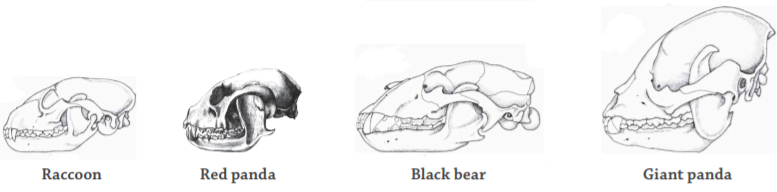
Skull Anatomy:
Analyze the images of the skulls below and select the best answer for this piece of evidence.
Both the giant panda and the red panda have strong jaw muscles, which help them chew tough bamboo stalks. Their skulls are extra-thick, and the places where the jaw muscles attach (the ridge at the top of skull and the upward-curving part of the lower jaw) are enlarged.
(Raccoon, black bear, and giant panda images modified from O’Brien, p. 105.)
Which statement does this evidence support?
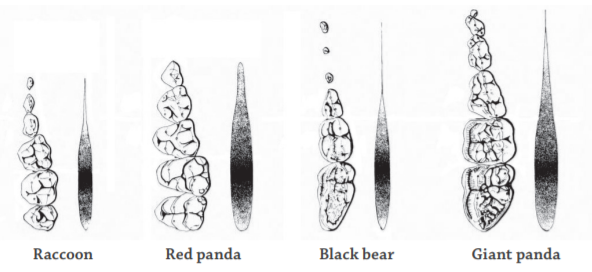
Tooth Anatomy:
Analyze the images of the teeth below and select the best answer for this piece of evidence.
The drawings below show the chewing surfaces of the teeth, along with a visual summary of their surface area, which affects how well they can grind tough food. (Images modified from Davis, p. 129.)
Which statement does this evidence support?
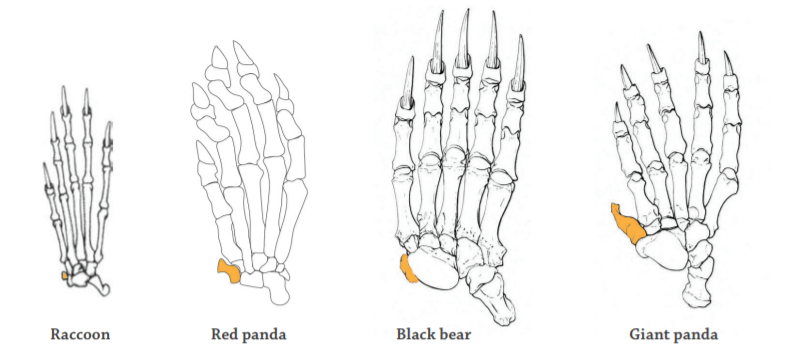
Paw Anatomy:
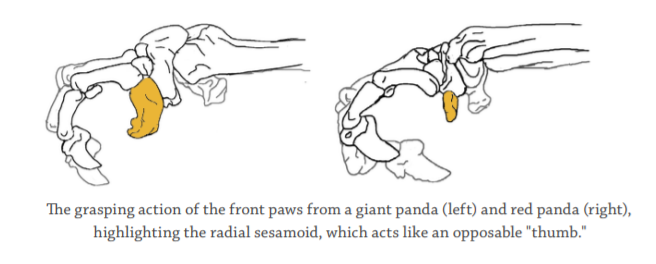
Analyze the images of the front paw skeletonal structure below and select the best answer for this piece of evidence.
Both the giant panda and the red panda have an opposable “thumb” (highlighted). In both cases, the thumb is actually a greatly enlarged and modified wrist bone. A smaller version of this bone is present in bears, raccoons, and other carnivores. It helps the pandas handle bamboo as they eat it. (Black bear and giant panda images modified from Davis, p. 30. Red panda based on Abella 2006, Figure 1.)
Which statement does this evidence support?
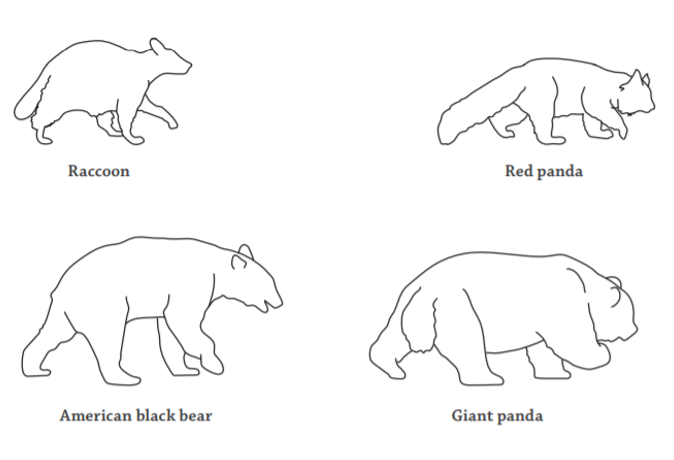
Movement:
Analyze the images of movement below and select the best answer for this piece of evidence.
Compare the movement of the American black bear, the Giant panda, the Red panda, and the Raccoon.
In 1964, an biologist named D. Dwight Davis published a detailed anatomy study of the giant panda and some of its relatives. Working from zoo animals that had died naturally, Davis and his team took measurements and made drawings of the bones, muscles, joints, blood vessels, nerves, brain, glands, organs, and more—enough to fill a 340-page book. Some of the findings are summarized below.
Which statement does this evidence support?
Molecular Evidence:
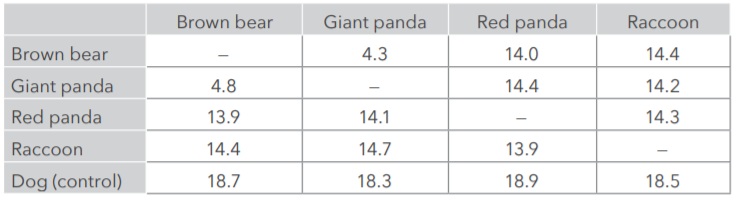
Tools for molecular biology during the mid-1980s were fairly simple compared to today's tools. Researchers did not have access to very many DNA sequences, so it was difficult to compare them directly. But they did have other ways of estimating similarity. One estimate relied the fact that single-stranded DNA molecules will "hybridize" with each other through complementary base pairing, as long as their DNA sequences are similar enough.
The data below summarize the results of a DNA hybridization experiment. Researchers mixed radioactive single-stranded DNA from one species (left column) with DNA from another species (top row), and then they measured their ability to hybridize with one another. The numbers show "stability units": a lower number means that the DNA sequences were more similar (the DNA hybridized at a higher rate) (data from O'Brien et al, 1985).
Which statement does this evidence support?
Molecular Evidence: Hemoglobin
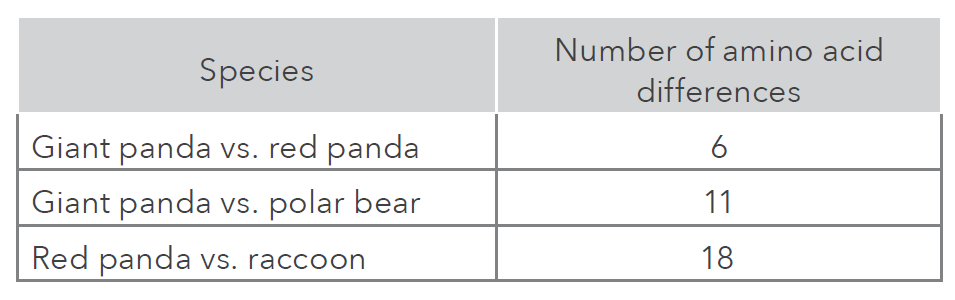
In 1986, a group of researchers published an analysis of beta hemoglobin amino acid sequences.
They made pair-wise comparisons of the amino acids sequences of hemoglobin proteins from a
variety of species. The table shows the number of amino acid differences out of 287 amino acids
total (data from Tagle et al, 1986).
The lower the number, the fewer differences in the DNA sequence.
Which statement does this evidence support?
The Origin of the Pandas' "Thumbs"
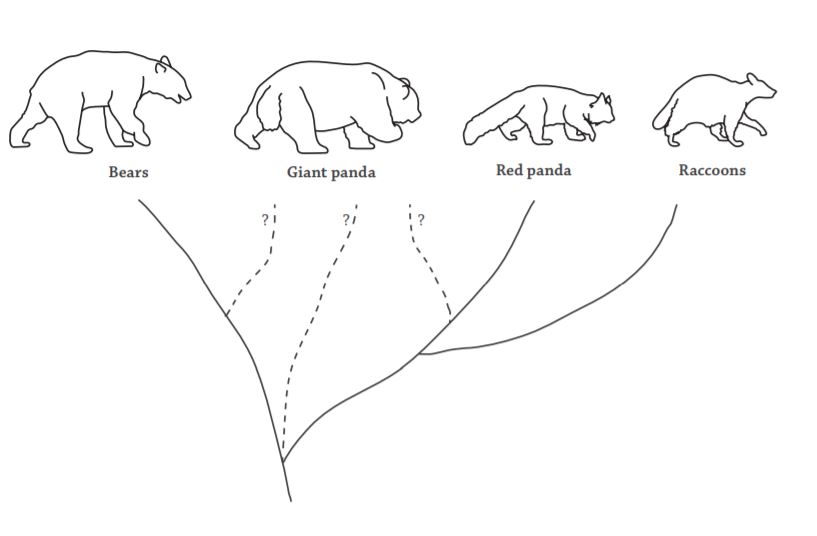
Both the giant panda and the red panda have an enlarged wrist bone that serves as an opposable "thumb" that helps the paws hold and manipulate bamboo. Over the years, some scientists have argued that this enlarged wrist bone must have been present in a bamboo-eating ancestor to both pandas, and others have argued that it could have arisen later and separately in both pandas (Image adapted from Abella, Figure 8).
Which statement does this evidence support?
Fossil Record:
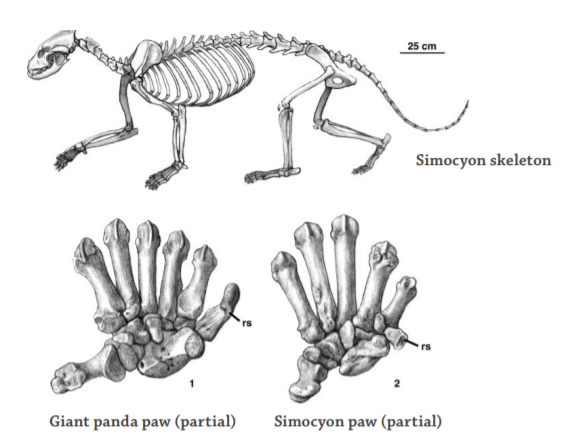
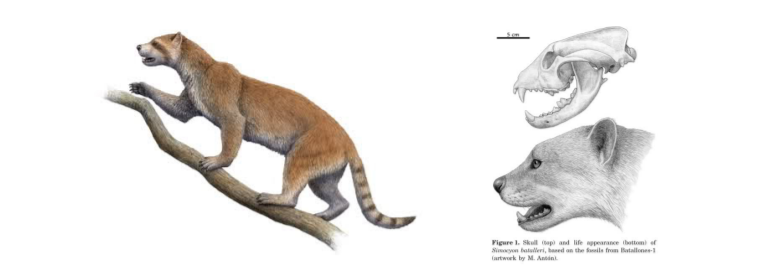
Simocyon batalleri
Simocyon lived between about 5 and 12 million years ago. A 2006 publication describes two nearly complete fossils from a cave in Spain. Among the fossilized remains were forelimbs, which had an enlarged wrist bone (the radial sesamoid) (Graphic: Salesa et al, Figure 1).
Which statement does this evidence support?
Fossil Record:
Simocyon batalleri
Simocyon shared many traits with modern red pandas, and the two clearly belong to the same lineage. One important difference, though, is in the jaws and teeth. Simocyon does not have the large, flattened molars or extra-strong jaw muscles of the red panda. Instead, its teeth look more like those of carnivores, suggesting that this ancestor did not eat bamboo or any other tough plants. So if Simocyon had a "thumb" but didn't use it for handling bamboo, then what was it for? Researchers think it helped the animal hold onto thin tree branches as it walked along them. (Below: Artistic renderings of Simocyon from Anton)Simocyon lived between about 5 and 12 million years ago. A 2006 publication describes two nearly complete fossils from a cave in Spain. Among the fossilized remains were forelimbs, which had an enlarged wrist bone (the radial sesamoid) (Graphic: Salesa et al, Figure 1).
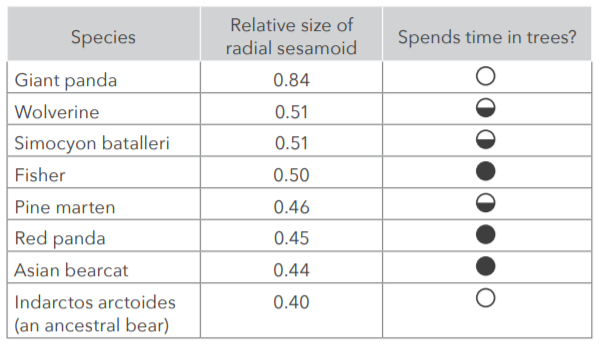
The Radial Sesamoid is Not Unique to Pandas In a 2015 study, researchers measured the radial sesamoid bones in several carnivores, both fossilized and living. They learned that this bone is enlarged in many carnivores, especially those that spend time in trees. The table below shows the size of the radial sesamoid bone relative to the size of the animals' paws (table modified from Abella, 2015):
Which statement does this evidence support?
Claim and Evidence:
Make a claim about the Giant panda and use the evidence above to support your claim.
Which organism shares the most recent common ancestor with the Giant panda?
How does the evidence you analyzed support your claim? (use at least 4 pieces of evidence)
To earn credit on #6-14, you must complete this question.