TPT - 5th Grade Informational Assessment (Bees/Destination)
star
star
star
star
star
Last updated over 3 years ago
18 Nsɛmmisa
How do paragraphs 7 and 11 contribute to the overall structure of the passage?
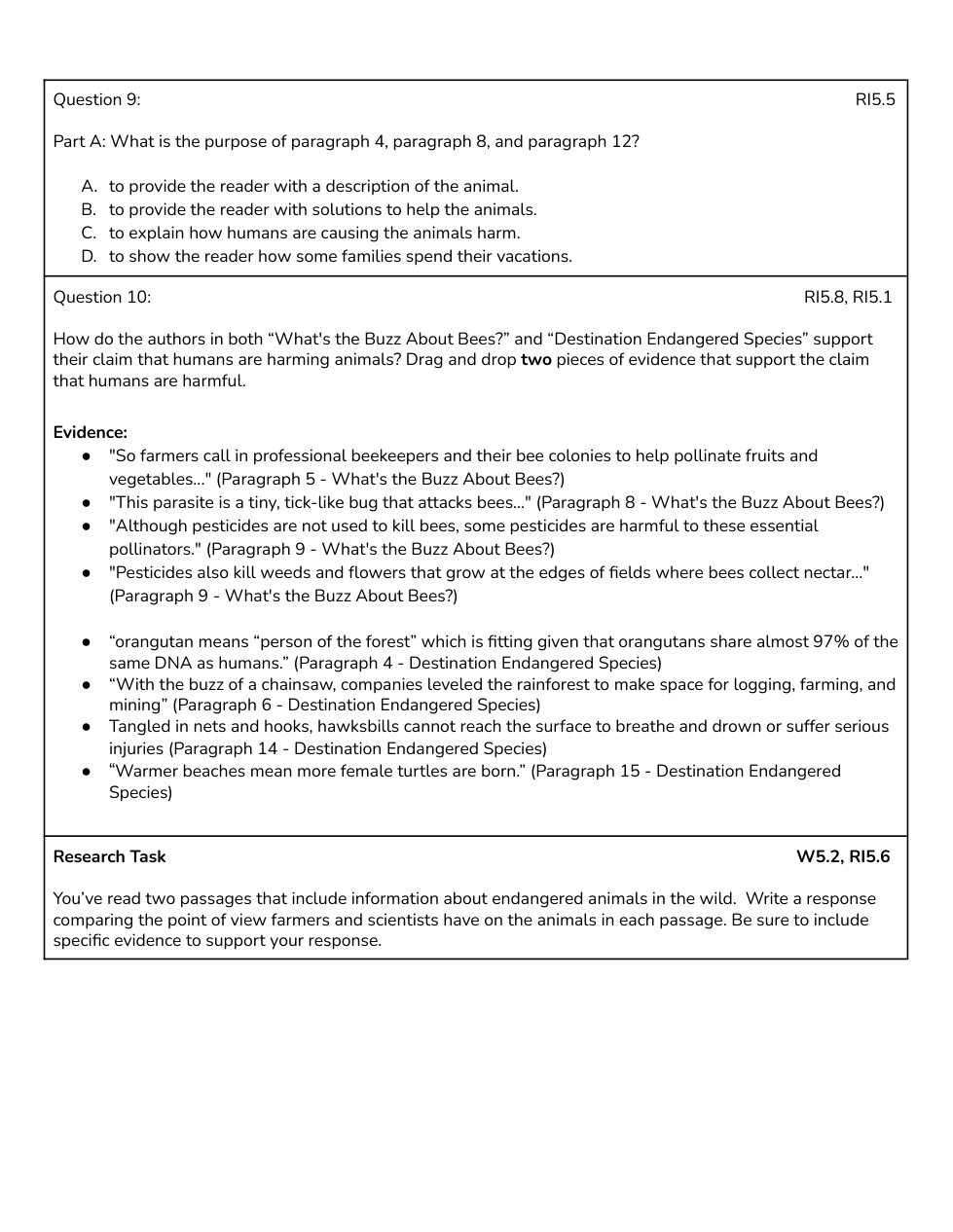
How do the authors in both “What's the Buzz About Bees?” and “Destination Endangered Species” support the claim that humans are harming animals?
"So farmers call in professional beekeepers and their bee colonies to help pollinate fruits and vegetables..." (Paragraph 5 - What's the Buzz About Bees?)
"This parasite is a tiny, tick-like bug that attacks bees..." (Paragraph 8 - What's the Buzz About Bees?)
"Although pesticides are not used to kill bees, some pesticides are harmful to these essential pollinators." (Paragraph 9 - What's the Buzz About Bees?)
"Pesticides also kill weeds and flowers that grow at the edges of fields where bees collect nectar..." (Paragraph 9 - What's the Buzz About Bees?)
“...orangutan means “person of the forest” which is fitting given that orangutans share almost 97% of the same DNA as humans.” (Paragraph 4 - Destination Endangered Species)
“With the buzz of a chainsaw, companies leveled the rainforest to make space for logging, farming, and mining” (Paragraph 6 - Destination Endangered Species)
Tangled in nets and hooks, hawksbills cannot reach the surface to breathe and drown or suffer serious injuries (Paragraph 14 - Destination Endangered Species)
“Warmer beaches mean more female turtles are born.” (Paragraph 15 - Destination Endangered Species)
“What's the Buzz About Bees?”
Drag and drop two pieces of evidence that support the claim that humans are harmful.
“Destination Endangered Species”
Drag and drop two pieces of evidence that support the claim that humans are harmful.
What does the word “unknowingly” mean as it's used in paragraph 4?
Choose one detail from the text that best supports the answer to part A.
What sentence states the main idea found in the passage?
Choose two paragraphs that support your answer to Part A.
Based on the passage, how does Colony Collapse Disorder affect the bees?
Choose one detail from the text that best supports the answer to part A.
Which statement best describes the relationship between farmers and beekeepers in the article?
Choose two details from the text that best supports the answer to part A.
Which paragraph serves a similar purpose as the answer to Part A?
What does the word striking mean as it's used in paragraph 13?
Choose one detail from the text that best supports the answer to part A.
What sentence states the main idea found in the passage?
According to the sections "#1 - BORNEO ORANGUTANS," and “#2 - AFRICAN FOREST ELEPHANT” which best describes the relationship between these animals and the growth of their ecosystem?
Which two pieces of evidence from the text best supports the answer to part A?
What is the purpose of paragraph 4, paragraph 8, and paragraph 12?
You’ve read two passages that include information about endangered animals in the wild. Write a response comparing the point of view farmers and scientists have on the animals in each passage. Be sure to include specific evidence to support your response.