According to the video, the type of energy possesed by an object or a system due to the constant movement of particles within the object or the system is a type of kinetic energy called
Watch the video in Discovery Education, under the Engage tab.
This Formative will cover Unit 3.2-3.5
This Formative will cover Unit 3.2-3.5
Energy is defined as the ability to do
Energy be made from nothing. We have to convert it from other forms to make electricity. Many power plants rely on fossil fuels which are a source of energy. The energy in fossil fuels such as oil and coal is a form of energy. Once we run out of fossil fuels, we will have to rely on alternative energy sources, such as wind and solar which sustainable.
According to the video, the type of energy possesed by an object or a system due to the constant movement of particles within the object or the system is a type of kinetic energy called
Watch the video in Discovery Education, under the Engage tab.
Most of the energy on Earth originally came from the
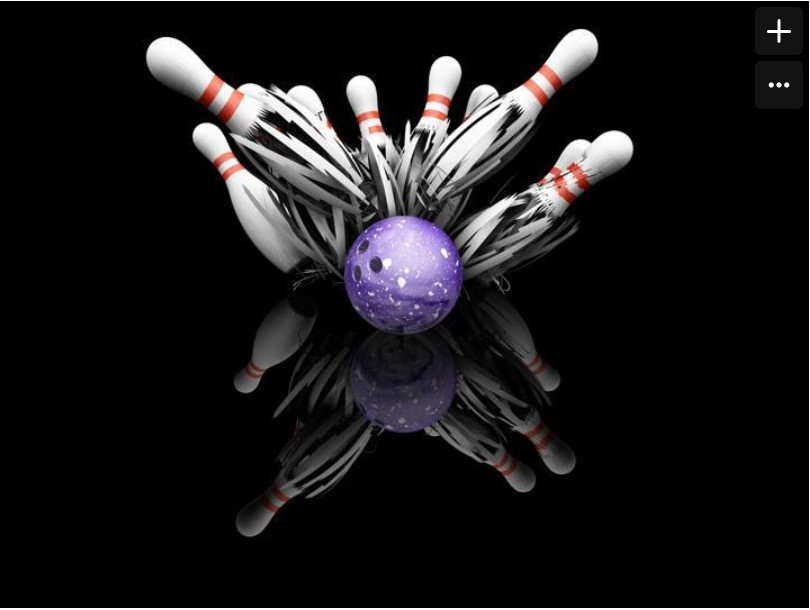
According to this picture, the bowling ball is energy and the pins are energy.
What does the law of conservation of energy state?
Stored energy is also known what kind of energy?
Energy of motion is also referred to as what type of energy?
In 1780, Charles Coulomb determined that the strength between two charges depended on the amount of
Which of the following relates to Coulombs law?
According to Coulomb's law, the force between two charged objects as the charge of either object increases.
According to Coulomb's law, the force between two objects as the distance between the objects increases.
Two copper spheres are currently 1.2 meters apart. One sphere has a charge of +2.2 × 10⁻⁴ C and the other has a charge of –8.9 × 10⁻⁴ C. What is the force between the charged spheres? Is the force attractive or repulsive?
Two metal rods in a factory are oppositely charged and placed 8.9 cm apart. One rod has a charge of 7.5x10⁻⁷ C and the other has a charge of -5.1x10⁻⁵ C. What is the force between the rods. Is it an attractive or repulsive force?
Two charged objects in a laboratory are brought to 0.22 meters away from each other. If the force between the spheres is 4,550 N and the charge on one object is 9.9 x 10⁻⁵ C, what is the charge on the other object?
What is the force between two protons that are separated by 1.0 mm? The charge of a proton is 1.6x10⁻¹⁹ C.
The gravitational force is an interaction between any two objects in the universe that have
If there is a force of gravity between all objects that have mass, why don't two people standing near each other not get pulled together from gravity?
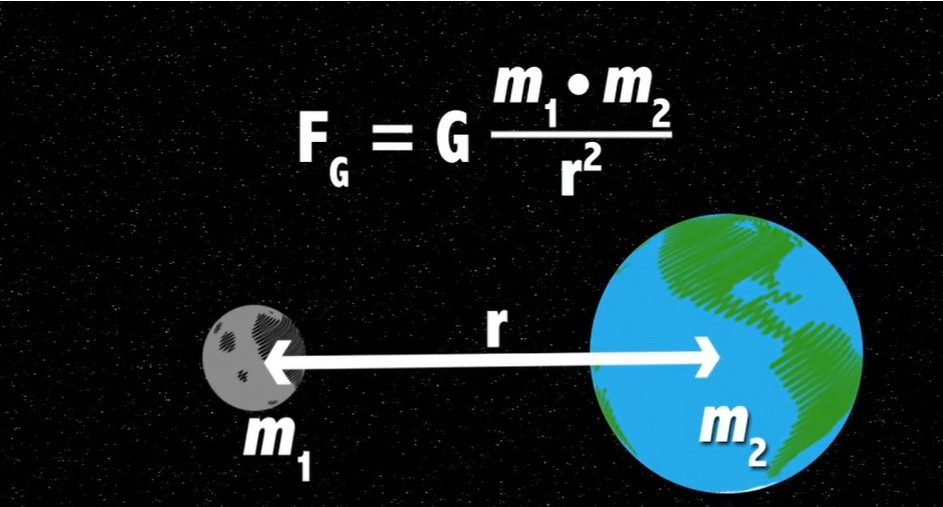
The force of gravity is calculated by finding the between G, m1 and m2.
The force of gravity is to the masses of two objects and to the distance between the objects.
Who discovered the law of universal gravitation?
The constant 'G', also known as the
If you had two objects and you doubled the mass of object one, then the force between them would. If you didn't change the mass but rather, decreased the distance between them by 1/2, then the force between them would .
Refer to this video in explore 2
A 485 kg sphere sits at 14.0 km due north of an 852 kg sphere. What is the force of gravity on the first sphere due to the second sphere? Compare this to the force of gravity on the second sphere due to the first sphere. (Show your work using the math symbol on the left toolbar)
If you recall, for calculating the force of gravity for objects near earth's surface, you can use Newton's 2nd Law of Motion. Knowing that as well as acceleration due to gravity (previously provided in your notes as well), what would be the Fg of a watermelon that had a mass of 3kg?
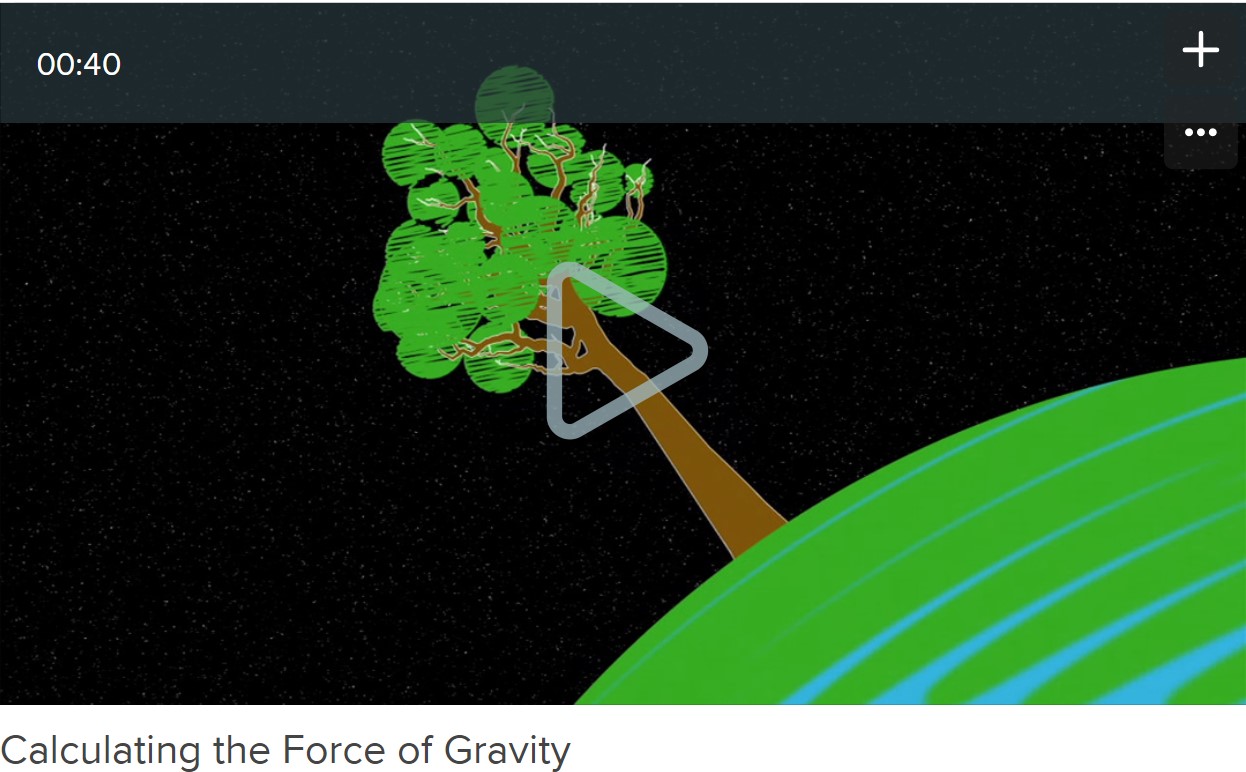
Refer to the above video if you need assistance
Draw the force diagram, as it relates to gravity, for the objects (use the drawing tools)
What is the distance between two objects if one (a 185,000 kg object) experiences a gravitational force of 0.00200 N due to a 225,000 kg object.
What is the acceleration due to gravity felt by the International Space Station? The ISS has a mass of 4.5 × 10⁵ kg and is in an orbit of about 380 km. Earth has a mass of 6.0 × 1024 kg and a radius of 6,400 km. (Assume G=6.67×10⁻¹¹N⋅m3⋅kg−1⋅s−2)
A 3.0 kg object sits at 2.0 m west of a 5.0 kg object. A 2.0 kg object sits at 2.5 m east of the 5.0 kg object. Find the center of mass of this system.
A spacecraft orbiting a planet at an altitude of 120 Km releases a satellite that falls toward the surface. The planet has a mass of 5.2 x 10²³kg and a radius of 2800 km. What is the acceleration of the satellite?
What element is the video referring to?
Why can't we 'harvest' (that is to say, why can't we get) hydrogen from the atmosphere (air)?
Instead of getting hydrogen from air, we can get it from water by splitting hydrogen from oxygen...but there's one problem...what is that problem?
What is the solution the speaker is suggesting for producing hydrogen with the least amount of energy?