Asemmisa {{asɛmmisaAhyɛnsode}}
15.
In Eastern Tennessee there are trees such as oak, maple, and beech that lose their leaves each year. What type of biome would these trees be found in?
Which non-living factor affects organisms living in the tundra?
Temperate forests have 4 distinct seasons
Coniferous trees are found in the taiga biome. What adaptation allows coniferous trees to survive there?
Look at the list of Temperate Deciduous Forest Adaptations. Why are ALL of these adaptations important in a temperate deciduous forest?
Temperate Deciduous Forest Adaptations
-Rabbits change their fur color to blend in with their surroundings.
-Birds migrate to warmer temperatures in the winter.
-Bears shed fur in summer and grow thick coats for winter.
Which of the following descriptions matches the deciduous forest biome?
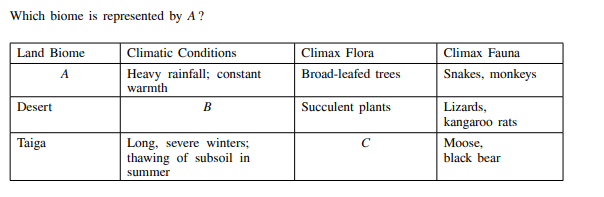
Found in regions close to the equator. Receive a lot of rain & warm temperatures throughout the year with constant sunlight. Many diverse animals & tall trees form a canopy.
Lots of trees that shed their leaves & grow new ones each year are found here. Receives 50 cm. of rain per year, enough to support the growth of trees & plants. Temperatures vary during the year with all the seasons. Many birds, opossums, bears, & porcupines are found here & may migrate or hibernate in the winter. Found in the eastern part of the United States.
Here in northern Canada you will find many trees that have needle like leaves & produce seeds in cones such as pine, fir, & spruce trees. Winters are very cold with much snow & summers are warm enough to melt the snow and bring much rain. Trees have a waxy covering, a necessary adaptation to keep water from evaporating since much of the year the water is frozen. Many herbivores live here such as deer, elk, moose, & beavers that attract large predators such as wolves, bears, & lynxes.
Extremely cold & dry biome located in the artic regions. Receives little precipitation like the desert but here most of the soil is permanently frozen. No trees grow here because of the permafrost not allowing for roots to grow. The top layer of soil thaws for grass to grow. Herbivores graze on the grass or lichen & have thick fur to withstand the freezing climate
There are no large trees in this biome due to the bitterly cold winters and because roots cannot penetrate the frozen ground.
Compare the Tundra vs the Taiga. Drag the correct descriptions under the correct biome. Number next to it is how many answers you should have! Watch out for the BOTH section!
Freezing temperatures
permafrost
bears/squirrels/rabbits/elk
cold year long
can grow tall evergreen tress
mild and wet summers
plants grow close to the ground
grasses/shrubs/moss
4 seasons
Animals hibernate/migrate
near the north pole
below freezing for half of the year
most coldest biome
reindeer/wolves/polar bears
plants have shallow roots
plants have needles to retain moisture
white fur
Largest land biome
plants have waxy fuzz
plants have deep roots
animals have thick fur or extra feathers
no trees
Cold winters
rain in the form of snow
Tundra (12)
BOTH (3)
Taiga (9)
Compare the Temperate Forest vs the Tropical Rainforest. Drag the correct descriptions under the correct biome. Number next to it is how many answers you should have! Watch out for the BOTH section!
2nd most rainfall
overgrazing/deforestation
animals have camouflage to help protect themselves
thick fur through winter months
warm and wet all year long
rich soil
drip tip leaves
mild temperatures
most species of any biomes
trees have thick bark
has dense vegetation
plants/animals can adapt to the changing seasons
FOUR Seasons
monkey/frogs/parrots/insects
most rainfall of any biome
black bears/bobcats
trees have thin bark
leaves change color and drop from trees
cold winters and hot summers
TWO seasons
found near equator
Temperate Forest (10)
BOTH (2)
Tropical Rainforest (9)
Match the correct plant and animals to their correct biome.
broadleaf deciduous tress, bushes, fern and evergreens
lichens, mosses, grasses, low woody shrubs
evergreen coniferous trees, lichens, mosses, shrubs
vines, various water tolerant trees and flowering plants
polar bear, caribou, arctic fox, arctic hare, snowy owl, walrus
black bear, white-tailed deer, squirrels, raccoons, birds
jaguar, anteater, monkeys, macaws, insects, amphibians
caribou, wolves, snowshoe hare, bison, lynx
Tundra
Taiga
Temperate deciduous forest
Tropical rainforest