Log in
Sign up for FREE
arrow_back
Library

CFU for 6.ESS3.1 and 6.ESS3.2

star
star
star
star
star
Last updated about 3 years ago
10 questions
1
1
1
1
1
1
1
1
1
1
6.ESS3.1
Question 1
1.

Question 2
2.

Question 3
3.

Question 4
4.

Question 5
5.

6.ESS3.2
Question 6
6.

Question 7
7.

Question 8
8.

Question 9
9.

Question 10
10.

What might happen if we continue burning fuels at the rate we do today? Choose the best answer.
The cost of fossil fuels may drop.
Fewer and fewer oil wells and coal mines may be constructed.
The earth's climate may change rapidly.
Automobiles will become less fuel-efficient.
Sally's class made a list of things that were used everyday by themselves and their families. Ms. Jennings, their teacher, asked the class which natural resources were renewable. Sally raised her hand and said "trees and cotton."
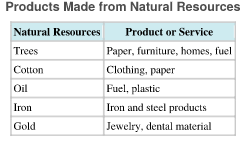

Why did Sally give those two resources as her answer?
Trees and cotton cannot be recycled.
As they are used, they can be replanted.
They are not used as fuels like the others.
Trees and cotton are not found in the ground.
To survive and advance, humans have used the natural resources in their environment for at least as long as recorded history. Some of these are renewable, like the wood from a forest. Some natural resources are not renewable, like oil pumped out of the ground. This is because we can use the wood from the forest and plant trees to replace what was taken. With oil, we cannot replace what we have used. When it is gone, it is gone for good.

What is another example of a resource that has a limited supply?
air
soil
coal
sunlight
One advantage of solar and wind power over fossil fuels is that
wind and solar are presently much less expensive than fossil fueld.
wind and solar come from natural processes and fossil fuels do not.
wind and solar are nonrenewable resources and fossil fuel are renewable.
wind and solar are continuously renewable and fossil fuels take millions of years to be renewed.
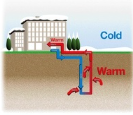
Hot water is pumped up from deep inside Earth and is used to heat homes or generate electricity. Which type of energy is being used?
biomass
hydroelectric
geothermal
nuclear power

Over the last several decades scientists have considered the problem of nonrenewable natural resources, such as fossil fuels. Humans are using fossil fuels at a rapid rate and scientists believe that one day, we will run out of usable fossil fuels. To solve this problem, research has been conducted on alternative energy sources. One alternative energy source is wind energy. Although wind energy is a good solution to this problem, it is not the perfect solution.

Which statement describes a drawback to wind energy?
Wind energy is a clean source of energy.
Good locations for turbines are limited.
Wind energy is inexpensive to set up and use.
Wind energy plants do not involve the use of hazardous chemicals.
Which alternative energy source does this information describe?
-Does not release pollution into the air.
-Located near rivers and large lakes
-Blades of a turbine turned by the movement of water.
Wind
Solar
Biofuels
Hydroelectric
Which of the methods of generating electricity does NOT use alternative energy resources?
Turbines spinning in a dam
Burning coal in a power plant
Solar panels taking in light energy
Drilling wells to reach hot rocks deep inside the earth
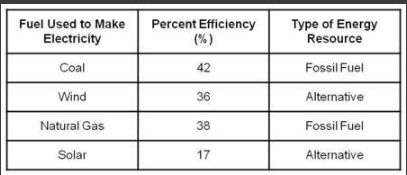
Based on the data collected, which source of alternative energy is most efficient?
Wind
Coal
Solar
Natural gas
What is a major reason solar energy is not used everywhere on a large scale?
It is too difficult to purchase and install solar panels.
Solar energy is not very effective at producing electricity.
The manufacture of solar panels produces too much pollution.
Solar panels are most efficient in places that receive lots of sunlight.