O Captain! My Captain!

Last updated over 2 years ago
15 questions
Note from the author:
Context of Lincoln's assassination, quick intro to elements of poetry, deconstruction and CER response to O Captain! My Captain!
Walt Whitman is considered the grandfather of modern American poetry. Largely self-taught, he broke from the traditional strictures of verse, writing long, robust lines brimming with populism, physicality, and personal content. Written to elegize the recently assassinated Abraham Lincoln, “O Captain, My Captain” strikes a distinctly patriotic note, and marked a departure from Whitman's typical style with its conventional meter and rhyme. The poem was collected into Leaves of Grass, of which Whitman wrote, "This is no book; who touches this touches a man."

Follow the directions for each of the questions to get a more in-depth understanding of Walt Whitman's poem about the death of Abraham Lincoln.
1
1
Required
1

Briefly summarize the assassination of Abraham Lincoln.

Required
1

What do you think is the biggest difference between poetry and prose (regular fiction or nonfiction writing)?

Required
1

What is your first reaction to this poem?

Required
1

Let's do a first read of Walt Whitman's poem to memorialize Abraham Lincoln, "O Captain! My Captain!" As you read, highlight all the words that rhyme (HINT: Repeated words are NOT Rhymes).

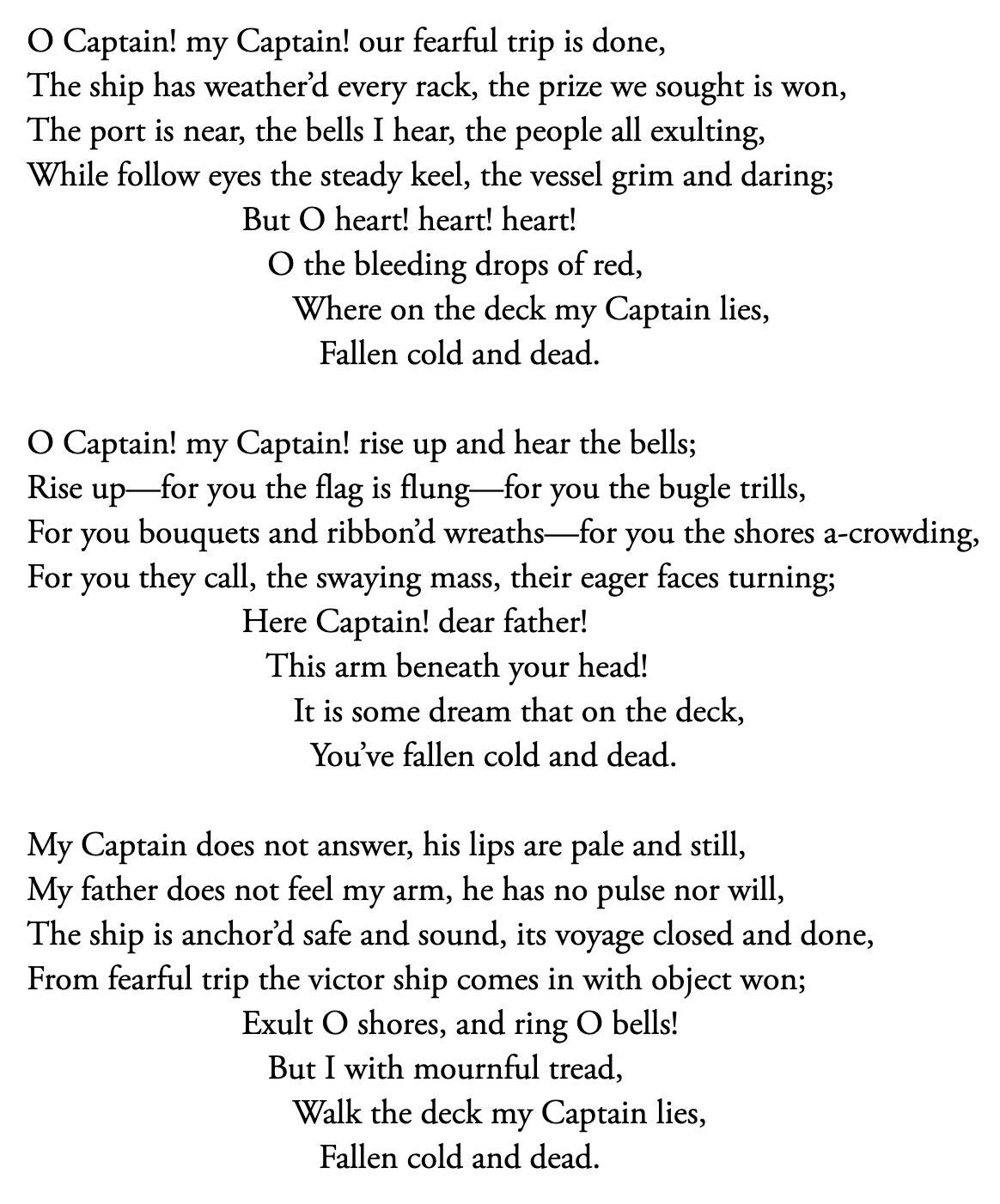
O Captain! my Captain! our fearful trip is done, The ship has weather'd every rack, the prize we sought is won, The port is near, the bells I hear, the people all exulting, While follow eyes the steady keel, the vessel grim and daring; But O heart! heart! heart! O the bleeding drops of red, Where on the deck my Captain lies, Fallen cold and dead. O Captain! my Captain! rise up and hear the bells; Rise up -for you the flag is flung -for you the bugle trills, For you bouquets and ribbon'd wreaths -for you the shores a-crowding, For you they call, the swaying mass, their eager faces turning; Here Captain! dear father! This arm beneath your head! It is some dream that on the deck, You've fallen cold and dead. My Captain does not answer, his lips are pale and still, My father does not feel my arm, he has no pulse nor will, The ship is anchor'd safe and sound, its voyage closed and done, From fearful trip the victor ship comes in with object won; Exult O shores, and ring O bells! But I with mournful tread, Walk the deck my Captain lies, Fallen cold and dead.
Required
1

Now, let's dive in a little deeper. As you read again, highlight all the examples of repetition (Alliteration/Consonance - repetition of CONSONANT sounds; Assonance - repetition of vowel sounds; Anaphora - repetition of phrases at the beginning of lines, phrases, stanzas; basic repetition - words, phrases in any part of the line/poem).

O Captain! my Captain! our fearful trip is done, The ship has weather'd every rack, the prize we sought is won, The port is near, the bells I hear, the people all exulting, While follow eyes the steady keel, the vessel grim and daring; But O heart! heart! heart! O the bleeding drops of red, Where on the deck my Captain lies, Fallen cold and dead. O Captain! my Captain! rise up and hear the bells; Rise up -for you the flag is flung -for you the bugle trills, For you bouquets and ribbon'd wreaths -for you the shores a-crowding, For you they call, the swaying mass, their eager faces turning; Here Captain! dear father! This arm beneath your head! It is some dream that on the deck, You've fallen cold and dead. My Captain does not answer, his lips are pale and still, My father does not feel my arm, he has no pulse nor will, The ship is anchor'd safe and sound, its voyage closed and done, From fearful trip the victor ship comes in with object won; Exult O shores, and ring O bells! But I with mournful tread, Walk the deck my Captain lies, Fallen cold and dead.
Required
1

One more time: As you read the poem for a third time, select all the lines that show you a metaphor in the poem.

O Captain! my Captain! our fearful trip is done, The ship has weather'd every rack, the prize we sought is won, The port is near, the bells I hear, the people all exulting, While follow eyes the steady keel, the vessel grim and daring; But O heart! heart! heart! O the bleeding drops of red, Where on the deck my Captain lies, Fallen cold and dead. O Captain! my Captain! rise up and hear the bells; Rise up -for you the flag is flung -for you the bugle trills, For you bouquets and ribbon'd wreaths -for you the shores a-crowding, For you they call, the swaying mass, their eager faces turning; Here Captain! dear father! This arm beneath your head! It is some dream that on the deck, You've fallen cold and dead. My Captain does not answer, his lips are pale and still, My father does not feel my arm, he has no pulse nor will, The ship is anchor'd safe and sound, its voyage closed and done, From fearful trip the victor ship comes in with object won; Exult O shores, and ring O bells! But I with mournful tread, Walk the deck my Captain lies, Fallen cold and dead.
Required
1

Match the metaphors to what they refer to:

Draggable itemCorresponding Item
The Captain
The United States
The Voyage
Abraham Lincoln
The Ship
The Civil War
Required
1
The poem “O Captain! My Captain!” is delivered mainly in __________ tense, from a __________ point of view.
Required
1

Select at least two quotes that best display the motif (repeated topic) of Admiration in the poem.

Required
1

What is most closely a theme of the poem?

Required
1

Choose the line from the poem that best supports the correct answer to the previous question.

Required
1

Place the events of the poem in chronological (time) order.

  1. The Captain is dead on deck.
  2. The narrator questions whether he is dreaming.
  3. The ship arrives
  4. The ship drops anchor in the harbor.
Required
5

Walt Whitman wrote this poem in 1865 to mourn the death of Abraham Lincoln. Explore how Whitman expresses emotion through metaphor, imagery, rhythm, and structure. What message or messages does this poem convey? Make sure you answer all parts of this question and follow CER format to construct your response.