Ɛhia
1
Q.3.d
Ɛhia
1
Q.3.d
Ɛhia
1
Q.3.d
Ɛhia
1
Q.3.d
Ɛhia
1
Q.3.d
Ɛhia
1
Q.3.d
Ɛhia
1
Q.3.d
Ɛhia
1
Q.3.d
Operations with numbers occur in many places and in various forms every day. Understanding how to perform basic operations with numbers will help you be successful on the job and at home with important tasks such as managing money or saving for retirement. You will also be able to better understand more complex math operations that are often needed in the workplace.
By the end of this unit you will be able to:
Order signed numbers, including fractions and decimals on a number line
Estimate answers and solve word problems
Work with fractions
Use ratios and proportions
Work with percents
One way to show numbers and their relationship to each other is on a number line. The markings on a number line divide the line into equal spaces. The arrows on a number line show that the numbers continue.
The number line below shows the whole numbers from 0 to 10. The set of whole numbers starts at 0 and includes the numbers you use for counting. On this number line, each mark represents 1.

In the following number line, we have zoomed in on the space between 0 and 1 where fractions or decimals would be located. Here, each space represents 1/4.
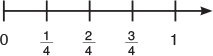
Values increase as you move to the right along the number line. What happens when you move to the left? They decrease.
Algebra includes the use of signed numbers. Signed numbers are either positive or negative. A negative number is written with a − sign.
A negative number has a value less than 0. Negative numbers are written to the left of 0.

Note: 0 is neither positive nor negative.
Positive numbers, to the right of 0, can be written with or without a + sign. Both +5 and 5 mean “positive 5.” A negative number must be written with a − sign.
Sometimes a negative number will have parentheses to help you see that the negative sign is attached to the number. Both −2 and (−2) mean “negative 2.”
whole numbers: the set of numbers that starts at 0 and is used for counting 0, 1, 2, 3, 4, 5, . . .
integer: any number in the set {..., −5, −4, −3, −2, −1, 0, 1, 2, 3, ...}
signed numbers: the set of numbers that includes positive and negative numbers. Zero is neither positive nor negative
positive: numbers greater than zero
negative: numbers less than zero
decimal point: point that separates the whole number from the fractional part or dollars from cents
An integer is any number in the following set: {... , −3, −2,−1, 0, 1, 2, 3, ...}
The dots (…) on each end of the list show that the integers continue forever in both directions.
What numbers are not integers? Fractional quantities such as 3434, 0.75, and 30% are not integers because they represent part of a whole.
You can use a number line to decide whether one integer is greater than or less than another.
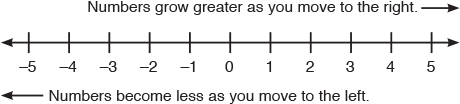
Which is greater, −3 or −1?
Find both integers on the number line.
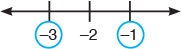
−1 is to the right of −3, so −1 is greater than −3.
Which is less, −2 or 1?
Find both integers on the number line.
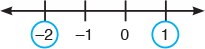
−2 is to the left of 1, so −2 is less than 1.
Thinking about the number line will help you avoid mistakes. For example, you are used to thinking that 8 is greater than 5, so you might also think that −8 is greater than −5. However, the opposite is true. Because −5 is to the right of −8 on the number line, −5 is greater. If you aren’t sure of an answer, try sketching a number line.
To compare the values of numbers, use the symbols shown here.
Symbol Meaning Example
= is equal to 7 = 7
< is less than −4 < 6
> is greater than 5 > 2
To remember the difference between < and >, think of each symbol as an arrow that points to the smaller number.
2 < 5 5 > 2
THE DECIMAL SYSTEM represents whole and decimal amounts. When a digit is written to the right of a decimal point, that digit has a value that is less than 1.
In the U.S. money system, parts of a dollar are shown using decimals. The amount $5.75 means 5 whole dollars and 75 hundredths of a dollar.
In this lesson, you’ll apply decimals in many practical situations. You’ll work with money and measurements. You’ll see how the use of unit rates can help you save money when you shop. You will also see how estimating and using a calculator can help you become a better problem solver.
Each time you use money, you are working with decimals. In the U.S. money system, a decimal point separates dollars from cents. Numbers after the decimal point represent a value less than $1.
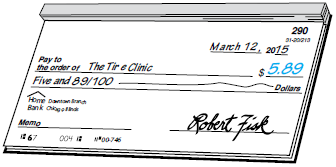
Similarly, our number system uses the decimal point to separate whole numbers from numbers with a value less than 1.
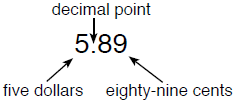
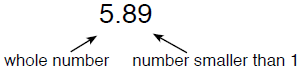
A digit’s position in relation to the decimal point (its place value) tells you how large or small it is. Look at the place value chart below.
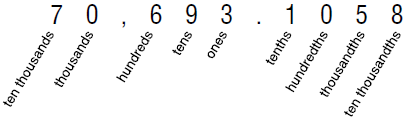
What place is the 9 in?
It represents 9 tens, or 90.
What place is the 5 in?
It represents the fraction 5 thousandths, or 5100051000.
There are two zeros in the number. Both are used as placeholders. In this number, there are no thousands and no hundredths.
Decimal values can be less than ten thousandths, just as whole numbers can be greater than ten thousands. The place value columns continue in both directions. Columns increase in value as they go to the left and decrease as they go to the right.
Which is larger: 0.5 or 0.05?
Step 1: Look at the place value of the last digit in the decimal.
0.5 0.05
The place value The place value
is tenths. is hundredths.
Step 2: Think of a box divided into that many parts.
divided into tenths
divided into hundredths
Step 3: Visualize the whole decimal as part of that box.
5 tenths (0.5)
5 hundredths (0.05)
5 tenths is larger than 5 hundredths.
Numbers after the decimal point end in ths: tenths, hundredths, thousandths, and so on.
Look at the number line. Is the decimal 2.7 closer to 2 or to 3?
The decimal 2.7 rounds to the whole number 3.
Rounding to the nearest whole number means to figure out which whole number the decimal is closest to. You often round to the nearest whole number when you shop. To round a decimal to a certain place value, look at the decimal to the right of the desired place.
Example 1 At the drug store, you buy items costing $3.99, $5.29, and $7.89. You have a $20 bill. Do you have enough money?
You can use rounding to estimate the amount of money the items cost. Round each item to the nearest dollar.
$3.99 rounds to $4 Add: $4
$5.29 rounds to $5 $5
$7.89 rounds to $8 +$8
$17
Even adding about $2 for sales tax, you should have enough money.
Example 2 Round 13.648 and 13.6712 to the nearest tenth.
Step 1
Identify the place you need to round to. Many students find it useful to underline this digit.
13.648
13.6712
Step 2
Look at the digit immediately to the right of the underlined digit.
If the digit to the right is less than 5, leave the underlined digit as is. Drop all the remaining digits to the right.
13.648
4 is less than 5.
The digit doesn’t change.
13.648 rounds to 13.6
If the digit to the right is 5 or more, add 1 to the underlined digit and drop the remaining digits.
If the digit to the right is 5 or more, add 1 to the underlined digit and drop the remaining digits.
13.6712
7 is more than 5.
Add 1 to the 6 and drop the rest.
13.6712 rounds to 13.7
Knowing how to round is crucial to interpreting calculator results.
After dividing $9 by 7, a calculator display reads: 9÷71.285714286
To round to 2 decimal places, you need 3 places. The thousandths place is equal to 5, so round up and drop the remaining digits.
1.285 rounds to 1.29
Because you use money every day, you know that $0.50 is more than $0.05. Fifty cents is more than 5 cents because 50 is greater than 5. When you take away the dollar sign, these decimals are written as 0.5 and 0.05, and 0.5 still has the greater value.
As you move farther to the right of the decimal point, the value of the digits gets smaller.
One tenth 0.1
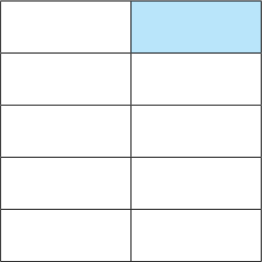
The box below is divided into 10 equal parts. One tenth is shaded.
One hundredth 0.01
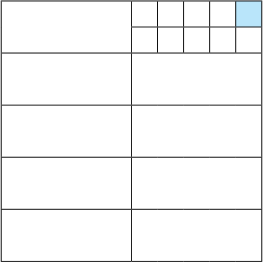
Each tenth in the previous box is divided into 10 equal parts. One hundredth is shaded.
One thousandth 0.001
Imagine dividing each hundredth in the previous box into 10 equal parts and then shading only 1 of those parts. One thousandth is shaded.
To compare decimals, use this important fact: Adding zeros to the end of a decimal does not change its value. The numbers 0.6 and 0.600 are equal.
Which is greater: 0.85 or 0.69?
Both numbers have the same number of decimal places. That is, both numbers are hundredths. Compare as you would with whole numbers.
0.85 is greater than 0.69 because 85 is greater than 69.
Which is greater: 0.4 or 0.215?
Step 1
Add zeros so that both numbers have the same number of decimal places: thousandths.
0.400 Adding zeros to the right of the last digit
does not change the value of the decimal.
0.215
Step 2
Compare the decimals as if they were whole numbers. 400 is greater than 215, so 0.4 is greater than 0.215.
Drag the <, >, and = to the correct spots to make each statement true.
9 -3
-1 -1
-12 -11
How many integers are greater than −8 and less than 0?
A library book has the number 791.48 on its spine. Which of the digits is in the tenths place?
A security guard walks an average of 4.375 miles per day. What part of a mile does the digit 5 represent?
John is 1.905 meters tall. What is his height to the nearest tenth of a meter?
When rounded to the nearest cent, which of these amounts rounds to $15.60?
Drag the <, >, and = to the correct spots to make each statement true.
0.4 0.40
0.054 0.43
0.9 0.88
You add to combine numbers to find a total amount. If the sum of a place value is 10 or more, you need to regroup. Write the last digit under the column you are adding and regroup (carry) the extra digit to the column to the left.
Good test takers estimate before adding to get an idea of what the answer should be. An estimate can also help you see whether your answer makes sense.
Sasha had $479. She earned $28 more. How much money does she have now?
Estimate first.
Round to the nearest 100. → 500
Round to the nearest 10. → + 30
530
Step 1
Add the ones. The ones add up to 17 ones. Write 7 in the ones column. Regroup 1 ten to the tens place.
1
479
+ 28
7
Step 2
Add the tens. The tens add up to 10 tens. Write 0 in the tens column. Regroup the 1 hundred to the hundreds place.
11
479
+ 28
07
Step 3
Add the hundreds.
11
479
+ 28
507
Check: The answer $507 is close to your estimate of $530.
addition: combining numbers to find a total amount
subtraction: the difference between numbers.
multiplication: the process of adding a number to itself a given number of times
division: the process of finding out how many times one number is contained in another
Subtraction is used to find the difference between numbers. To subtract, put the larger number on top. If a digit in the top number is smaller than the digit below it, you need to regroup (borrow) from a higher place value column.
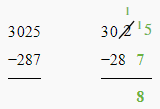
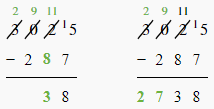
Game Time, a video game store, has 3,025 games in stock. The store sold 287 games on Monday. How many games are still in stock?
Estimate first.
Round both numbers and subtract.
Step 1
Subtract the ones. Since you cannot subtract 7 from 5, regroup 1 ten.
Step 2
Subtract the tens. You can’t subtract 8 from 1. You can regroup across the 0. Borrow 1 from 30. Then continue to subtract.
Check: The answer 2,738 is close to 2,700.
Like addition, multiplication often requires regrouping. When a product of two digits is 10 or more, regroup to the next place value column. Multiply by the digit in the next place, then add the regrouped amount.
Find the cost of 9 months of health insurance at $428 a month.
Estimate first.
400
× 10
4000
Step 1
Multiply the ones. The product is 72 ones. Regroup 7 to the tens place.
7
$428
× 9
2
Step 2
Multiply the tens. Add the regrouped 7.
2 × 9 = 18, and 18 + 7 = 25
Regroup 2 to the hundreds place.
27
$428
× 9
52
Step 3
Multiply the hundreds. Add the regrouped 2.
4 × 9 = 36, and 36 + 2 = 38
27
$428
× 9
$3852
Check: The answer $3,852 is close to your estimate of 4,000.
Long division is a four-step process that repeats until there are no digits left to bring down. Any nonzero number left over after the final step is called a remainder. The remainder must always be less than the number you divided by.
Four-Step Division Process
Step 1. Divide and write the answer as part of the quotient.
Step 2. Multiply the answer by the divisor.
Step 3. Subtract.
Step 4. Bring down the next digit and repeat the process if needed.
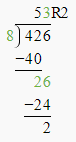
Frank needs to package 426 designer cupcakes. If a box holds 8 cupcakes, how many boxes can he fill? Estimate: 400 ÷ 8 = 50
Step 1
Divide 8 into 42. Write the answer above the 2.
Step 2
Multiply: 5 × 8 = 40
Step 3
Subtract: 42 − 40 = 2
Step 4
Bring down the next digit. Repeat.
The remainder is 2. Write the remainder after the letter R.
Frank can fill 53 boxes. He will have 2 cupcakes left over.
Check: Your answer of 53 is reasonably close to 50.
Adding signed numbers is like walking on a number line. Positive distances are to the right, and negative distances are to the left.
The number line shows what happens when you add + 3 and −5. Starting at 0, go 3 steps to the right. To add −5, go 5 steps to the left.
-Page-26-img-001.png "null")
What would happen if you took 1 step forward and then 1 step back? You would be right back where you started. In other words, + 1 plus −1 is 0.
-Page-26-img-002.png "null")
In the examples below, positive and negative counters are used to model addition.
(+ 2) + (+ 3) = + 5
-Page-26-img-003.png "null")
(−4) + (−2) = −6
-Page-26-img-004.png "null")
These examples add positive and negative numbers.
These examples add positive and negative numbers.
(+ 5) + (−2) = + 3
Draw 5 positive circles and 2 negative circles. Since + 2 plus −2 = 0, there are 3 positives left.
-Page-26-img-005.png "null")
(−4) + (+ 3) = −1
Draw 4 negative circles and 3 positive circles. Since −3 plus + 3 = 0, there is 1 negative left.
-Page-26-img-006.png "null")
There are rules for adding signed numbers. Make sure you understand how the rules in the box relate to the examples. Good test takers do more than memorize rules. They try to visualize what the rules are saying.
Rules for Adding Signed Numbers
If the signs are the same, add the numbers and keep the same sign.
If the signs are different, subtract the numbers (without their signs). Think about the circles. Keep the sign that would have more circles.
Multiplication is fast addition. In other words, you can multiply when you have to add the same number many times.
5 + 5 is the same as 2 × 5. Both equal 10.
(−5) + (−5) is the same as 2 × (−5). Both equal −10.
Multiplying a negative number by a negative number is hard to visualize. You can apply your reasoning skills to find out how it works.
What number works in the blank?−5 × _____ = 10
If you put a positive number in the blank, the product would have to be −10. A positive number won’t work. The missing number must be negative: −5 × −2 = 10
Remember that multiplication can be written in three ways: using a times symbol (×), using a raised dot (•), or writing the numbers next to each other in parentheses.
In algebra, division is written using a fraction bar. For example, 15 ÷ 5 is written 155155.
Use these rules to multiply or divide two signed numbers:
If the signs are the same, the answer is positive.
If the signs are different, the answer is negative.
$302 + $95
Local schools and businesses worked together to clean up a five-mile stretch of the coastline. The schools gathered 2,379 pounds of garbage. The businesses cleaned up 4,096 pounds. What was the total number of pounds of garbage collected?
$473 + $125
Two recent business closures put many people out of work. An aircraft company laid off 569 employees. When a food company closed, 1,392 people lost their jobs. How many jobs were lost because of these closures?
507 − 395
-10 + (-5)
Type the answer in the box. Use numbers only.
1,035 × 75
(−2)(−2)(−2)(−2)
Type the answer in the box.
18,306 ÷ 9
Type the answer in the box.
Estimation is a very useful math tool. As you have seen, a good estimate is a useful way to check an answer. On a multiple-choice test, a good estimate may be all that you need to choose the correct answer.
Estimating is most helpful when you can do all the work in your head. The goal in estimation is to work with “friendly” numbers. Usually, you will use rounding to make the work easier. But remember, there is no single right way to estimate.
In the examples below, three different ways of estimating are shown. When you estimate, you can check that your answer is close to your estimate.
3,206 × 9
Use front-end estimation. Round to the first digit on the left.
Remember: To multiply numbers that end in 0, multiply the leading digits (3 × 1 = 3). Then add on the number of zeros in the problem.
3,206 ≈ 3,000 3 zeros
×9 ≈ ×10 1 zero
28,854 30,000 4 zeros
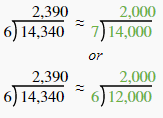
14,340 ÷ 6
Use compatible numbers. Watch for relationships between numbers.
26,379 + 24,278
Use your knowledge of money. If you use nickels, dimes, and quarters, you’re used to working with multiples of 5, 10, and 25. Both the numbers in this problem are close to 25,000. Because you know 25 + 25 = 50, you know the answer will be close to 50,000.
1 11
26,379 ≈ 25,000
+ 24,278 ≈ + 25,000
50,657 50,000
Check: In each case, the estimate was close to the exact answer.
A word problem is a story with numbers that asks a question. Before you perform any operations, you need to make sense of the problem. On a test, word problems are not meant to be tricky. If you read carefully and choose a strategy that makes sense, you can find the correct answer.
There is almost always more than one way to solve a problem. The right strategy is the one that works for you.
Most word problems require you to choose an operation or a combination of operations. How do you know which operation to pick? Good test takers watch for words and phrases that suggest a certain operation.
Addition Subtraction
sum difference
total minus
plus how many more
in all how many less
combined how much left
altogether
Multiplication Division
product quotient
times divided
doubled shared equally
per equal parts
each each
These word clues are only a guide. Addition and subtraction are opposite operations, so you will sometimes see addition words in a subtraction problem. The same is true for multiplication and division. As you read, you should also pay attention to any numbers that are missing from the problem.
A lamp is placed on a table. The combined height of the lamp and the table is 54 inches. The table is 36 inches tall. What operation should you use to find the height of the lamp?
Step 1
Look for words that suggest a certain operation.
Combined is an addition word. The height of the lamp plus the height of the table is the combined height.
Step 2
What information is missing?
Lamp height + Table height = Combined height
? 36 54
You don’t know the height of the lamp.
Step 3
Choose an operation.
Since you already know the combined height, addition doesn’t make sense. You should choose the opposite operation: subtraction.
Some word problems require only one operation or step. But other problems may require you to use multiple operations and steps to get the answer. Be sure to read the problem carefully so you know you are answering the right question. Take a look at this multi-step word problem.
On Monday, Fast Copy had 325 cases of copy paper in stock. By the end of the week, it had only 210 cases in stock. The company orders 300 cases every Monday morning. If Fast Copy uses twice as much paper next week, will it have enough?
Step 1 Understand the question.
Put the question in your own words. What do you need to find out?
I need to know how many cases of copy paper would be used if Fast Copy used twice as much as last week.
Step 2 Find the facts you need.
What numbers will help you answer the question?
The company started with 325 cases. It ended the week with 210 cases.
The company orders 300 cases every Monday.
Step 3 Choose operations.
Operations
Add to combine numbers.
Subtract to find a difference.
Multiply to add a number many times.
Divide to cut a larger number into equal parts.
To find the difference between the starting and ending number of cases, subtract.
Step 4 Do the work.
325
− 210
115
Fast Copy used 115 cases of copy paper.
If they use twice as much next week, figure out how much that is:
115 × 2 = 230
Step 5 Look back.
Think: Does your answer make sense? Does it answer the question?
If they use twice as much paper, they will use 230 cases. They will order 300 cases on Monday.
Use estimation: 300 − 230 = 70.
If they order 300 cases, they will still have enough paper.
Round the above numbers to the nearest 10 and then choose the best estimated answer.
Carrie buys 3 dozen cake donuts to share with co-workers. She also buys 18 glazed donuts and 15 powdered donuts. How many donuts does she buy in all?
Tickets to a play are $8 each. The total ticket sales for one night were $1,024. How many tickets were sold for that night?
Lola earns $30 babysitting on Monday and $20 on Tuesday. Altogether, how much does she earn over the two days?
A school team has $400 to spend on jerseys. Team jerseys are $27 each. How many dollars will the team have left if it buys all the jerseys it can?
The total cost of a car loan is $6,524. Colin agrees to make monthly payments of $182. How much will his final payment be?
A fraction is a way of showing part of something. Imagine cutting a pie into eight equal pieces. Each piece is one-eighth of the entire pie.
Fractions are useful in measuring because they are very accurate. The bottom number of a fraction tells you how many equal parts a thing is divided into. The top number tells exactly how many of those parts you have.
You may recall that decimals can also be used to describe a part of something. In fact, decimals are a kind of fraction; however, decimals always break everything into some power of ten. With regular fractions, you can break something into as many parts as you want.
In this lesson, you’ll apply fractions in many situations. You will see how to use fractions when working with measurements. You will also see how fractions and decimals are connected.
Fractions represent a part of a whole. They can also represent division.
The fraction 1414 can mean “1 out of 4 parts.”1414 can also mean “1 divided by 4.” The fraction bar in a fraction means “divided by."
-Page-70-img-001.png "null")
-Page-70-img-002.png "null")
Every fraction has two numbers: a numerator and a denominator. In a proper fraction, the numerator is smaller than the denominator.
numerator ← top number
denominator ← bottom number
fraction: a number written as the part over the whole. A fraction bar separates the part from the whole.
equivalent fractions: fractions that are equal in value
improper fraction: a fraction in which the numerator is the same size or greater than the denominator
mixed number: a number that contains both a whole number and a fractional amount
proper fraction: a fraction in which the numerator is smaller than the denominator
These numbers are arranged from least to greatest: 2, 3, 4, 5
These fractions are arranged from least to greatest:
Sometimes a fraction will take a different form. A fraction with the top number equal to or greater than the bottom number is called an improper fraction.
When the numerator is the same as the denominator, the fraction is equal to 1.
4/4 = 1 because 4 divided by 4 is 1.
-Page-70-img-003.png "null")
When the numerator is greater than the denominator, the fraction is greater than 1.
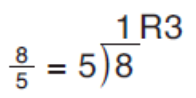
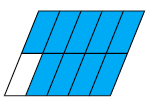
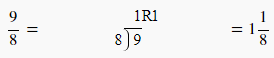
8/5 > 1 because 8 divided by 5 is 1 with a remainder of 3.
-Page-70-img-004.png "null")
A mixed number is a “mix” of a whole number and a fraction. An improper fraction can be written as a mixed number using division.
Write 8/5 as a mixed number.
Step 1
Divide the numerator by the denominator.
Step 2
The quotient becomes the whole number part.
Put the remainder over the original denominator to make the fraction part.
Step 1
Multiply the whole number by the denominator. Write the product over the denominator of the fraction.
2 × 4 = 8
Step 2
Add the original numerator to the product found in Step 1.
Write the total over the denominator.
You can add and subtract fractions only if they have the same denominators.
Imagine trying to add 1/2 and 1/3. The circles are cut into sections of different sizes, so there isn’t a way to combine them.
To add them, look for a way to cut both circles into sections of the same size.
Here the circles are cut into sixths. 1/2 becomes 3/6. 1/3 becomes 2/6.
Now you can add:
-Page-80-img-001.png "null")
In this lesson, you will practice finding a common denominator and writing equivalent fractions.
You can always find a common denominator by multiplying the denominators.
Find a common denominator for 3/4 and 1/6, and write equivalent fractions.
Step 1
Multiply the denominators.
4 × 6 = 24
Step 2
Write equivalent fractions with the denominator 24.
Multiplying the denominators isn’t the best way to find a common denominator, but it will always work.
The best way to find a common denominator is to find the least common multiple (LCM) for both denominators.
List the first few multiples for each denominator. Then look for the lowest number that both lists have in common.
Find a common denominator for 3/4 and 1/6, and write equivalent fractions.
Step 1
List a few multiples for both numbers.
4: 4, 8, 12, 16, 20, 24, . . .
6: 6, 12, 18, 24, . . .
Step 2
Find the least common multiple.
The lowest number in both lists is 12.
Step 3
Write equivalent fractions with the denominator 12.
A fraction represents a part of a whole. Decimals are a kind of fraction because they show parts of a whole. For example, fifty cents ($.50) is a fraction of one dollar (1/2 dollar).
Decimals use place value to show the value of a digit. The decimal 0.7 means seven tenths because the digit 7 is in the tenths place. You can also write seven tenths as 7/10.
-Page-68-img-001.png "null")
The shaded portion of this figure can be written 0.7 or 7/10. Both are read “seven tenths.”
In the fraction 7/10 the top number, or numerator, tells how many parts are shaded. The bottom number, the denominator, tells how many total parts there are in the figure.
7 numerator
10 denominator
When the denominator of a fraction is 10, 100, 1,000, or another multiple of 10, you can easily change the fraction to a decimal.
Step 1
Think: How many decimal places does a fraction with a denominator of 1,000 need?
It needs 3 decimal places.
0. ___ ___ ___ ← thousandths place
Step 2
The numerator should fill the place value named by the denominator. Use placeholder zeros if necessary.
0.075 means “seventy-five thousandths” ↑ placeholder zero
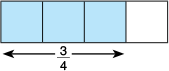
What fraction of the wedges are shaded?
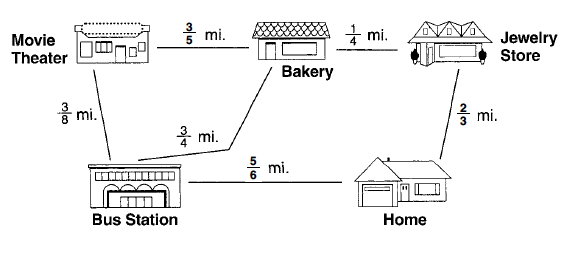
What denominator would you use to add the distances from the bus station to home to the jewelry store?
Type the answer in the box.
Write the fraction as a whole number or as a mixed number:
Drag the correct numerator and denominator into the correct places for the best answer.
Change the mixed number into a fraction:
Numerator:
Denominator:
Find the least common denominator for fractions with the following denominators: 3 and 5
Drag the correct symbol in to the equation to make it true.
The Utvich family spends 0.3 of their income on rent. What fraction of their income is spent on rent?
Like fractions are fractions that have the same denominator. For example, 1/8 and 3/8 are like fractions. 1/8 and 2/4 are unlike fractions because they have different denominators.
To add like fractions, just add the numerators. The denominator remains the same.
The answer to an addition or subtraction problem may need to be simplified. Always write your answers in lowest terms. Change improper fractions to mixed numbers.
Step 1
Add the numerators.
Step 2
Place the result over the denominator.
Step 3
Change to a mixed number if necessary.
To subtract like fractions, just subtract the numerators. The denominator remains the same.
The answer to an addition or subtraction problem may need to be simplified. Always write your answers in lowest terms. Change improper fractions to mixed numbers.
Step 1
Subtract the numerators.
Step 2
Place the result over the denominator.
Step 3
Simplify if necessary.
When you multiply a fraction by a fraction, you are taking something small and breaking it into even smaller parts. You can expect the answer to be smaller than either of the fractions you started with.
Sylvia had 3/4 pound of candy. She wanted to give each of her 3 grandchildren 1/3 of the candy. How much candy should Sylvia give each grandchild?
Step 1
Multiply 3/4 by 1/3. Look for ways to cancel (or factor out) a multiple common to the numerator and the denominator. This makes the problem simpler.
Step 2
Cancel the numerator of the first fraction and the denominator of the second fraction.
Step 3
Multiply across using the new numerators and denominators.
Step 1
Look for ways to cancel. Notice that canceling may include both numerators and denominators.
Step 2
Cancel the numerator of the first fraction and the denominator of the second fraction.
Step 3
Cancel the numerator of the second fraction and the denominator of the first fraction.
Step 4
Multiply across using the new numerators and denominators.
If you did not cancel the fractions before multiplying, you would still get the same answer. However, the answer would have a larger numerator and denominator, and you would have to simplify your answer after multiplying. Therefore, it is much easier to cancel first.
Division and multiplication are opposite operations. This important fact allows you to change division into multiplication.
To divide a fraction, change the division symbol to multiplication and invert the number you are dividing by. The inverted fraction is the reciprocal of the original fraction.
Angela has to give her cat 1/4 of a pill twice a day. If she has 1/2 of a pill left, how many more times can she give her cat its medicine?
-Page-90-img-001.png "null")
Step 1
Invert the divisor (the number you are dividing by).
Step 2
Change ÷ into ×. Use canceling, if possible.
Step 3
Multiply across using the new numerators and denominators.
Angela can give her cat 1414 of a pill 2 more times.
The Morrison family has 3/4 of a pie left over. If there are 6 people in the family, what fraction of the original pie will each person get?
-Page-90-img-002.png "null")
Step 1
Write the whole number as a fraction with a denominator of 1. Then invert the fraction.
Step 2
Change ÷ into ×. Use canceling, if possible.
Step 3
Multiply across using the new numerators and denominators.
Each person will get 1/8 of the pie.
When you are multiplying or dividing, you should always change mixed numbers to improper fractions.
A rectangle measures 1 3/4 inches by 2 1/2 inches. What is the area of the rectangle in square inches? (Hint: To find the area of a rectangle, multiply the length by the width.)
-Page-92-img-001.png "null")
Step 1
Change mixed numbers to improper fractions.
Step 2
Multiply the improper fractions.
Step 3
Change the improper fraction to a mixed number.
The area of the rectangle is 4 3/8 square inches.
As you work, remember that your final answer should be in lowest terms. Always check the fraction part of the answer to see if it can be simplified.
Bill used 2 1/2 gallons of paint to cover one side of a warehouse. Each side is the same size. How many sides could he paint if he had 6 1/4 gallons of paint?
Step 1
Change mixed numbers to fractions.
Step 2
Invert the divisor and change the ÷ to a ×.
Step 3
Cancel if possible and multiply.
Step 4
Change improper fractions to mixed numbers.
Bill could paint 2 1/2 sides with 6 1/4 gallons of paint.
A recipe for salad dressing calls for 1 3/4 cups of vegetable oil, 1/3 cup of white wine vinegar, and 1/8 cup of mayonnaise. How many cups of dressing will the recipe make?
A school replaces a fence that is 6 3/4 feet high with a wall that is 10 1/2 feet high. How many feet taller is the new structure?
Mustafa had a section of paneling 2/3
yard long. He had to use 1/2
of the section to repair a wall. How much of the paneling did Mustafa use?
Margaret’s recipe called for her to grate 3/4 cup of cheese. The next step was to set aside 1/2 of the cheese. How much of the cheese is to be set aside?
After carving the turkey, the Peterson family had 10 2/3 pounds of meat. How many 1/3-pound servings is that?
A ratio compares one number to another. A fraction is a kind of ratio that compares a part to a whole.
Marcus has 15 coins: 5 quarters and 10 dimes. What is the ratio of quarters to coins?
There are 5 quarters out of 15 total coins. 5/15=1/3
The ratio of quarters to total coins is 1/3.
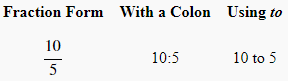
You can also write a ratio comparing the number of dimes to the number of quarters. Like all ratios, it can be written in three different forms.
Ratios can be simplified to lowest terms, just like fractions. As with fractions, divide both numbers in the ratio by the same whole number.
Written in lowest terms: 10/5=2/1 or 2:1 or 2 to 1.
The simplified ratio means that there are 2 dimes for every 1 quarter.
Ratios can be used to answer questions asking for a fraction of an amount.
A local animal shelter rescues cats and dogs. The current ratio of cats to dogs is 12 to 15.
What fraction of the animals are cats?
Step 1
Add the number of cats and dogs to find the total number of animals.
12 + 15 = 27
Step 2
Find the number of cats in the ratio.
Cats are listed first in the ratio, so there are 12 cats.
Step 3
Write a fraction.
At the shelter, 49 of the animals are cats.
ratio: a comparison of one number to another
unit rate: a ratio that compares a quantity to one unit
50 miles per hour is a unit rate comparing a distance of 50 miles to 1 hour:
cross products: the results of multiplying diagonally across the equal sign The cross products are:
equivalent fractions: fractions that are equal in value
You have already learned how to find unit price. Unit price is an example of a unit rate. Unit rates are ratios that compare a quantity to one unit. Rates often use the word per, which means “for each.”
A clerk can type 270 words in 6 minutes. How many words per minute can the clerk type?
Step 1
Write a ratio.
Step 2
Simplify to get a denominator of 1.
The clerk can type 45 words per minute.
Unit rates are easy to compare. In math problems and in real-life situations, you may need to compare ratios. Changing the ratios to unit rates will help you judge which ratio is preferable.
Two grocery stores are offering deals on bags of snack mix. Green’s Grocer sells 3 large bags for $11.79. Conway’s Co-op sells 5 large bags for $17.50. Which store offers a better deal?
Step 1
Write a ratio to represent the price per bag for each store.
Step 2
Change the ratios to unit rates.
At $3.50 per bag, Conway’s Co-op offers the better deal.
You can use proportions to solve many kinds of problems. Use cross products to solve a proportion.
To solve using a proportion, be sure that the two ratios have corresponding units.
At Bright’s Movie Theater, 3 tickets cost $24. How much would 4 tickets cost?
Step 1
Write a ratio with two numbers from the problem. Include labels.
Step 2
Write a proportion, using a variable for the number you do not know.
Step 3
Multiply to get the cross products and find the unknown value.
3 × p = 24 × 4
3 × p = 96
p = 96 ÷ 3
p = $32
The cost of 4 tickets is $32.
Another way to set up a proportion for this problem is this:
It doesn’t matter which number goes on top or bottom in the first ratio. What does matter is that both ratios are set up in the same order with corresponding units.
For example, in the problem above, writing the two ratios as
would not be a true proportion because they do not compare the same units in their numerators or the same units in their denominators.
Another way to express the same proportion is
A scale drawing such as a floor plan or a map uses proportions to compare values in the drawing to actual values. For example, if a floor plan shows that a room’s length is twice its width, then the actual room will be twice as long as it is wide.
-Page-118-img-001.png "null")
The scale above tells you that every 1212 inch on this drawing represents 3 feet on the real floor. The scale is a ratio—inches in the drawing to feet in the building. You can determine the actual size of all the rooms by setting up a proportion.
The window in the drawing measures 3434 inch. How many feet across will the bay window be?
Step 1
Set up a proportion.
Step 2
Multiply to find the cross products and find the unknown.
Step 3
Check your proportion by using cross products.
The bay window will be 4 1/2 feet across.
The ratio of boys to girls in a class is 5:7. What fraction of the class are girls?
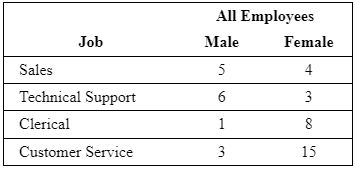
The table shows a company's personnel statistics. What is the ratio of female to male employees in technical support? Express ratios in lowest terms.
Convert the following ratio to a unit rate.
75 ounces to 3 bottles
Convert the following ratio to a unit rate.
José earned $45 working at his job for 5 hours. How much would he earn for 7 hours of work?
Jennifer drove for 120 miles on 4.5 gallons of gasoline. How much gasoline would she need to drive 155 miles?
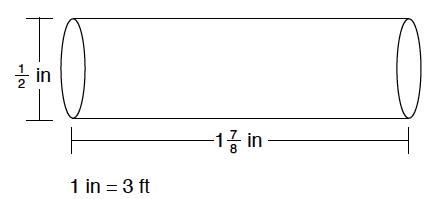
What is the length of the rod in feet?
What is the diameter of the rod in feet?
A percent represents the number of parts out of 100 parts.
In the box shown here, 40 of the 100 squares are shaded. Therefore, 40% of the squares are shaded and 60% are unshaded.
-Page-122-img-001.png "null")
If all of the squares were shaded, then 100% would be shaded.
100% represents the whole amount. (100% = 1)
Percents can be added or subtracted as long as they represent parts of the same whole.
If 40 of the 100 squares are shaded, then what percent of the squares are unshaded?
You can figure the percent of unshaded squares by subtracting the percent of shaded squares (40%) from 100%.
100% − 40% = 60%
If 40 of the 100 squares are shaded, and you shade 10 more, what percent of the squares will be shaded?
If 40% of the squares are shaded and you shade 10 more, then you have shaded another 10% of the squares. Add the percents together to find the total percent shaded.
40% + 10% = 50%
Since 100% stands for the whole amount, a percent less than 100% represents a part of the whole amount. A percent more than 100% represents more than the whole.
How much does 125% represent?
You can rewrite 125% as 100% + 25%. Since 100% is the same as the whole amount, 125% represents the whole amount plus 25% more.
-Page-122-img-002.png "null")
-Page-122-img-003.png "null")
discount: the amount by which a price has been reduced regular price − discount = sale price
percent: a part of a whole that is divided into 100 equal parts. The symbol % means percent. 50 percent is 50 parts out of 100 parts. 50% means 50 percent.
Decimals, fractions, and percents are all ways to express numbers as amounts other than whole numbers. Decimals use digits to the right of the decimal point to write tenths, hundredths, thousandths, and so on. In fractions, the numerator expresses the number of parts and the denominator expresses the whole. A percent indicates the number of parts out of 100.
Write 80% as a decimal.
Step 1
Drop the percent sign and move the decimal point two places to the left.
80% = .80
(Note: 80% = 80.%)
Step 2
Drop any unnecessary zeros.
.80 = .8
What is .3 expressed as a percent?
Step 1
Move the decimal point two places to the right, adding any necessary zeros.
.30.
Step 2
Add a percent sign.
.30 = 30%
Emily finished 25% of her paperwork. What fraction of her paperwork did she finish?
Step 1
Drop the percent sign and write the number with a denominator of 100.
Step 2
Simplify the fraction if necessary.
Emily finished 1/4 of her paperwork.
4545 of the registered voters of Barden voted in the mayoral election. What percent of the registered voters voted?
Step 1
Divide the denominator into the numerator.
Using a calculator:
4 ÷ 5[enter]4÷50.8
Step 2
Change the decimal answer into a percent by moving the decimal point two places to the right.
.80.
Step 3
Add a percent sign.
.80 = 80%
80% of the registered voters of Barden voted in the election.
In this lesson, you’ve learned that percents represent part of a whole. In many math problems and real-life situations, you must solve a percent equation, and then use the information to find another answer. The percent equation states that some percent of a whole equals the part.
Mario makes $14 an hour. After one year on the job, he gets a 7% raise. What is Mario’s hourly wage after the raise?
Step 1
Set up the percent equation.
7% of $14 is p.
0.07 × 14 = p
Step 2
Solve for the unknown part.
0.07 × 14 = p
0.98 = p
Step 3
Decide what operation is needed for the second step
Add the increase to the old hourly pay to find the new hourly pay.
Step 4
Solve.
$0.98 + $14.00 = $14.98
Mario now earns $14.98 per hour.
You can add a percent increase in one step by adding 100%. The raise was for 7%. That means the new hourly wage will be 107% of the current wage.
A jacket originally cost $120. The store put the jacket on sale for 20% off. When the jacket still didn’t sell, the store reduced the price another 10%. What is the current sale price of the jacket?
Step 1
Find the amount of the first discount.
20% of $120 is d.
0.20 × $120 = $24
The first discount is $24.
Step 2
Subtract the first discount.
$120 − $24 = $96
$96 is the sale price after the first discount.
Step 3
Find the amount of the second discount.
10% of $96 is d.
0.10 × $96 = $9.60
The second discount is $9.60
Step 4
Subtract the second discount.
$96 − $9.60 = $86.40
The current price of the jacket is $86.40.
After two discounts, the price of the jacket was reduced $24 + $9.60, for a total discount of $33.60. This is not the same as taking a 30% discount once. A 30% discount takes $36 off the price: $120 × .30 = $36. Always work the steps of a percent problem separately and in the order described in the problem.
You can also write percent problems as proportion problems. One ratio compares the percent to 100. The other ratio compares the part to the whole. Use a variable to represent the missing element. Then solve the proportion.
Nick got an 84% on his last test. If there were 50 questions on the test, how many questions did he answer correctly?
Step 1
Set up a proportion.
Step 2
Solve the proportion.
100 × p = 84 × 50
100 × p = 4,200
p = 4,200 ÷ 100
p = 42
Nick correctly answered 42 out of 50 questions.
In a recent election, the mayor received 3,600 votes, or 45% of the vote. How many people voted in the election?
Step 1
Set up a proportion.
Step 2
Solve the proportion.
45 × w = 100 × 3,600
45 × w = 360,000
w = 360,000 ÷ 45
w = 8,000
8,000 people voted in the election.
If 7 out of 20 students bring their lunch to school, what percent of students bring their lunch?
Step 1
Set up a proportion.
Step 2
Solve the proportion.
20 × n = 7 × 100
20 × n = 700
n = 700 ÷ 20
n = 35
35% of students bring their lunch to school.
What percent of the coins are dimes?
What percent of the coins are not quarters?
Drag each fraction to the equivalent percent.
75%
10%
50%
12%
The Tanakas planted corn on 5/8
of the acreage on their farm. What percent of the land was planted with corn?
A sporting goods store estimates that the price of a popular basketball shoe will increase by 4% next year. If the shoes cost $95.00 this year, how much will they cost next year?
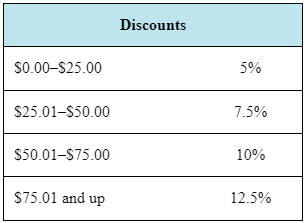
The original price of a pair of earrings is $34.80. Find the discounted price.
The average person uses about 750 pounds of paper in a year. About 33 1/3 % does not get recycled. About how many pounds of paper does the average person not recycle?
Jewelry that is 14-karat gold is 58% pure gold. If a 14-karat gold necklace weighs 15 grams, how many grams of pure gold are in the necklace?