DE_Phys_Unit4_NuclearProcesses

Last updated over 2 years ago
23 questions
3
(Engage) Every active star in the universe is generating energy through __________ reactions. The sun is composed of gases, primarily hydrogen and helium, which are compressed into a form of matter called __________. The __________ of such a large mass of gas causes intense pressure at the core of the sun which, combined with the extreme temperature (15,000,000°C), allows nuclear reactions to occur.
1
(Explore 1) A _______ is any particle in the nucleus, so it refers to protons and neutrons collectively.
1
(Explore 1) Different atoms of the same element can have a different number of _______ .
2
(Explore 1) Helium has two stable forms, Helium-3 which has _______ protons and _______ neutron, and Helium-4 which has _______ protons and _______ neutrons.
1
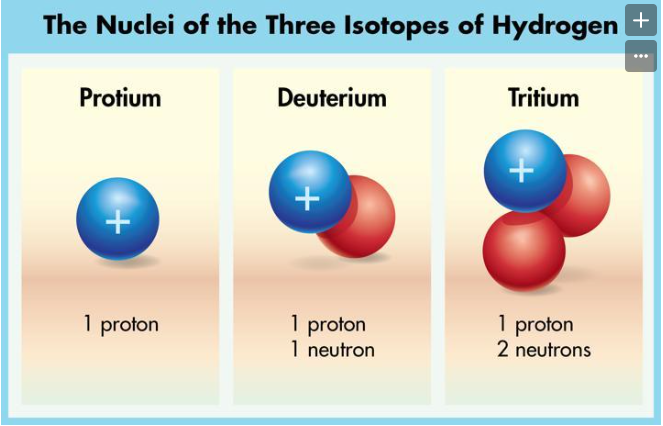
(Explore 1) Pictured are three isotopes of Hydrogen. They differ in the number of _______.
1

(Explore 1) Which of these isotopes is named hydrogen-3 (H-3)?

1

(Explore 1) Which sentence explains why C-12 and C-13 are more prevalent on Earth.

Certain isotopes of an element occur in nature much more frequently than others. For instance, carbon-12 accounts for about 98.9 percent of all carbon atoms in nature. The main factor that affects the frequency of a particular isotope is its stability. Certain isotopes of carbon, such as carbon-12 and carbon-13, are stable.
2
(Explore 1) Some isotopes are unstable. The unstable isotopes will __________ radioactively at a continuous, predictable rate. When unstable isotopes decay, they __________ radioactive particles. Eventually they also transform into different elements.
1
(Explore 1) Vocabulary: A _______ isotope that forms from the radioactive decay of an atom; the isotope may or may not be the same element as its parent.
1
(Explore 1) Vocabulary: A _______ isotope is one that changes into different isotopes through radioactive decay.
1
The three types of particles emitted during radiation are _______ particles, _______ particles, and _______ rays.
1

What comprises an alpha particle (what is an alpha particle)?

1
Positrons are another name for _______ particles.
1
(Explore 1) _______ is the word used to describe an element radioactively decaying into another element.
1
(Explore 2) Inside the nucleus, you would expect all the protons to repel each other...but they don't. This is due to another force acting on them called the _______ _______ force.
1

(Explore 2) Select all true attributes of strong nuclear forces

4
(Explore 2) Many isotopes of elements that are found in nature are _______ . The protons and neutrons of unstable elements will not naturally stay together...they will eventually _______ . As they undergo radioactive decay, the nuclei will emit particles as they transform. This process can happen very _______ or very_______ .
1
(Explore 2) So far, scientists have found _______ types of naturally occurring radioactive decay. With alpha decay, the daughter isotope will become an entirely different element because it has lost _______ protons. Beta decay involves the emission of beta particles when a _______ decays into a _______ , _______ , and a subatomic particle called an _______ .
3
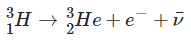
(Explore 2) Based on this nuclear reaction, the hydrogen started with _______ neutrons and ended with _______ neutrons. Additionally, an electron and a _______ were emited.
1
(Explore 2) The amount of time it takes for one-half of a sample to decay is the _______ of an isotope.
1
One of the applications of half-lives of isotopes is radioactive _______ .
1

Half-life decay of a radioactive isotope is not an exponential process.

6
Radioactive decay of atoms does not happen all at once. It happens ______________ and is impossible to predict when and which atoms will decay...it is a ___________ process. The only thing that can be determined is the ____________ rate of decay, which ___________ by isotope. The number of decays is _________________ to the number of particles in the sample. The amount of time for half of a sample of a particular isotope to decay is _____________ and is known as the half-life of the isotope.
Other Answer Choices:
gradually
average
random
constant
varies
proportional