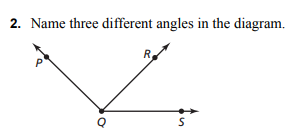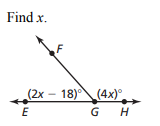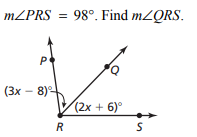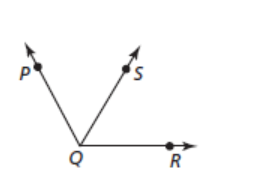
Name angles one of two ways:
You can write your answer in the Show Your Work section using the angle symbol OR
You can type your answer. Find the angle (∠ ) symbol using the math menu under the f( ).
Please do not use inequality signs (< or >) on your laptop keyboard to name angles.
Be sure to show all of your work.
Name angles one of two ways:
You can write your answer in the Show Your Work section using the angle symbol OR
You can type your answer. Find the angle (∠ ) symbol using the math menu under the f( ).
Please do not use inequality signs (< or >) on your laptop keyboard to name angles.
Be sure to show all of your work.
![]()
Measure and classify angles. Use angle bisectors to calculate angle measures.

![]()
Angle: Two rays joined at a common endpoint.
Vertex: Point at which the two rays meet.
Acute Angle: Angle that measures less than 90º.
Obtuse Angle: Angle that measures great than 90º but less than 180º.
Right Angle: Angle that measures 90º exactly.
Straight Angle: Angle that measures 180º exactly, a straight line.
Angle Bisector: A ray that divides the angle exactly in half.

![]()
∠ = symbol for angle
≅ = symbol for congruent
m∠A = the measure of angle A, a numerical value in degrees, such as 60°
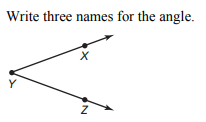
Please use the angle symbol in the math keyboard under the f() menu.
Find the angle measure. Then classify the angle as acute, obtuse, right or straight. You should have two answers, the angle measure and classification. For example:
20, acute
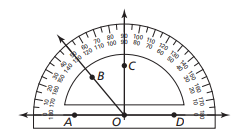
m∠AOB
Find the angle measure. Then classify the angle as acute, obtuse, right or straight.
m∠COD
Find the angle measure. Then classify the angle as acute, obtuse, right or straight.
m∠AOD
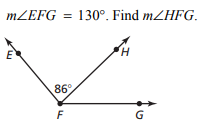
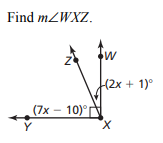
Find the measure of ∠PQR.
Show your work.
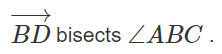
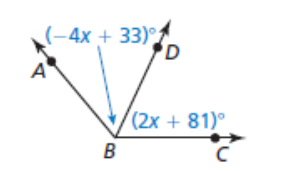
Find the m∠DBC.
Your friend claims it is possible for a straight angle to consist of 3 acute angles. Is she correct? Why or why not? If so, list an example.
Show all your work.
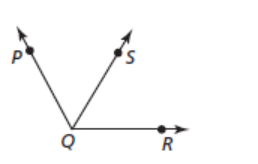
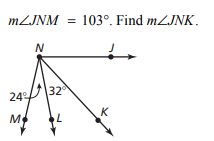
Find the measure of ∠RQS.
EXTENSION:
Let 2x-10 represent an acute angle. What are some possible values of x?
EXTENSION: Draw a sketch using this information. Be sure to label all of the angles, then find each degree measure.
EXTENSION: The ray from the origin through (4,0) forms one side of an angle. Use the numbers below as x and y coordinates to create each type of angle in a coordinate plane.
-2, -1, 0, 1, 2
Rate your understanding on using algebra to measure angles.