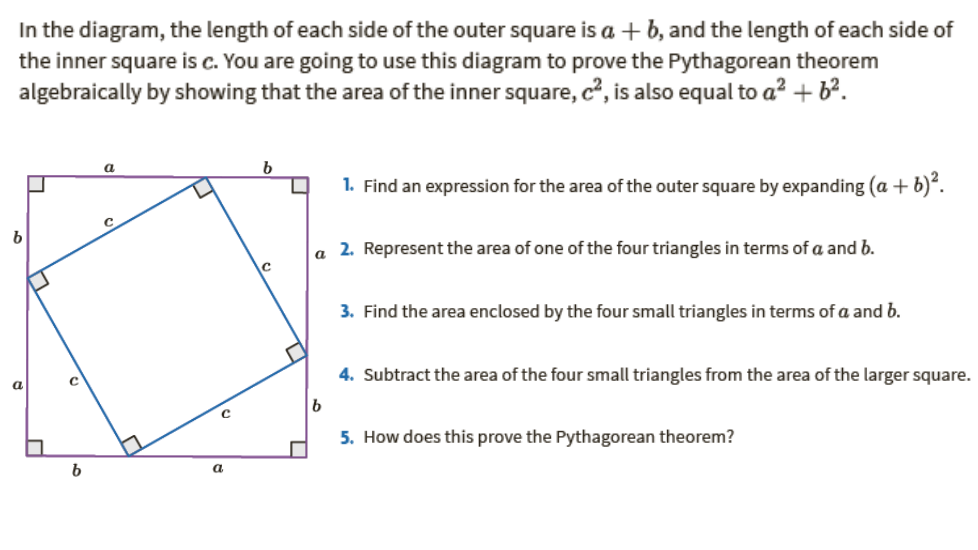
Find an expression for the area of the outer square by expanding (a + b)2
Encuentre una expresión para el área del cuadrado exterior expandiendo (a + b)2
1 point
1
Question 12
12.
Represent the area of one of the four triangles in terms of a and b.
Representa el área de uno de los cuatro triángulos en términos de a y b.
1 point
1
Question 13
13.
Find the area enclosed by the four small triangles in terms of a and b.
Encuentra el área encerrada por los cuatro triángulos pequeños en términos de a y b.
1 point
1
Question 14
14.
Subtract the area of the four small triangles from the area of the larger square.
Resta el área de los cuatro triángulos pequeños del área del cuadrado más grande.
1 point
1
Question 15
15.
How does this prove the Pythagorean theorem?
¿Cómo prueba esto el teorema de Pitágoras?
Enfoque de aprendizaje
Demostrar el teorema de Pitágoras algebraicamente.
¿Cuándo y cómo uso el álgebra en una prueba geométrica?
¿Qué revela cada prueba del teorema de Pitágoras?
Read the directions carefully first. Then follow the directions exactly.
Lea las instrucciones cuidadosamente primero. Luego siga las instrucciones exactamente.
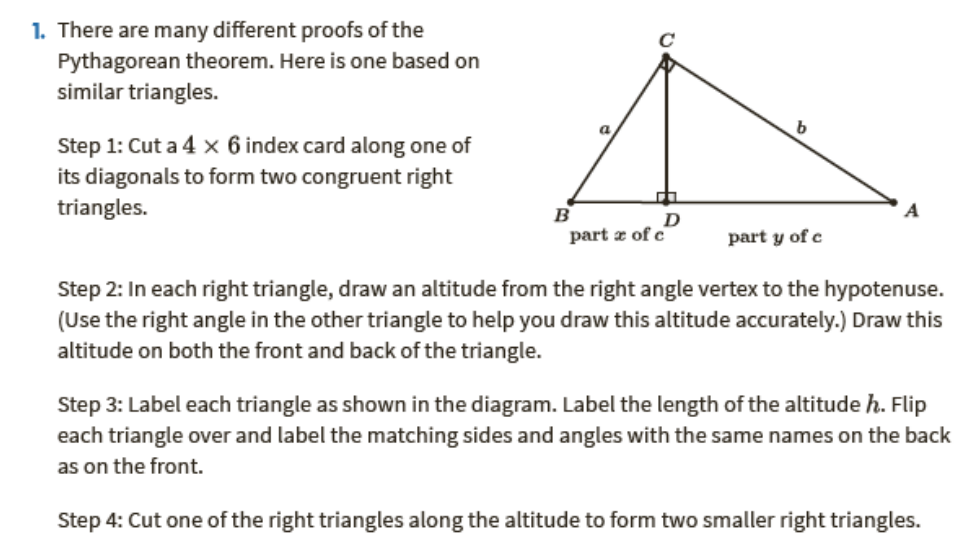
There are many different proofs of the Pythagorean theorem. Here is one based on similar triangles.
Step 1: Cut a 4 x 6 paper along one of its diagonals to form two congruent right triangles.
Step 2: In each right triangle, draw an altitude from the right angle vertex to the hypotenuse. (Use the right angle in the other triangle to help you draw this altitude accurately.) Draw this altitude on both the front and back of the triangle.
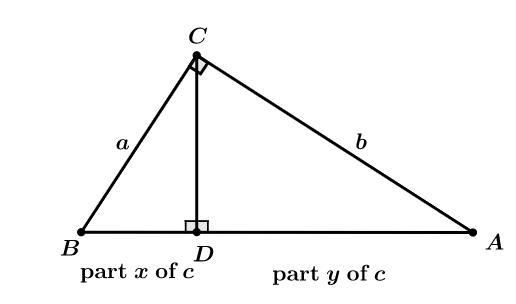
Step 3: Label each triangle as shown in the diagram. Label the length of the altitude h. Flip each triangle over and label the matching sides and angles with the same names on the back as on the front.
Step 4: Cut one of the right triangles along the altitude to form two smaller right triangles.
Hay muchas demostraciones diferentes del teorema de Pitágoras. Aquí hay uno basado en triángulos semejantes.
Paso 1: Corta un papel de 4 x 6 a lo largo de una de sus diagonales para formar dos triángulos rectángulos congruentes.
Paso 2: En cada triángulo rectángulo, dibuja una altura desde el vértice del ángulo recto hasta la hipotenusa. (Usa el ángulo recto en el otro triángulo para ayudarte a dibujar esta altitud con precisi ón). Dibuja esta altitud tanto en la parte delantera como en la trasera del triángulo.
Paso 3: Etiqueta cada triángulo como se muestra en el diagrama. Etiqueta la longitud de la altura h. Voltee cada triángulo y etiquete los lados y ángulos correspondientes con los mismos nombres en la parte posterior que en el frente.
Paso 4: Corta uno de los triángulos rectángulos a lo largo de la altura para formar dos triángulos rectángulos más pequeños.
1 point
1
Question 16
16.
Escriba las posibles preguntas matemáticas que se podrían hacer sobre los triángulos.
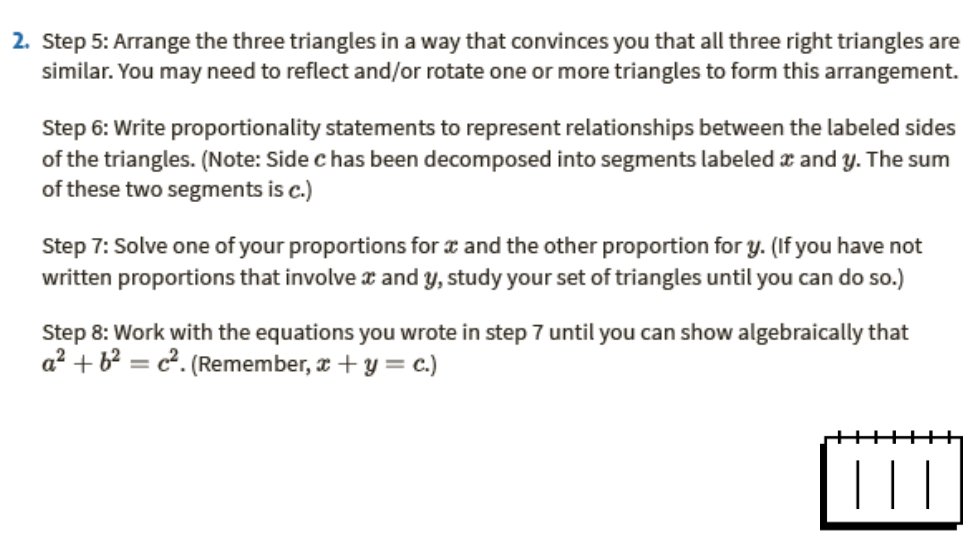
Step 5: Arrange the three triangles in a way that convinces you that all three right triangles are similar. You may need to reflect and/or rotate one or more triangles to form this arrangement.
Paso 5: Ordena los tres triángulos de una manera que te convenza de que los tres triángulos rectángulos son similares. Es posible que deba reflejar y/o rotar uno o más triángulos para formar este arreglo.
1 point
1
Question 17
17.
Step 6: Write proportionality statements to represent relationships between the labeled sides of the triangles. (Note: Side c has been decomposed into segments labeled x and y. The sum of these two segments is c.)
1 point
1
Question 18
18.
Step 7: Solve one of your proportions for x and the other proportion for y. (If you have not written proportions that involve x and y, study your set of triangles until you can do so.)
Paso 7: Resuelve una de tus proporciones para x y la otra proporción para y. (Si no ha escrito proporciones que involucran x e y, estudie su conjunto de triángulos hasta que pueda hacerlo).
1 point
1
Question 19
19.
Step 8: Work with the equations you wrote in step 7 until you can show algebraically that a2 + b2 = c2 . (Remember, x +y = c.)
Paso 8: Trabaje con las ecuaciones que escribió en el paso 7 hasta que pueda demostrar algebraicamente que a2 + b2 = c2. (Recuerde, x + y = c.)
STRONGER AND CLEARER - Meet with two to three partners in a row for feedback on Step 6.
MÁS FUERTE Y MÁS CLARO - Reúnase con dos o tres socios seguidos para recibir comentarios sobre el Paso 6.
How did you set up your ratios?
How do you know those ratios are equivalent?
Which triangles did you use?
What parts of the triangles did you use?
¿Cómo estableciste tus proporciones?
¿Cómo sabes que esas razones son equivalentes?
¿Qué triángulos usaste?
¿Qué partes de los triángulos usaste?
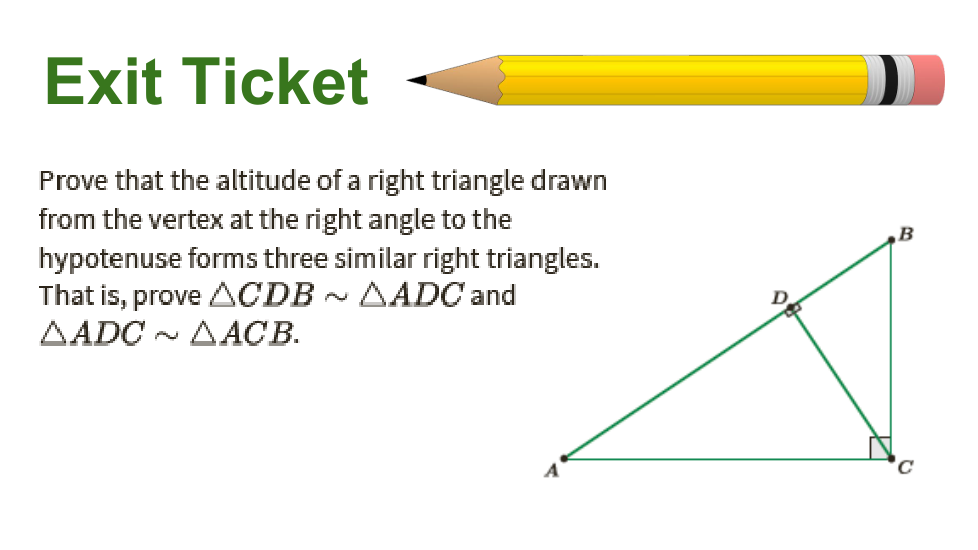
The altitude creates two smaller triangles that are similar to the original right triangle.
Proportions written about the three similar triangles can be used to prove the Pythagorean theorem algebraically.
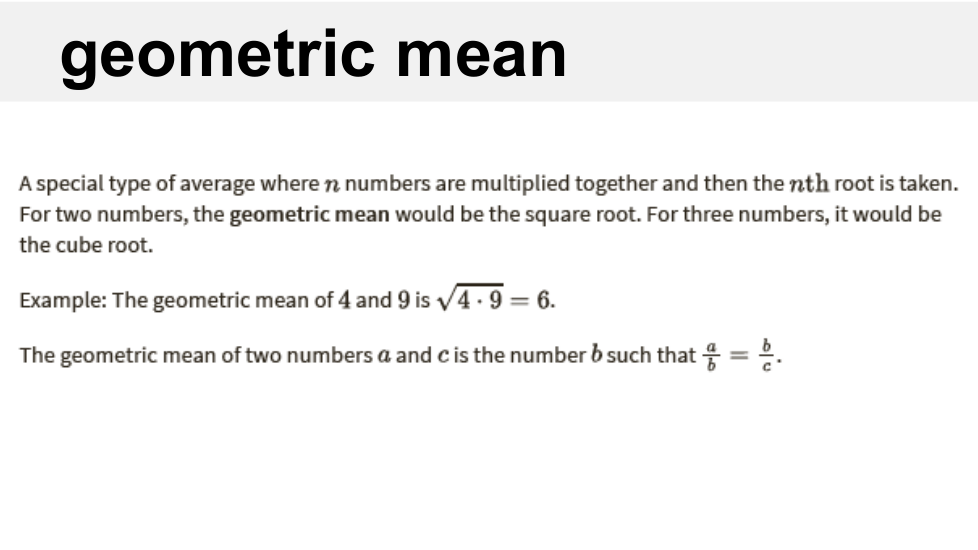
The altitude is the geometric mean of the two segments formed on the hypotenuse by the endpoint of the altitude.
Each leg of the original right triangle is the geometric mean of the adjacent segment formed on the hypotenuse and the hypotenuse.
La altitud crea dos triángulos más pequeños que son similares al triángulo rectángulo original.
Las proporciones escritas sobre los tres triángulos semejantes se pueden usar para demostrar algebraicamente el teorema de Pitágoras.
La altura es la media geométrica de los dos segmentos formados en la hipotenusa por el punto final de la altura.
Cada cateto del triángulo rectángulo original es la media geométrica del segmento adyacente formado en la hipotenusa y la hipotenusa.
significado geometrico
Un tipo especial de promedio cuando se multiplican n números y luego se saca la raíz enésima. Para dos números, la media geométrica sería la raíz cuadrada. Para tres números, sería la raíz cúbica.
La media geométrica de dos números a y c es el número b tal que a/b = b/c.
1 point
1
Question 20
20.
Demostrar que la altura de un triángulo rectángulo trazado desde el vértice en ángulo recto con la hipotenusa forma tres triángulos rectángulos semejantes. es decir, demostrar
y
Lesson Summary
Muhtasari wa Somo
Resumen de la lección
Incamake y'Isomo
Soo koobid Cashar
In today’s lesson, we learned that drawing the altitude of a right triangle from the vertex at the right angle to the hypotenuse divides the right triangle into two smaller triangles that are similar to each other and to the original right triangle. We were able to prove the Pythagorean theorem using proportionality statements about the three similar triangles.
En la lección de hoy, aprendimos que dibujar la altura de un triángulo rectángulo desde el vértice en ángulo recto hasta la hipotenusa divide el triángulo rectángulo en dos triángulos más pequeños que son similares entre sí y al triángulo rectángulo original. Pudimos probar el teorema de Pitágoras usando enunciados de proporcionalidad sobre los tres triángulos semejantes.
1 point
1
Question 21
21.
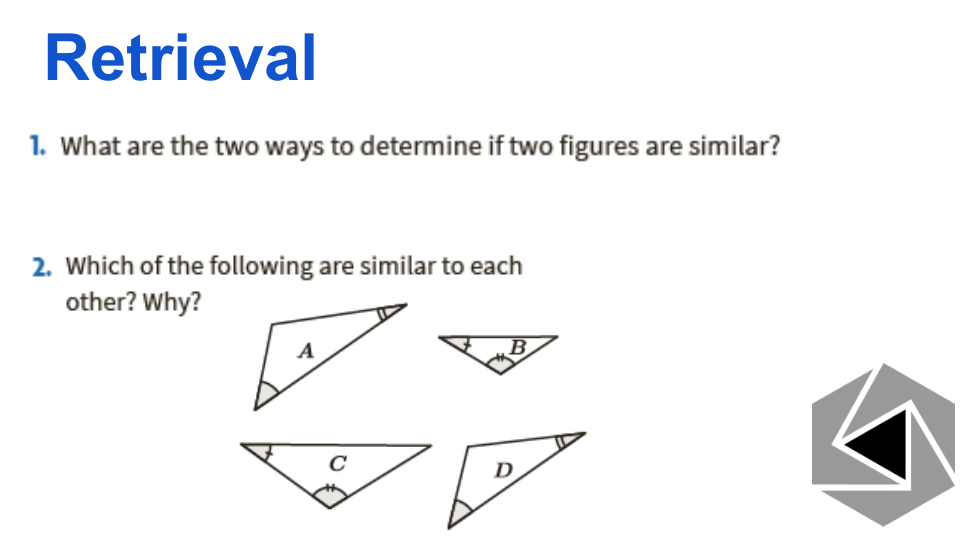
What are the two ways to determine if two figures are similar?
1 point
1
Question 22
22.
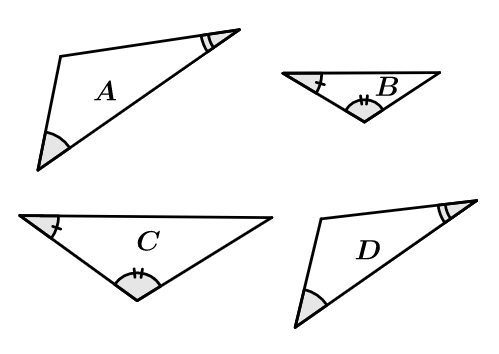
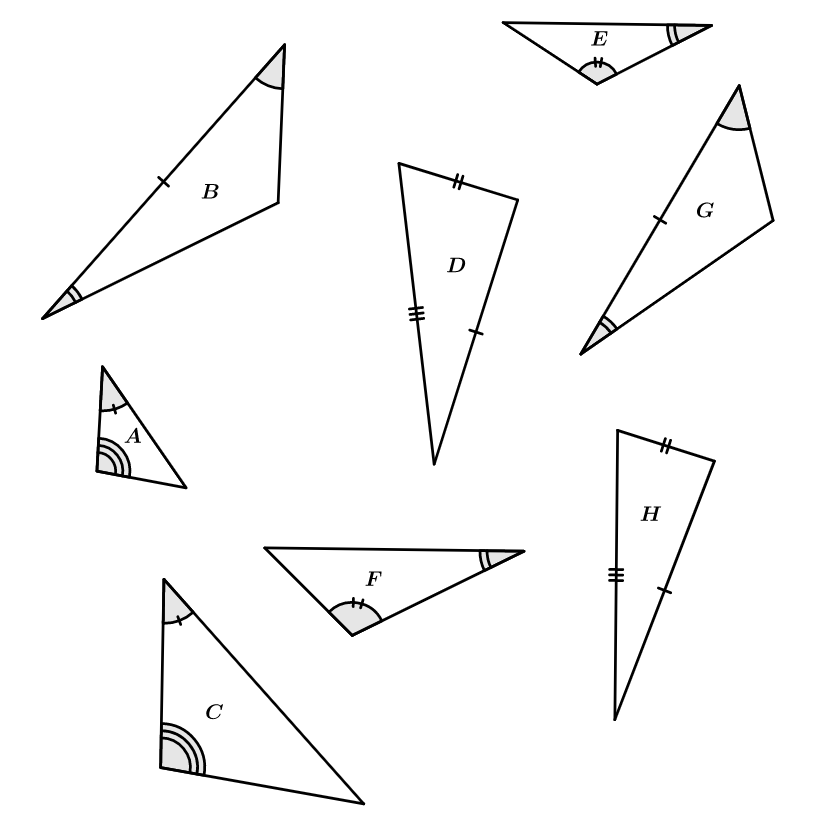
Which of the following are similar to each other? Why?
¿Cuáles de los siguientes son similares entre sí? ¿Por qué?
Practice
Practica
Calculator:
Calculadora:
https://www.desmos.com/scientific
1 point
1
Question 23
23.
Determine which of the triangles below are similar and which are congruent. Justify your conclusions. Give your reasoning for the triangles you pick to be similar and congruent.
Determina cuáles de los siguientes triángulos son semejantes y cuáles son congruentes. Justifique sus conclusiones. Da tu razonamiento para que los triángulos que elijas sean similares y congruentes.
1 point
1
Question 24
24.
Using the right triangle with altitude drawn to the hypotenuse, prove the Pythagorean theorem, a2 + b2 = c2.
Usando el triángulo rectángulo con la altura dibujada en la hipotenusa, demuestre el teorema de Pitágoras, a2 + b2 = c2.
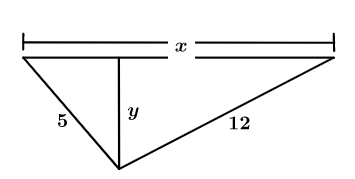
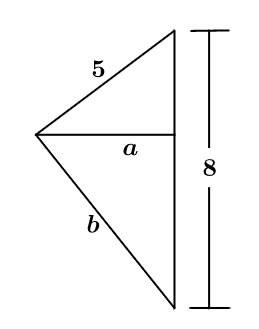
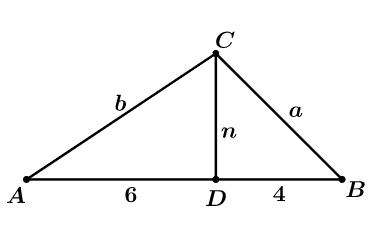
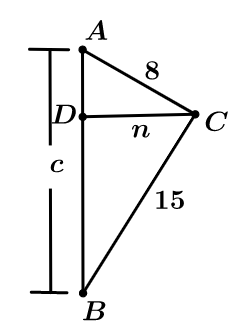
Find the missing values for each right triangle including the length of the altitude.
Encuentra los valores que faltan para cada triángulo rectángulo, incluida la longitud de la altitud.
1 point
1
Question 25
25.
1 point
1
Question 26
26.
1 point
1
Question 27
27.
1 point
1
Question 28
28.
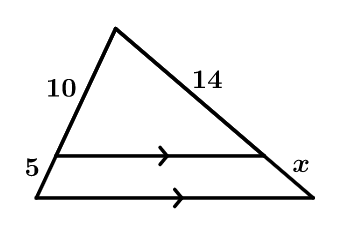
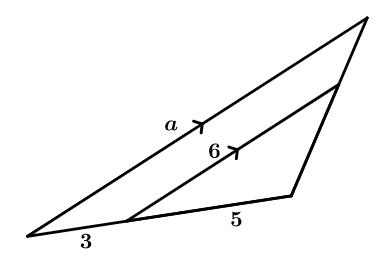
In each problem, find the missing values using the similar triangles, parallel lines, and proportional relationships. Write a proportion and solve.
En cada problema, encuentra los valores que faltan usando los triángulos semejantes, las rectas paralelas y las relaciones proporcionales. Escribe una proporción y resuelve.
1 point
1
Question 29
29.
1 point
1
Question 30
30.
What's my score?
¿Cuál es mi puntuación?
Alama yangu ni nini?
waa maxay dhibcahaygu?
Amanota yanjye ni ayahe?
Standard 1A
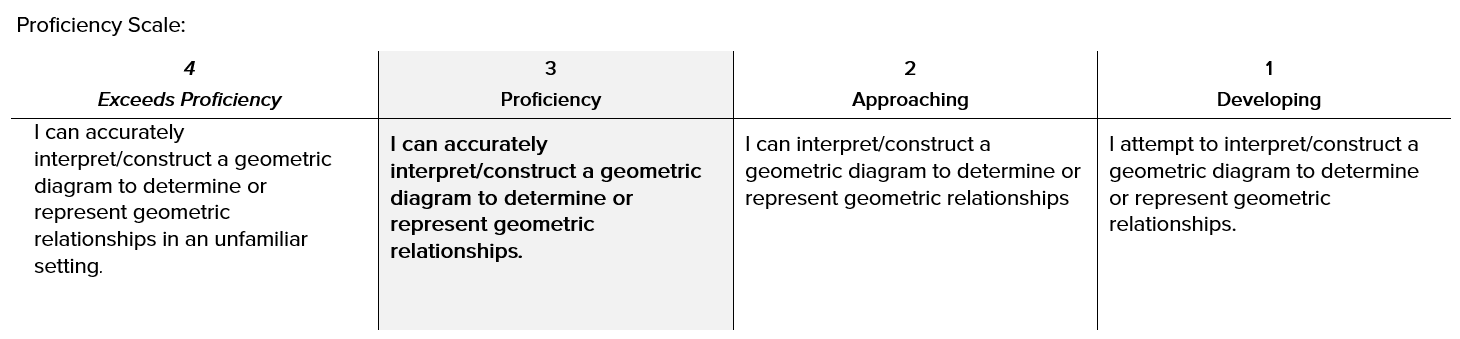
I can accurately interpret/construct a geometric diagram to determine or represent geometric relationships.
Puedo interpretar/construir con precisión un diagrama geométrico para determinar o representar relaciones geométricas.