Formative_DE_Phys_Unit5

Last updated over 2 years ago
20 questions
Wave Characteristics
1
A disturbance caused by a vibration that propagates through space and time is referred to as a _______ .
DE_Phys_5.1.1
10
Some waves move through matter. The matter that a wave moves through is called the ___________ of the wave. A traveling wave is a disturbance that moves through space and time, transferring ___________ without transferring matter. Waves originate from an initial disturbance, or ________________ , that provides some energy to the system. In general, as particles in a medium oscillate or vibrate, they _____________ the energy of this oscillation to particles around them, and this process continues to transmit the energy of an oscillation to particles across a distance. Through this process, a wave “_______________ ” through a medium. In this way, waves transfer energy without transferring matter. When particles oscillate in a direction __________________ to the direction that the wave propagates, the wave is a _______________ wave. This is the most familiar type of wave. However, sometimes the particles in a wave oscillate in the _________ direction that the wave propagates. These waves are called ______________________ waves. Sound waves and seismic “P-waves” are examples of longitudinal waves. They are occasionally known as _____________ waves or compression waves.
Other Answer Choices:
propagates
transfer
medium
same
oscillation
longitudinal
perpendicular
transverse
pressure
energy
4
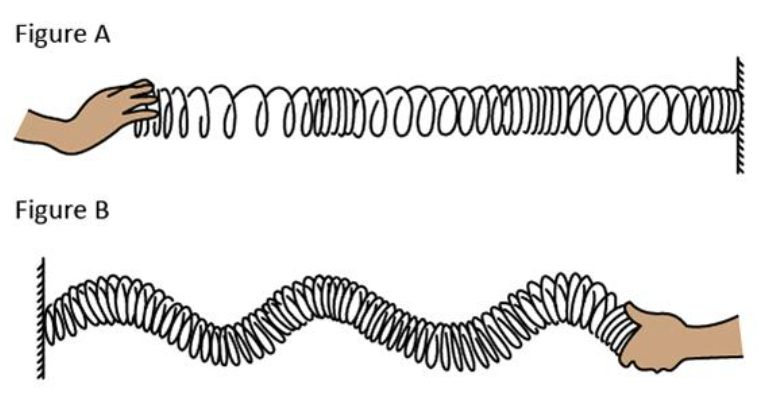
Figure A represents a ______________________ wave, in which matter oscillates _____________ to the direction of wave propagation. Figure B represents a _______________ wave, in which matter oscillates __________________ to the direction of wave propagation. In both cases, energy is transmitted parallel to the direction of wave propagation.
Other Answer Choices:
longitudinal
transverse
perpendicular
parallel
1

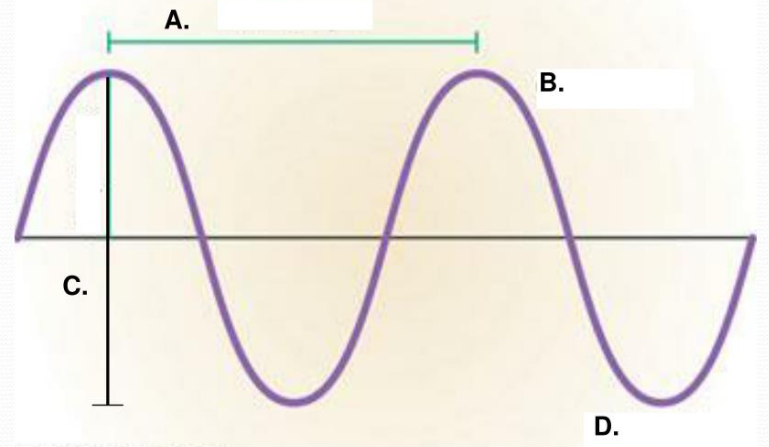
Which label refers to the 'trough' of the wave?

1

Which label refers to the 'height' of the wave?

1

Which label refers to the 'crest' of the wave?

1

Which label refers to the wavelength?

4
Similar to the wavelength is the wave period (or just “period”) of a wave. The wave period is the _______ it takes for a wave to complete one full _______ . The period is a measure in “_______ ,” so it is expressed in units of seconds and is represented by the symbol _______ .
1
Imagine a string, that, at rest as an amplitude of 0 on the y-axis and therefore looks like a straight line in its equilibrium position (x-axis). When it is moved up and down, it gains energy and oscillates back and forth about the ________________ point (x-axis). When plotted over time, we get the graph of a _____________ wave.
Other Answer Choices:
periodic
equilibrium
1

What do you notice about the particle represented by the red dot in the transverse wave and the red line in the longitudinal wave?

1
The inverse of the period, that is to say, the number of oscillations that a wave makes in one second, is referred to as the _______ of a wave. It is measured in "_______ per second", which has units of 1/s. This unit is referred to as _______ . The symbol "f" is often used to denote frequency.
3

The speed at which a wave travels depends on which of the following?

1
Draggable itemCorresponding Item
Demonstrates the relationship between period and frequency
f=1/T and T=1/f
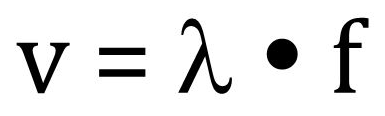
formula to calculate velocity of a wave
2

What is the speed of a sound wave traveling through a lake if it has a frequency of 440.0 Hz and a wavelength of 3.368 meters?

1

What is the wavelength of a wave traveling at the same speed as the wave in question #14 but at a frequency of 240.0 Hz

Untitled SectioDE_Phys_5.3
1
Compressional seismic waves generated by earthquakes that travel through Earth (can travel through liquids, gases and solids) are known as _______ waves.
1
_______ waves are a type of seismic wave that propagates only through solids; a transverse wave.
1
The point on Earth's surface that is directly above the focus of an earthquake is called the _______.
1
The boundaries outside of which seismic waves are not recorded due to the liquid core stopping or refracting various waves is known as a _______ zone.
1
_______ waves are seismic waves that don't travel through Earth's interior and tend to be the most destructive due to their low frequency, long duration and large amplitude.