The diagram below shows a "regular" heptagon. The word "regular" here has a specific geometric meaning; it means that all the side lengths are equal and all the angles are congruent.
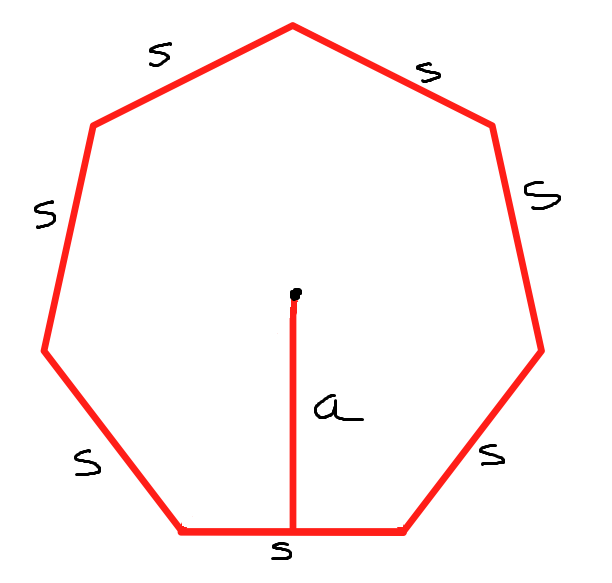
The diagram indicates that the side length (remember - all sides are the same) is \frac{3}{14}(\sqrt[3]{5})^\frac{2r}{3} \textrm{ cm}.
The diagram also shows us the length of a line called the "apothem" (the dotted line), which goes from the center of the polygon to the midpoint of a side. The length of the apothem is (\sqrt[3]{5})^{\frac{r}{3}} \textrm{ cm}.
The hexagon's total area is \frac{15}{4}\sqrt[3]{5} \textrm{ cm}^{2}. And it is known that the area of a regular polygon is equal to \frac{1}{2} the product of the perimiter length and the apothem length. That is, if A is the total area, a the length of the apothem, and p the total perimeter length (all the sides together), then:
\large{A=\frac{p\cdot a}{2}=\frac{\big[\textrm{(number of sides)}\cdot \textrm{(length of each side)} \big]\cdot \textrm{(length of the apothem)}}{2}}
Use this information to determine the value of r.